
Eleven months after his victory at Panipat, Babur faced a more dangerous enemy. In March 1527, at Khanwa near Fatehpur Sikri, he fought Rana Sanga of Mewar, the most powerful Rajput ruler of the age, at the head of a great alliance. Babur’s victory there, more than Panipat, decided that the Mughals would stay in India.
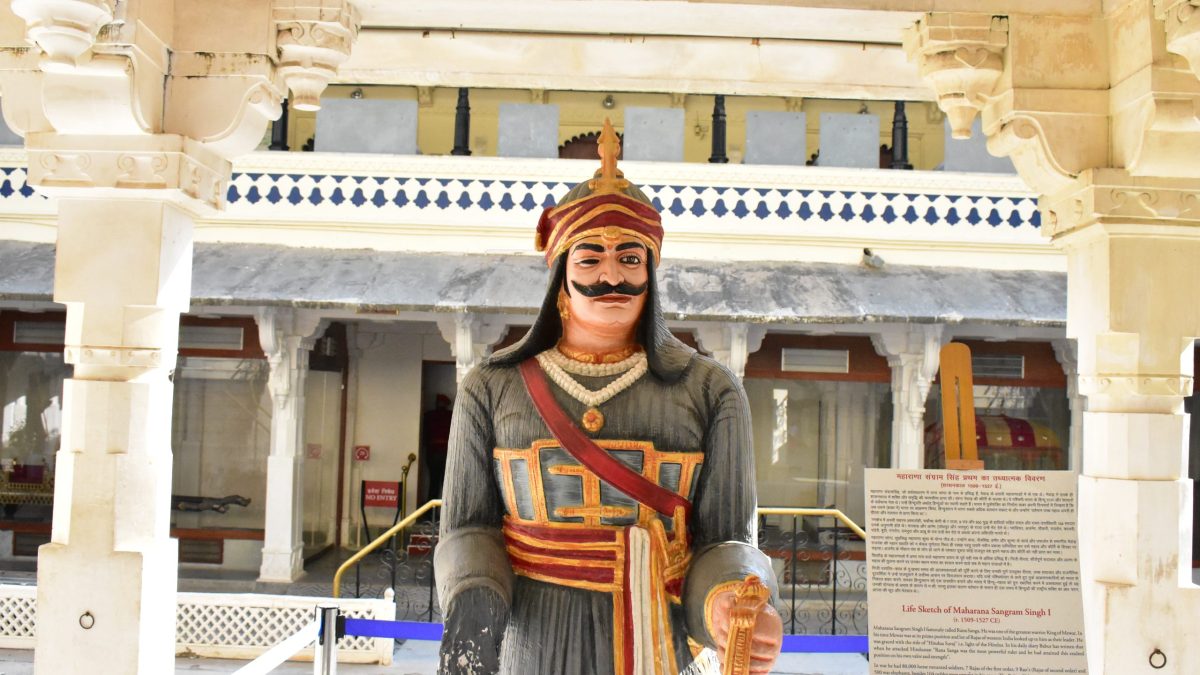
Rana Sanga
Maharana Sangram Singh, known as Rana Sanga, had ruled Mewar from Chittor since 1508. He had defeated the sultans of Malwa and Gujarat and Ibrahim Lodi of Delhi, and most of the Rajput states acknowledged his leadership. He was a veteran of many battles who, tradition says, had lost an eye and an arm and carried eighty wounds.
According to Babur, Sanga had earlier sent a message proposing joint action against the Lodis. Whatever was agreed, Sanga had expected Babur to plunder and leave, as Timur had. When Babur stayed, they became rivals for north India.
The alliance
Sanga gathered an army that Babur’s memoirs put at more than 200,000, certainly an exaggeration, but far larger than the Mughal force.
- Rajput chiefs: from Marwar, Amber, Chanderi under Medini Rai, and many others
- Afghans: Mahmud Lodi, a brother of the dead sultan, whom Sanga recognised as Sultan of Delhi
- Mewat: Hasan Khan Mewati with his horsemen
Hindu and Muslim chiefs thus fought together against the invader.
Fear in the Mughal camp
Sanga’s advance guard destroyed a Mughal detachment near Bayana, and the survivors spread alarming accounts of Rajput bravery. An astrologer predicted disaster. Babur’s officers were silent and gloomy.
Babur answered with a public act. He renounced wine, to which he was much attached, had his gold and silver drinking vessels broken up and given to the poor, and poured his stock of wine on the ground. He abolished a tax on Muslims, declared the war a holy one, and made his officers swear on the Quran to fight to the death.
The battle
The armies met on 16 or 17 March 1527 at Khanwa, about sixty kilometres west of Agra.
Babur used the methods of Panipat: a line of carts chained together, ditches where carts were lacking, wheeled wooden tripods to shield the matchlockmen, cannon under Ustad Ali Quli in the centre, and flanking parties on the wings.
The Rajputs attacked the Mughal right and then the left with great force, and for hours the line was under heavy pressure. The guns and muskets took a steady toll. In the afternoon Babur sent his flanking parties round and ordered the centre forward. Rana Sanga was wounded and carried unconscious from the field. Tradition holds that Silhadi of Raisen went over to Babur during the fighting. Hasan Khan Mewati and many Rajput chiefs were killed.
After the victory Babur took the title Ghazi and had a tower built of the heads of the slain.
The death of Sanga
Sanga recovered and swore not to return to Chittor until he had beaten Babur. He was preparing another campaign when he died in January 1528, by some accounts poisoned by his own nobles, who thought further war was ruinous.
Why it mattered
- Panipat had removed a weak sultan. Khanwa broke the only power in north India able to challenge the Mughals.
- Babur moved the centre of his rule from Kabul to Agra.
- Rajput leadership passed in time from Mewar to other houses, though Mewar’s resistance continued, most famously under Sanga’s grandson Maharana Pratap at Haldighati.
Image: A statue of Rana Sanga at the City Palace, Udaipur. Photo by TNSE NEETHI VPM, licensed under CC BY-SA 4.0, via Wikimedia Commons.

Leave a Reply