
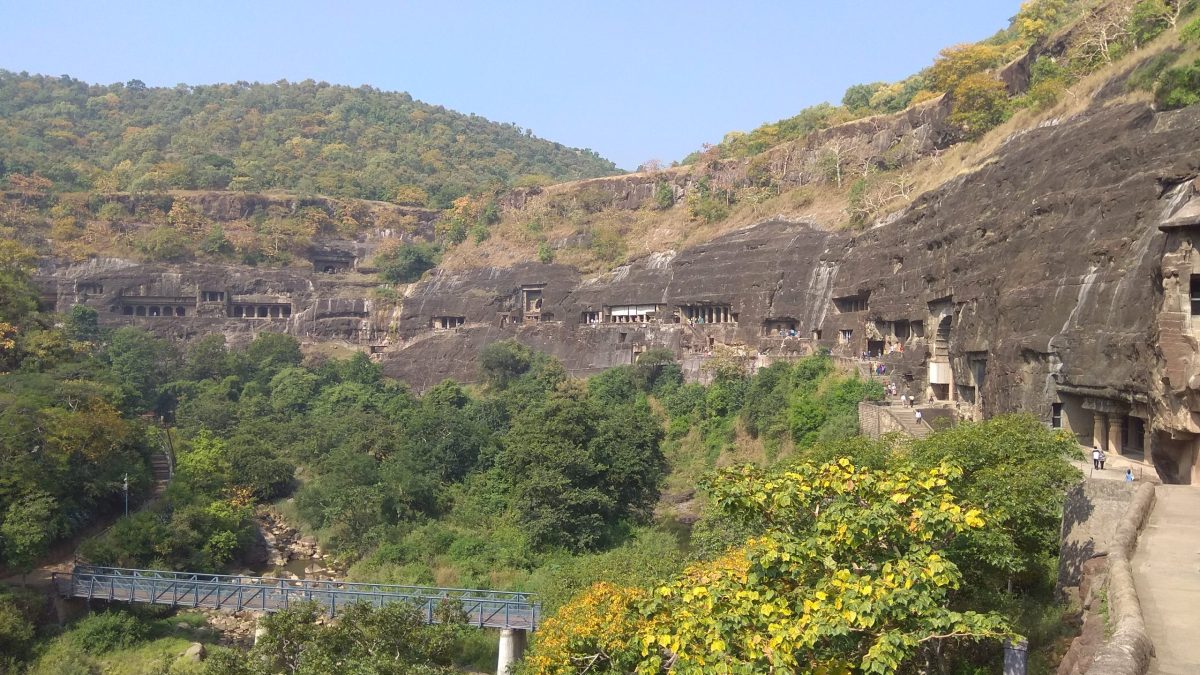
The Ajanta Caves are about thirty Buddhist halls and monasteries cut into a horseshoe-shaped cliff above the Waghora river in Maharashtra. Their wall paintings are the greatest surviving examples of ancient Indian painting. UNESCO inscribed the caves as a World Heritage Site in 1983.
At a glance
- Location: Chhatrapati Sambhajinagar (Aurangabad) district, Maharashtra
- Inscribed: 1983
- Type: Cultural
- Period: second century BCE to about the sixth century CE
- Number of caves: about 30
History
The caves were made in two phases.
- First phase: in the second and first centuries BCE, under the Satavahana dynasty, when the Buddha was represented only by symbols such as the stupa
- Second phase: in the fifth century CE, under the Vakataka king Harishena and his nobles, when most of the caves and nearly all the surviving paintings were made
After the decline of Buddhism in the region the caves were forgotten and covered by forest. In 1819 a British officer, John Smith, came upon them while hunting a tiger. He scratched his name on a pillar in Cave 10, where it can still be seen.
What to see
- Chaitya halls: prayer halls with a stupa at the end and a ribbed vault imitating wooden beams, such as Caves 9, 10, 19 and 26
- Viharas: monasteries with cells around a central hall
- Cave 1: the paintings of the Bodhisattvas Padmapani, holding a lotus, and Vajrapani
- Caves 2, 16 and 17: scenes from the Jataka tales, the stories of the Buddha’s former lives, with crowded pictures of courts, processions and ordinary life
- Cave 26: a large carved figure of the reclining Buddha
The paintings were done on dry plaster in mineral colours and show remarkable skill in line and expression.
Why it is a World Heritage Site
UNESCO describes the paintings and sculptures of Ajanta as masterpieces of Buddhist religious art that had a considerable influence on the art of India and of Asia beyond.
Visiting
Ajanta is about 100 kilometres from Chhatrapati Sambhajinagar and is usually combined with the Ellora Caves. The caves are closed on Mondays. Lighting inside is kept low to protect the paintings.
Image: The Ajanta Caves in Maharashtra. Photo by Ajjuravi, licensed under CC BY-SA 4.0, via Wikimedia Commons.


Leave a Reply