
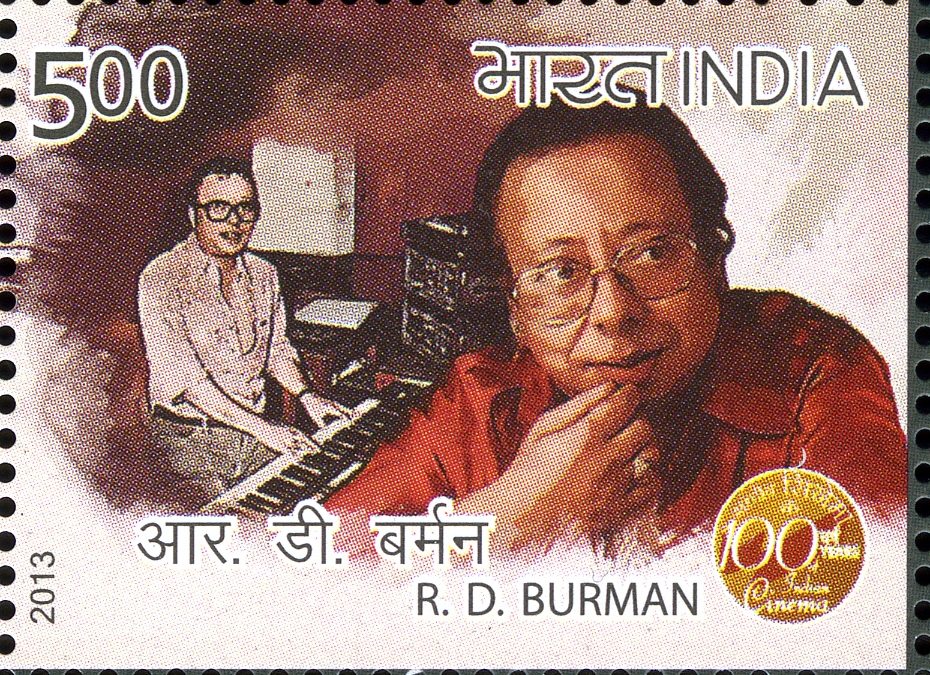
Rahul Dev Burman (27 June 1939 – 4 January 1994), known as Pancham, was an Indian music director, the most influential composer in the history of Hindi film music. The son of S. D. Burman, he brought rock, jazz, Latin rhythms and electronic sound into film songs in the late 1960s and dominated the 1970s. He scored some three hundred and thirty films. Neglected in his last years, he has since been recognised as the source of most of what came after.
Quick Facts
| Full name | Rahul Dev Burman |
| Nickname | Pancham |
| Born | 27 June 1939, Calcutta |
| Died | 4 January 1994, Bombay (aged 54) |
| Occupation | Music director, singer |
| Years active | 1961–1994 |
| Notable films | Teesri Manzil, Padosan, Kati Patang, Amar Prem, Hare Rama Hare Krishna, Yaadon Ki Baaraat, Sholay, Aandhi, Hum Kisise Kum Naheen, Masoom, Ijaazat, 1942: A Love Story |
| Awards | Three Filmfare Awards for Best Music Director |
| Spouse | Rita Patel (m. 1966, div. 1971); Asha Bhosle (m. 1980) |
Early Life
He was born in Calcutta, the only child of the composer S. D. Burman and the lyricist Meera Dev Burman, and through his father a member of the royal family of Tripura. Of the origin of his nickname several stories are told; the best known is that the actor Ashok Kumar heard the baby crying on the fifth note of the scale, “pa”.
He was brought up in Calcutta by his grandmother while his parents worked in Bombay. He was nine when he composed a tune that his father used some years later in the film Funtoosh. He learnt the sarod under Ali Akbar Khan and the tabla under Samta Prasad, and taught himself the mouth organ, which he played on the hit song “Hai apna dil to awara”.
Apprenticeship
He became his father’s assistant in the mid-1950s and worked on the scores of Pyaasa, Guide, Jewel Thief and Aradhana, to some of which he contributed more than was credited. His first film as an independent composer was the comedian Mehmood’s Chhote Nawab (1961).
Breakthrough
Teesri Manzil (1966), a musical thriller, made his name: its songs, “Aaja aaja”, “O haseena zulfon wali”, were driven by drums, brass and electric guitar in a way Hindi films had not heard. Padosan (1968) showed his gift for comedy.
The 1970s
With the singer Kishore Kumar and the actor Rajesh Khanna he formed one of the great partnerships of Indian cinema.
- Kati Patang (1970) and Amar Prem (1972), the latter with songs based on classical ragas
- Caravan and Hare Rama Hare Krishna (1971), with “Dum maro dum”
- Yaadon Ki Baaraat (1973) and Hum Kisise Kum Naheen (1977)
- Sholay (1975), including the background score and “Mehbooba mehbooba”, which he sang himself
- Aandhi (1975), Kinara, Ghar and, later, Ijaazat, with the poet-director Gulzar, his closest friend, for whom he wrote his most delicate music
The Sound
He was restless in the search for new sounds. He blew across the mouths of bottles, rubbed sandpaper, scraped a comb, struck glasses with spoons and recorded the gargle of a singer. He brought in the bossa nova, funk and disco as they appeared, used the electronic organ and early synthesisers, and built his recordings around a large rhythm section. Yet he was trained in classical music, and beneath the surface his tunes are usually built on ragas and Bengali folk melodies.
Asha Bhosle
Asha Bhosle sang many of his most adventurous songs, cabaret numbers and ghazal-like pieces alike. They married in 1980. Both had failed marriages behind them; she was six years older.
Decline
From the mid-1980s his films failed one after another, and producers turned to younger composers, some of whom had been his assistants and many of whom borrowed from him. He had heart surgery in 1989. He went on composing: Masoom (1983), Ijaazat (1987) and Parinda (1989) are among his finest scores.
Death
He died of a heart attack in Bombay on 4 January 1994, aged fifty-four. 1942: A Love Story, released a few months later, was a great success and won him a posthumous Filmfare Award.
Legacy
His songs have been remixed and reused more than those of any other Indian composer, and musicians from A. R. Rahman onwards have named him as a model. The Filmfare award for new musical talent carries his name.
Featured image: R. D. Burman, from a 2013 postage stamp of India. Photo by India Post, Government of India, licensed under Government Open Data License – India, via Wikimedia Commons.



