
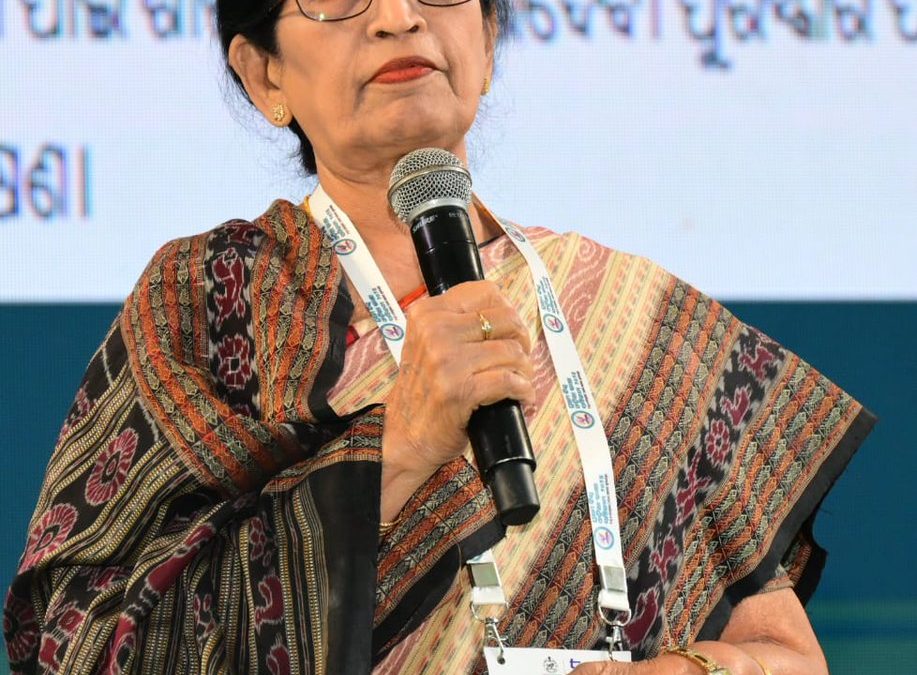
Pratibha Ray (born 21 January 1943) is an Indian novelist and short-story writer who writes in Odia. Her novel Yajnaseni, the Mahabharata told by Draupadi, is one of the most widely translated works of modern Indian fiction. In 2011 she received the Jnanpith Award, the first Odia woman to do so.
Quick Facts
| Full name | Pratibha Ray |
| Born | 21 January 1943, Alabol, Balikuda, Cuttack district (now in Jagatsinghpur district), Odisha |
| Age | 83 |
| Language | Odia |
| Occupation | Novelist, short-story writer, academic |
| Education | Ravenshaw College, Cuttack (M.Sc., M.Ed.); Ph.D. in educational psychology |
| Notable works | Barsha Basanta Baishakha, Shilapadma, Yajnaseni, Adibhumi, Mahamoha, Magnamati, Ullanghan |
| Awards | Moortidevi Award (1991), Sahitya Akademi Award (2000), Padma Shri (2007), Jnanpith Award (2011), Padma Bhushan (2022) |
| Spouse | Akshay Chandra Ray |
| Children | 3 |
Early Life
She was born at Alabol, a remote village in the Balikuda area of coastal Odisha. Her father, Parashuram Das, was a Gandhian, a teacher and a poet who had given up a job with the Tatas to start a school in his village. She has said that her belief in equality, and her habit of questioning custom, came from him. Her first poem was published in a newspaper when she was nine.
Education
She studied science, taking a master’s degree in botany from Ravenshaw College in Cuttack. She later took a master’s in education and a doctorate in educational psychology. For post-doctoral research she studied the Bonda, a small and isolated tribal community of the Malkangiri hills, living among them for long periods.
Career
Teacher
She began as a schoolteacher and then taught for some thirty years in the government colleges of Odisha. After taking voluntary retirement she served as a member of the Odisha Public Service Commission.
Novels
Her first novel, Barsha Basanta Baishakha (1974), was an immediate popular success. She has since published more than twenty novels and as many collections of stories.
- Shilapadma (1983): the building of the Sun Temple at Konark and the lives of its sculptors; it won the Odisha Sahitya Akademi Award
- Yajnaseni (1984): Draupadi, at the point of death, writes a long letter to Krishna reviewing her life, her five husbands and the wrongs done to her. It brought her the Moortidevi Award in 1991, the first given to a woman.
- Adibhumi (1993): a novel of the Bonda people, drawn from her fieldwork
- Mahamoha (1997): the story of Ahalya
- Magnamati: the Odisha super cyclone of 1999
- Uttarmarg: the forgotten freedom fighters of an Odisha village
Her short-story collection Ullanghan won the Sahitya Akademi Award in 2000.
Themes
Her constant subject is the dignity of people whom custom puts in the wrong: women in the epics blamed for the faults of men, tribal people called primitive, the poor in the path of storms and officials. She has called herself a humanist and not a feminist, holding that men and women are made differently but are of equal worth.
Speaking Out
She has written against caste and religious discrimination, and after an experience at the Jagannath temple in Puri she published a newspaper article, “The Colour of Religion is Black”, criticising the conduct of its priests. Some of them filed a defamation case against her, which went on for years.
Awards
- Odisha Sahitya Akademi Award, 1985
- Sarala Award, 1990
- Moortidevi Award, 1991
- Sahitya Akademi Award, 2000
- Padma Shri, 2007
- Jnanpith Award, 2011
- Padma Bhushan, 2022
Personal Life
She is married to Akshay Chandra Ray, an engineer. They have two sons and a daughter. She lives in Bhubaneswar and continues to write and to speak at literary gatherings in Odisha and elsewhere.
Legacy
Yajnaseni has been translated into English, Hindi and many other Indian languages and has been adapted for the stage. With Gopinath Mohanty and Sitakant Mahapatra she is among the Odia writers honoured with the Jnanpith Award.
Featured image: Pratibha Ray speaking at the World Odia Language Conference, February 2024. Photo by Government of Odisha, licensed under CC BY 4.0, via Wikimedia Commons.



