
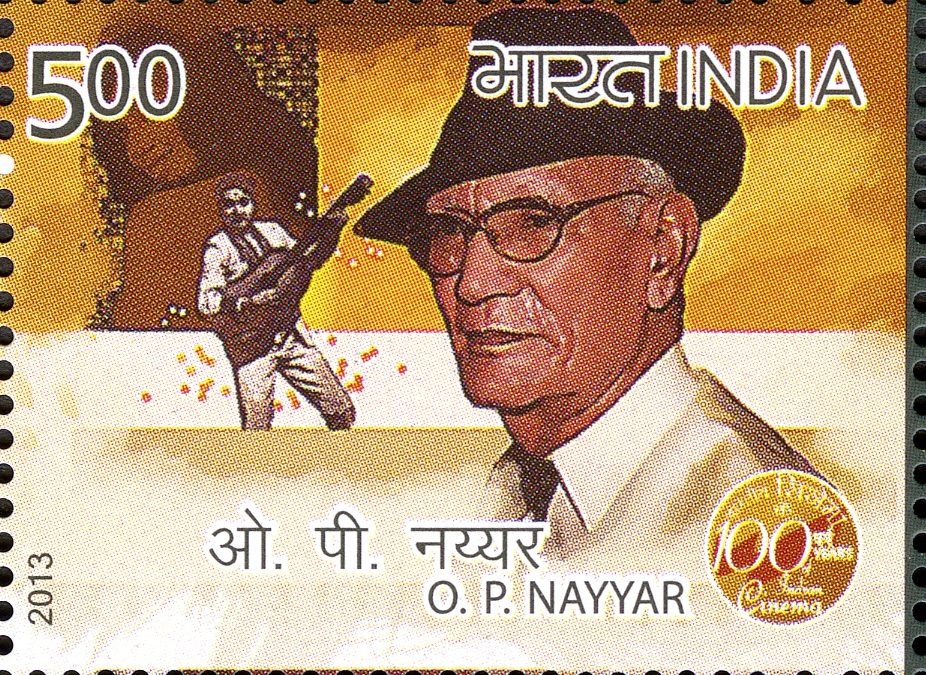
Omkar Prasad Nayyar (16 January 1926 – 28 January 2007), known as O. P. Nayyar, was an Indian film music director, one of the most successful and distinctive composers of Hindi cinema in the 1950s and 1960s. His tunes, breezy, rhythmic and steeped in the folk music of Punjab, are recognisable within a few bars. He was the only leading composer of his time who never recorded a song with Lata Mangeshkar, and he made Asha Bhosle a star.
Quick Facts
| Full name | Omkar Prasad Nayyar |
| Born | 16 January 1926, Lahore, Punjab (now in Pakistan) |
| Died | 28 January 2007, Thane, Maharashtra (aged 81) |
| Occupation | Music director |
| Years active | 1949–1995 |
| Notable films | Aar Paar, Mr. & Mrs. ’55, C.I.D., Naya Daur, Tumsa Nahin Dekha, Howrah Bridge, Kashmir Ki Kali, Mere Sanam |
| Awards | Filmfare Award for Best Music Director (1958) |
Early Life
He was born in Lahore into a middle-class Punjabi family that expected him to study. He had no training in music at all and could not read notation; he said that tunes simply came to him. He sang on the radio as a boy and composed a private song, “Preetam aan milo”, recorded by the singer C. H. Atma, that became popular in the mid-1940s.
After Partition the family left Lahore, and he made his way to Bombay.
Breakthrough
His first films, beginning with Aasman (1952), failed, and he was about to go back to Amritsar. Guru Dutt, who owed him money for one of them, offered instead to let him score his next film. Aar Paar (1954) was a great hit, with “Babuji dheere chalna” and “Kabhi aar kabhi paar”. Mr. & Mrs. ’55 and C.I.D. (1956) followed.
The Hits
- Naya Daur (1957), for which he won the Filmfare Award: “Ude jab jab zulfen teri”, “Maang ke saath tumhara”
- Tumsa Nahin Dekha (1957), which launched Shammi Kapoor as a star
- Howrah Bridge (1958): “Aaiye meherbaan”, “Mera naam Chin Chin Chu”
- Phir Wohi Dil Laya Hoon and Ek Musafir Ek Hasina
- Kashmir Ki Kali (1964): “Deewana hua badal”, “Yeh chand sa roshan chehra”
- Mere Sanam (1965): “Pukarta chala hoon main”, “Jaaiye aap kahan jayenge”
At his height he was the highest-paid composer in the industry and, it is said, the first to be paid a lakh of rupees for a film. Distributors bought films on the strength of his name.
The Sound
His signature was a jaunty rhythm like the trot of a horse pulling a tonga, played on woodblocks and drums, over which he set melodies drawn from Punjabi folk songs. He used the sarangi, an instrument associated with sad music, in lively songs, and gave the santoor, the harmonium and the clarinet solo passages. His orchestration was light and uncluttered.
In the 1950s the government radio thought his songs too modern and for a time kept them off the air. They were heard on Radio Ceylon instead and became more popular still.
The Singers
He never used Lata Mangeshkar, whose voice he said did not suit his tunes; other accounts trace it to a quarrel at the start of his career. He relied at first on Geeta Dutt and Shamshad Begum, and then, from 1957, on Asha Bhosle, with whom he formed one of the most fruitful partnerships in film music and a close personal bond. Their songs together established her as a singer of the first rank.
They parted in 1974. Their last recording, “Chain se humko kabhi”, won her a Filmfare Award, which she did not collect. He worked little after that. His main male singer was Mohammed Rafi, with whom he also quarrelled for some years.
The Man
He was famously proud and unbending, always in a white suit and hat, and did not forgive a slight. He never worked with several of the biggest stars and directors because he would not seek them out.
Last Years
He became estranged from his wife and children and left home. For the last years of his life he lived as a paying guest with a family of admirers in Thane, near Mumbai, practising homoeopathy and astrology and receiving visitors. He asked that his family not be allowed at his funeral.
He died on 28 January 2007. India issued a postage stamp in his honour in 2013.
Among the other great composers of his era were Naushad, Shankar and Jaikishan, and S. D. Burman.
Featured image: O. P. Nayyar, from a 2013 postage stamp of India. Photo by India Post, Government of India, licensed under Government Open Data License – India, via Wikimedia Commons.



