
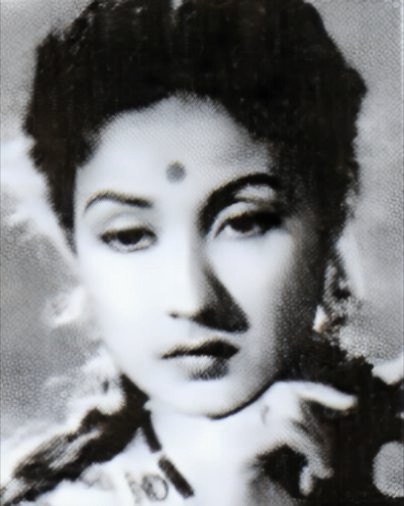
Meena Kumari (1 August 1933 – 31 March 1972), born Mahjabeen Bano, was an Indian actress, one of the greatest in the history of Hindi cinema, and a poet in Urdu. In a career that began when she was a small child she acted in more than ninety films, among them Baiju Bawra, Parineeta, Sahib Bibi Aur Ghulam and Pakeezah. She was known as the Tragedy Queen, for the suffering women she played and for her own unhappy life, which ended at thirty-eight.
Quick Facts
| Birth name | Mahjabeen Bano |
| Born | 1 August 1933, Bombay |
| Died | 31 March 1972, Bombay (aged 38) |
| Occupation | Actress, poet |
| Years active | 1939–1972 |
| Notable films | Baiju Bawra, Parineeta, Sharada, Dil Apna Aur Preet Parai, Sahib Bibi Aur Ghulam, Kaajal, Phool Aur Patthar, Pakeezah |
| Awards | Four Filmfare Awards for Best Actress |
| Spouse | Kamal Amrohi (m. 1952; separated 1964) |
| Pen name | Naaz |
Early Life
She was born in Bombay into a poor theatrical family. Her father, Ali Bux, was a harmonium player and music teacher who worked on the fringes of the film industry; her mother had been a stage dancer. She was the second of three daughters.
She did not go to school. When she was about six her father took her to the studios to earn, and the director Vijay Bhatt cast her in Leatherface (1939). She worked steadily as “Baby Meena” and was the family’s main support. She taught herself to read, loved books all her life, and kept her earliest longing for an education she never had.
Stardom
She moved to adult roles in mythological and fantasy films. Baiju Bawra (1952), again for Vijay Bhatt, made her a star, and for it she received the Filmfare Award for Best Actress in 1954, the first year the awards were given. She won again the next year for Parineeta.
Through the 1950s she played with equal ease in tragedy, as in Sharada and Dil Apna Aur Preet Parai, and in light comedy, as in Azaad and Miss Mary. Her voice, low and slightly husky, and her way of speaking Urdu were unlike anyone else’s.
Kamal Amrohi
In 1952, at eighteen, she secretly married the writer and director Kamal Amrohi, who was fifteen years older and already married with children. He directed her in Daera. The marriage was troubled by his restrictions on her work and movements and by her growing fame. She left his house in 1964.
Sahib Bibi Aur Ghulam
In Guru Dutt’s production of 1962, set in a decaying landlord family of nineteenth-century Bengal, she played the Chhoti Bahu, the neglected young wife who takes to drink to keep her husband at home and is destroyed by it. It is regarded as one of the finest performances in Indian cinema. At the Filmfare Awards for that year all three nominations for Best Actress were hers. See Guru Dutt.
She won a fourth award for Kaajal (1965). She also helped to launch the career of the young Dharmendra, with whom she acted in several films, among them the hit Phool Aur Patthar (1966).
Decline
She suffered from chronic insomnia, and a doctor is said to have prescribed a little brandy. By the mid-1960s she was drinking heavily. In 1968 she was found to have cirrhosis of the liver and was treated in London and Switzerland. She recovered for a time and returned to work, in character parts.
Pakeezah
Amrohi had begun Pakeezah, the story of a courtesan of Lucknow who longs for respect and love, in 1956, as a tribute to his wife. Work stopped when they parted. In 1969 friends brought them together to finish it. She was very ill and could not dance; a double was used in some sequences.
The film opened on 4 February 1972 to a cool reception. She died eight weeks later, and audiences then filled the cinemas. It is now counted among the classics of Hindi film, for its music, its design and her performance.
Poet
She wrote Urdu poetry under the name Naaz and recorded an album of her poems set to music by Khayyam. After her death her diaries and verses were entrusted to the poet Gulzar, who published a collection. They speak of loneliness in plain, unguarded language.
Death
She died in a Bombay nursing home on 31 March 1972 of liver disease. She had worked for thirty-three of her thirty-eight years. It is often said that there was not enough money at hand to settle the hospital bill.
Her contemporaries among the great actresses of the period included Madhubala and Nargis.
Featured image: Meena Kumari. Photo by the Ministry of Communications, licensed under Government Open Data License – India, via Wikimedia Commons.



