
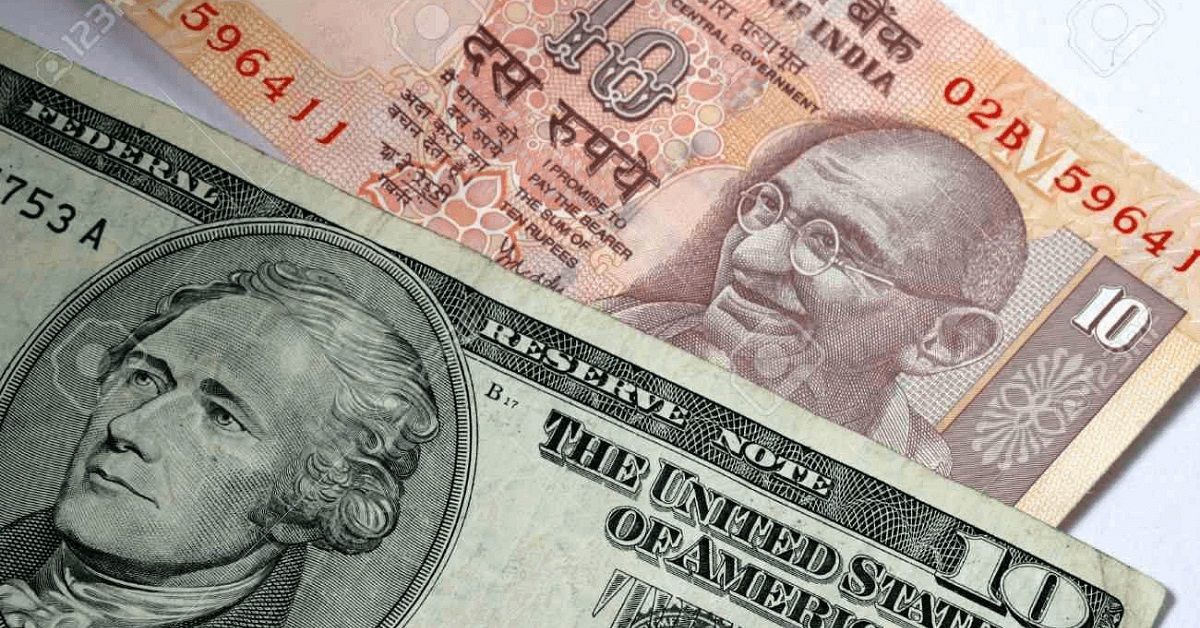
The rupee fell 2 paise to close at 94.91 against the US dollar on Monday, October 19, 2026, from 94.89 on Friday, ThePrint reported. It traded between 94.75 and 94.97 during the session. The Sensex ended at 73,852.90, down 876.37 points, and the Nifty at 22,888.95, down 257.20 points. Foreign institutional investors were net sellers of Rs 1,148.64 crore, the Dollar Index was at 101.93, up 0.09 percent, and Brent crude was at 108.58 dollars a barrel, down 1.17 percent. India’s foreign exchange reserves were 726.027 billion dollars, after a weekly decline of 8.578 billion dollars in the week ended October 9.
The case that the rupee is under pressure is seen in the sources of stress. Foreign investors sold Rs 1,148.64 crore in one session and the Sensex fell 876 points, a combination that usually weakens a currency, while Brent at 108.58 dollars is expensive for a country that buys most of its crude abroad. Reserves fell 8.578 billion dollars in a single week, which can reflect central bank dollar sales to smooth the currency’s moves, though the report did not say so. Gaurav Garg of Lemonn said that measures by the Reserve Bank of India “may help stabilise short-term currency movements, but sustainable recovery hinges on lower oil prices, improved foreign capital flows.”
The case that the situation is under control is that the day’s move was tiny and the buffer is large. A fall of 2 paise is about 0.02 percent, and the rupee stayed in a range of 22 paise, so there was no sign of panic. Reserves of 726.027 billion dollars are still a big cushion, and the weekly decline of 8.578 billion dollars is about 1.2 percent of the total. Anuj Choudhary of Mirae Asset Sharekhan said he expects “positive bias from dollar weakness, though elevated crude and FII outflows may limit sharp appreciation.” HDFC Sky’s outlook for Wednesday put the rupee at 94.75 to 94.80, slightly stronger than Monday’s close.
The rupee matters because a currency near 95 to the dollar raises the cost of imported oil, electronics and fertiliser, and it makes foreign education and travel more expensive for Indians. A weaker rupee also helps exporters, such as those who will use the new trade pacts. For the Reserve Bank, the choice between spending reserves and letting the currency fall is a continuing balance, and the data on reserves, released every week, will be watched for further falls. For investors, currency risk is a part of the return on any foreign holdings. On the same day the Sensex fell 876.37 points to 73,852.90 and the Nifty 257.20 points to 22,888.95. The dollar index of 101.93 was up 0.09 percent, so the pressure came from both a firmer dollar and expensive oil, and the reserve figure of 726.027 billion dollars is the latest one in the report. Both analysts quoted tie the currency’s direction to oil prices and capital flows.
The rupee is stable in the short run and exposed in the long run. Oil and foreign flows will determine which way it moves.




Leave a Reply