
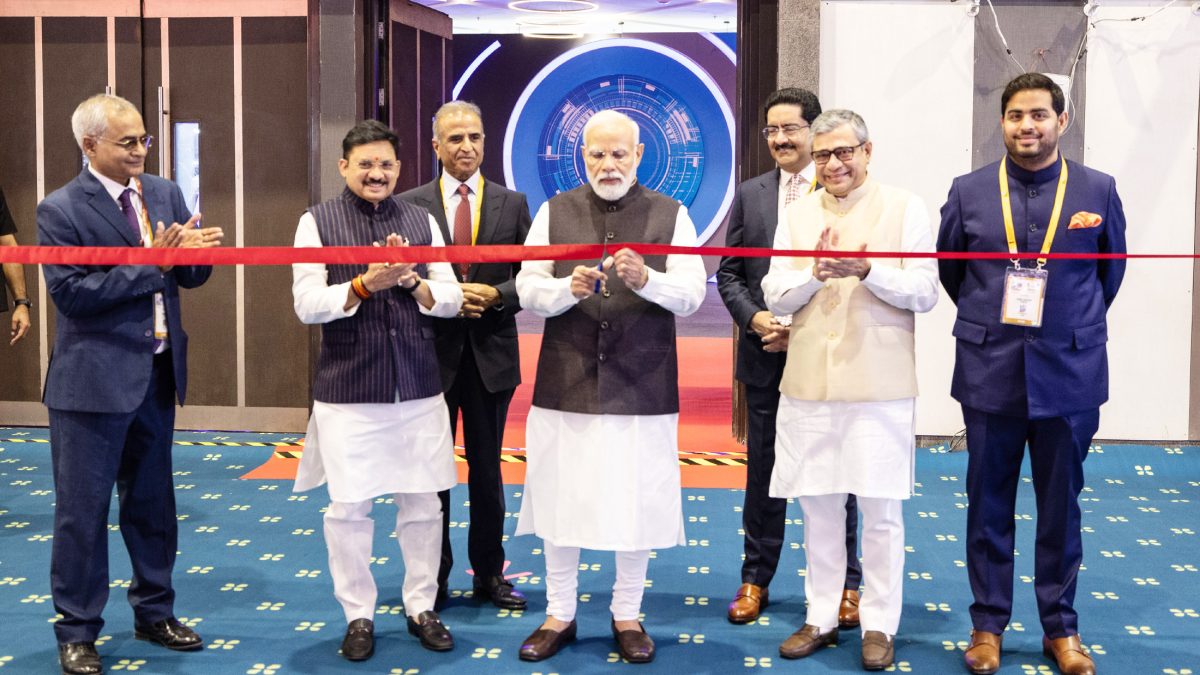
The tenth edition of the India Mobile Congress ran from 7 to 10 October 2026 at Yashobhoomi in Delhi under the theme “Scale Without Boundaries.” Prime Minister Narendra Modi inaugurated it, and it is organised jointly by the Department of Telecommunications and the Cellular Operators Association of India. Organisers expected more than 150,000 attendees from over 100 countries, more than 500 partners and exhibitors, over 600 startups, over 900 thought leaders, more than 2,000 technology use cases and over 120 sessions. The show has grown from its first edition in September 2017, which had about 2,000 delegates and 32,000 visitors, to a major forum for 5G, 6G, artificial intelligence, semiconductors, satellite networks and quantum communication.
The argument that India is positioning itself for 6G is based on the numbers presented. The Bharat 6G Alliance has 90 institutions and 7,700 patents, of which 4,400 are international, which is about 57 percent of the total. Communications Minister Jyotiraditya Scindia said India’s data is the cheapest in the world: one gigabyte cost Rs 268 in 2014 and costs Rs 8 now, while average monthly usage per customer has risen from 0.26 GB to 36 GB, about 140 times. The 2026 edition had nine anchor sectors, including 5G and 6G, AI networks, semiconductors, non-terrestrial networks, cyber security and quantum communication, and four new sectors: smart mobility, stadium experiences, industrial robotics and transport technology. The 2022 edition was where Modi launched India’s 5G services, and it drew more than 100,000 attendees.
The counter-argument is that the show produced more themes than concrete announcements. Coverage before the event listed Akash Ambani of Reliance Jio and Sunil Bharti Mittal of Bharti Enterprises as keynote speakers, but no confirmed product launches from Jio, Airtel or Vodafone Idea have been reported. The government’s figures also focus on cost and usage and do not say how the telecom operators are doing financially. No specific 6G targets or timelines were given, and the patent count of 7,700 says little about whether India’s technology will be adopted in the global standard. The dispute over Elon Musk’s claim that Starlink is being blocked was also running in the background, and the Communications Ministry responded to it.
The event matters for the country because the telecom network underpins digital payments, e-governance and a growing share of the economy. A fall in the cost of data from Rs 268 to Rs 8 per gigabyte has helped bring hundreds of millions of people online, and the move to 6G is about the next stage of that development. For the industry, the show is where deals are made and policy is signalled. The addition of sectors such as smart mobility and industrial robotics shows that telecom is now seen as a platform for other industries.
The India Mobile Congress showed a country that sees itself as a leader in telecom and wants a place in 6G. The patents and the cheap data are real achievements, but the tests of 6G leadership will come in standards bodies and in the market.
Featured image: Prime Minister Narendra Modi inaugurating the seventh India Mobile Congress (file photo; the 2026 edition was the tenth). Photo: Prime Minister's Office, GODL-India, via Wikimedia Commons.


Leave a Reply