
India’s first commercial semiconductor fabrication plant is being built at Dholera in Gujarat by Tata Electronics with Taiwan’s Powerchip Semiconductor Manufacturing Corporation. According to an India Semiconductor Mission overview published in October 2026, the project costs about Rs 91,000 crore, which is roughly the $11 billion figure given in other reports. It is also called a logic fab, because it will make chips used in computing, cars and other products.
The construction is about half done. The overview says that the plant is 50% complete and that trial production is targeted for December 2026, and a search summary of a Bharat Business Index guide says that it has crossed the halfway mark with trial chip production aimed for December 2026. The date matches a 2024 statement by Union Minister Ashwini Vaishnaw that the first chip from the plant would come out in December 2026, though a trial run is not the same as commercial output.
The plant is designed for mature chip technologies. The reports give a 28-nanometre process node in the overview and a range of 28, 40, 55 and 110 nanometres in the search summaries, with a capacity of 50,000 wafers a month. These are not the most advanced chips in the world, but they are the kind used widely in cars, power systems, displays and consumer electronics, where demand is steady.
The partnership structure matters. The summaries describe it as a joint venture between PSMC and Tata Electronics, and the Taiwanese firm brings the process know-how. The sources reviewed do not give the ownership split or the technology licence terms, so those are not described here.
Government support is large. The mission offers fiscal support covering up to 50% of project costs, according to the overview, which does not say whether the figure includes other incentives. For a plant of this cost, the support is a major part of the financing, and it is one reason why the project went ahead in India.
The location has been prepared for the industry. Dholera in Gujarat is a planned industrial region, and the Sanand plant of Micron, which does assembly and testing, is also in the state. Having several plants in one region can help suppliers and skilled workers cluster, though the sources reviewed here do not discuss the local supply chain.
Why does a fab matter more than an assembly plant? A fab makes the chips themselves from silicon wafers, a process that needs very clean conditions and costly equipment, while an assembly and test plant packages chips that were made elsewhere. A separate IndiaX24 explainer covers the difference. Because India has until now had no commercial fab, Dholera would be the first step in making chips at home.
There are risks. Fabs take many years to reach stable production, and yields in the early period are often low. The trial run is a first test, and the speed at which the plant moves to full capacity will determine whether the investment pays off. The sources reviewed do not give figures for the yield or the date of commercial output.
For now, the milestones are clear: construction is at the halfway point, the target for trial chips is December 2026, and the plant is designed for 50,000 wafers a month at mature nodes.
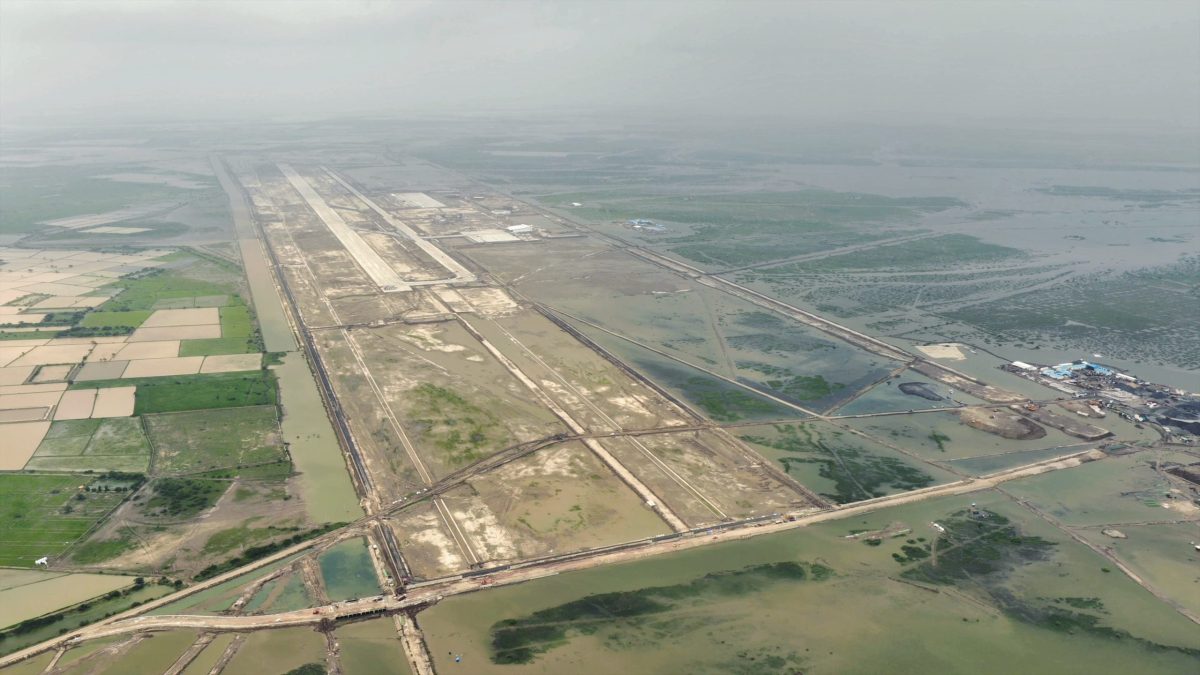
Featured image: Construction work in the Dholera region of Gujarat (file photo of Dholera International Airport; not a photo of the fab). Photo by Sarvajanik Puralekh, licensed under CC BY-SA 4.0, via Wikimedia Commons.




Leave a Reply