
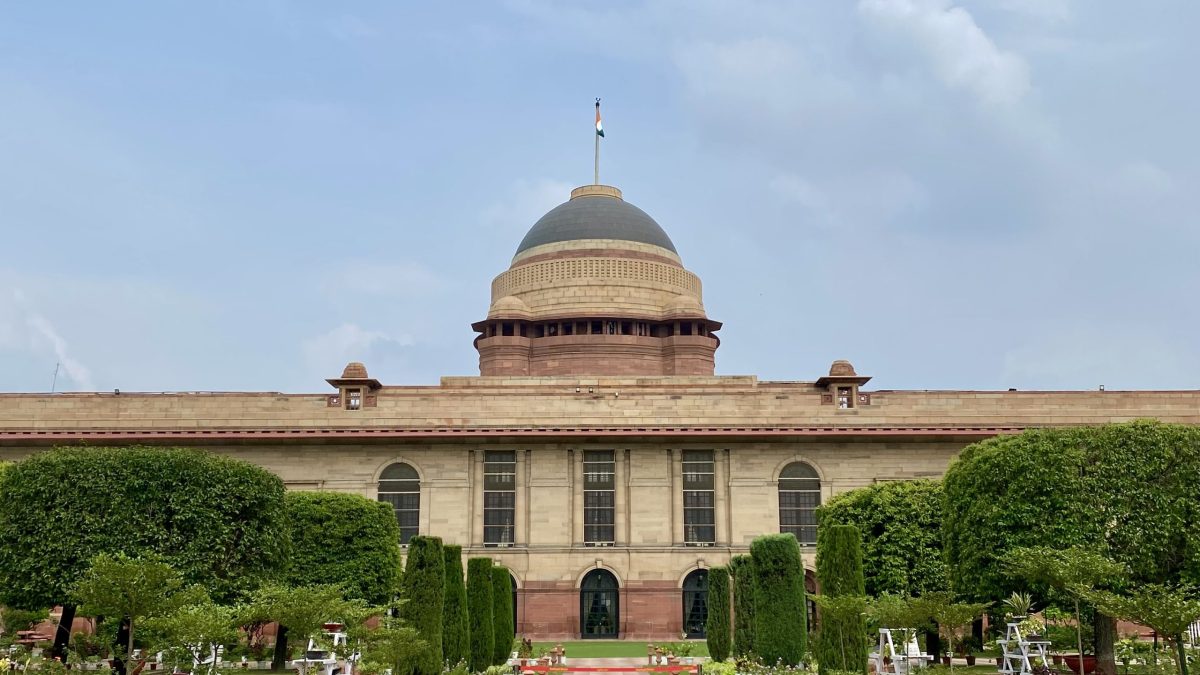
Rashtrapati Bhavan, the official residence of the President of India, stands at the western end of Rajpath on Raisina Hill in New Delhi. It was first the Viceroy’s House, from 1931 to 1947, and then Government House, from 1947 to 1950, before taking its present name when India became a republic. It was designed by Edwin Lutyens and Herbert Baker in a style called the Delhi Order, based on Indo-Saracenic architecture.
It was built because the capital moved. The Governor-General had lived at Government House in Calcutta, but in December 1911 the Delhi Durbar decided that the capital would be shifted to Delhi, and the new Viceroy’s House was given an enormous size and a prominent position. About 4,000 acres were acquired for it and the adjoining Secretariat buildings, and the villages of Raisina and Malcha were relocated, with about 300 families, under the Land Acquisition Act of 1894.
Lutyens had the primary architectural responsibility, with Baker assigned to the two Secretariat buildings in front. The finished palace turned out very similar to Lutyens’ early sketches, sent to Baker from Shimla on 14 June 1912. The design was long and politically charged. A dispute arose over the approach: the original plan placed the Viceroy’s House at the top of Raisina Hill with the secretariats lower down, but it was later decided to put both on the plateau, moving the house back about 400 yards. Lutyens wanted a long, gentle incline to the house, but the gradient was fixed at 1 in 22 instead of 1 in 25, a steeper gradient than the committee of 1914 had allowed, which made the approach harder.
Construction began in 1912 and was completed in 1929. The main building spreads across four floors and a basement, with 340 rooms and 2.5 kilometres of corridors, on a floor area of 200,000 square metres. It was built with about 700 million bricks and 85,000 cubic metres of stone, with very little steel. The estate covers 320 acres, including gardens, stables, offices and staff housing. By total floor area it is the largest official residence of any head of state in the world, according to Wikipedia.
Its design belongs to the Edwardian Baroque, with heavy classical motifs meant to express power, but Lutyens added Indian elements. Circular stone basins were put on top of the building because water features matter in Indian architecture, and a deep chhajja, a thin projecting eave extending 8 feet, took the place of the classical frieze, casting shade and protecting windows from monsoon rain. Pierced red sandstone screens, or jalis, were inspired by Rajasthani designs.
The signature feature is the Delhi Order, a “nonce order” invented by Lutyens for the building. Twelve unevenly spaced columns stand at the east front, with capitals that combine acanthus leaves with four pendant Indian bells. One bell is on each corner at the top of the column, and the account notes the ancient belief that bells signalled the end of a dynasty, so that it was said that as the bells were silent British rule in India would not end. Unlike earlier Indo-Saracenic buildings, which grafted Mughal elements on a Western body, Lutyens also drew on the earlier Buddhist art of the Mauryan period, as seen in the dome and the capitals.
The residence has been restored twice. The first restoration, from 1985 to 1989, stripped Ashoka Hall of later additions and returned it to its original state under the architectural restorer Sunita Kohli. A second project began in 2010 with Charles Correa and Kohli.
The Indian president has other residences, in Dehradun, Hyderabad and Shimla, but Rashtrapati Bhavan is the main one, and it houses the president’s official residence, reception halls, guest rooms and offices.
Rashtrapati Bhavan shows how an imperial building was adopted by a republic. It was designed to project authority and to be seen from a long distance, and after 1950 the same structure became the home of the elected head of state.
Featured image: The garden side of Rashtrapati Bhavan in New Delhi (file photo). Photo by Tamjeed Ahmed, licensed under CC BY-SA 4.0, via Wikimedia Commons.




Leave a Reply