
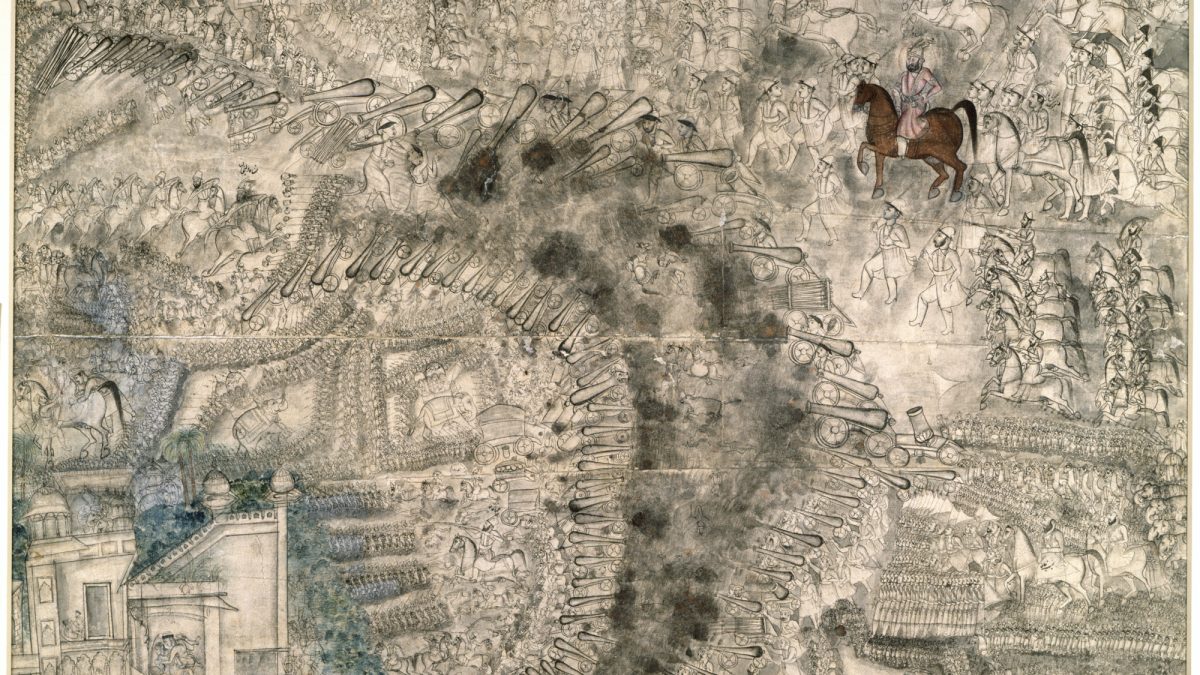
On 14 January 1761, on the same plain where the Mughal empire had been founded, the army of the Maratha confederacy was destroyed by the Afghan king Ahmad Shah Abdali and his Indian allies. It was one of the largest and bloodiest battles fought anywhere in the eighteenth century.
The Marathas at their height
By the 1750s the Marathas, directed by the Peshwa at Pune, were the strongest power in India. They collected tribute from most of the subcontinent and acted as protectors of the helpless Mughal emperor at Delhi. In 1758 their armies under Raghunathrao drove the Afghans out of Punjab and reached Attock on the Indus.
Abdali
Ahmad Shah Abdali, also called Durrani, had been an officer of Nadir Shah and, after his death, founded the kingdom of Afghanistan. He had invaded India several times and regarded Punjab as his. He was urged to return by Najib-ud-Daula, the Rohilla Afghan chief who dominated Delhi and feared the Marathas. In late 1759 Abdali came, and in January 1760 he killed the Maratha commander Dattaji Scindia near Delhi.
The campaign
The Peshwa, Balaji Baji Rao, sent a great army north under his cousin Sadashivrao Bhau, with his own teenage son Vishwasrao as nominal chief. It included a corps of infantry and artillery trained on the French model under Ibrahim Khan Gardi. It also carried an enormous train of families, pilgrims and followers, bound for the holy places of the north.
Both sides sought allies, and Abdali did better. Shuja-ud-Daula of Awadh, courted by both, joined him. The Jat ruler Suraj Mal, who advised the Bhau to leave the heavy baggage behind and fight a mobile war, was ignored and went home. The Rajputs and Sikhs stood aside, alienated by years of Maratha exactions.
The Bhau took Delhi and then the Afghan post of Kunjpura. Abdali, in a bold stroke, crossed the flooded Yamuna in October 1760 and placed himself between the Marathas and Delhi, cutting their road home. The Marathas entrenched at Panipat.
The siege
For more than two months the armies lay facing each other. Abdali’s horsemen cut off the Maratha supplies while his own came freely from the Rohilla country. In the Maratha camp food and fodder ran out and men and animals starved. By January the soldiers begged to be led out to die fighting.
The battle
Before dawn on 14 January 1761 the Marathas marched out, perhaps 45,000 to 60,000 fighting men against a somewhat larger enemy. Ibrahim Khan Gardi’s battalions on the left shattered the Rohillas opposite them. In the centre the Bhau’s cavalry broke the Afghan line, and by early afternoon Abdali’s army was close to defeat.
Abdali then sent in his reserve of fresh troops and camel-mounted swivel guns, and ordered fugitives driven back into battle. The Maratha horses and men, half-starved, were exhausted. About that time Vishwasrao was shot dead. The Bhau, seeing his nephew’s body, plunged into the fighting and was not seen again. Word spread that the leaders were dead. Malharrao Holkar’s contingent left the field, and the army broke.
The slaughter
The pursuit and the massacre of the camp went on through the night and the next day. Tens of thousands were killed, and prisoners were beheaded in rows. Total Maratha deaths, soldiers and non-combatants together, are estimated at 60,000 to 100,000; the Afghan side lost perhaps 20,000 to 30,000. A merchant’s coded letter to the Peshwa is said to have read: two pearls have been dissolved, twenty-seven gold coins lost, and of the silver and copper the total cannot be cast up.
The Peshwa, who was marching north with reinforcements, never recovered from the news. He died in June 1761.
The consequences
- Abdali gained little. His troops insisted on going home; he returned to Afghanistan and soon lost Punjab to the Sikhs.
- The Marathas recovered under the next Peshwa, Madhavrao, and under Mahadji Scindia re-entered Delhi in 1771. But the confederacy was never again so united.
- The British were the real gainers. With their two possible rivals weakened in the same year, the East India Company, already master of Bengal, faced no power able to stop it.
Image: The Third Battle of Panipat, in a painting made about 1770. Photo by an unknown artist, in the public domain, via Wikimedia Commons.




Leave a Reply