
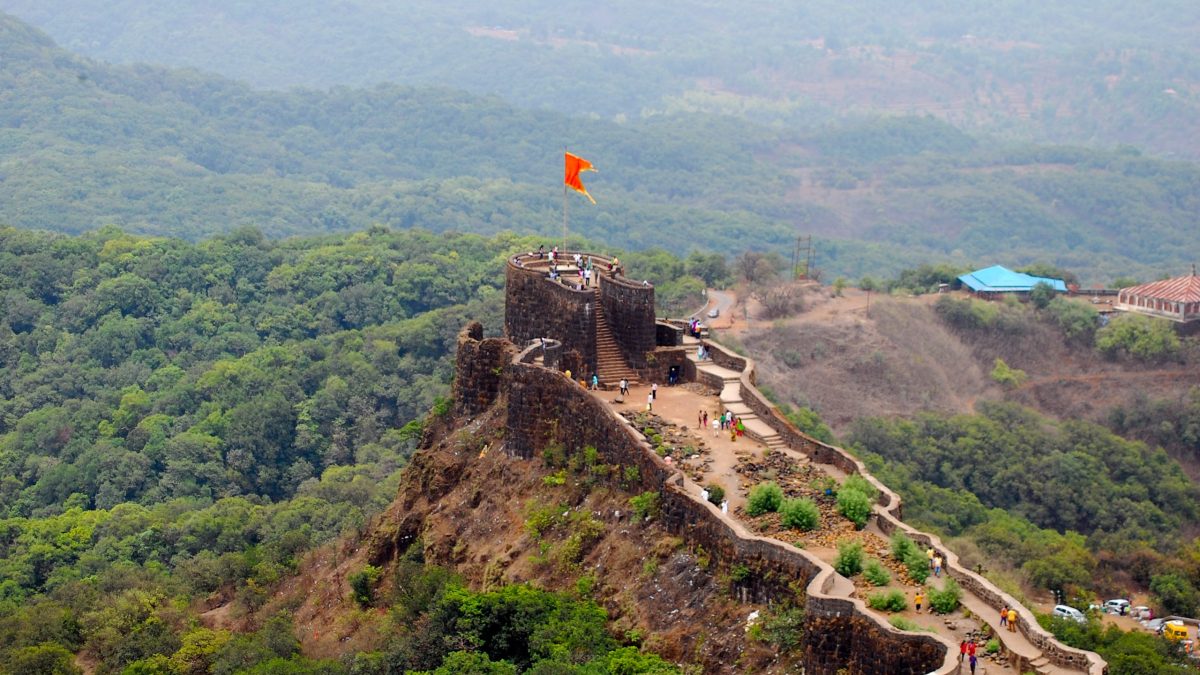
On 10 November 1659, at the foot of the hill fort of Pratapgad in the Western Ghats, the young Maratha leader Shivaji met Afzal Khan, a general of the Sultanate of Bijapur, for a parley. Afzal Khan did not leave it alive. In the hours that followed, Shivaji’s men destroyed his army in the surrounding forest. It was the first great victory of the Marathas.
Shivaji and Bijapur
Shivaji Bhonsle was the son of Shahaji, a Maratha noble in the service of the Adil Shahi sultans of Bijapur. From his father’s estate around Pune he had, since his teens, been taking hill forts in the Sahyadri range, building a domain of his own inside Bijapur’s territory. In 1656 he seized the valley of Javali and built Pratapgad to command it.
The sultan, Ali Adil Shah II, was a youth, and the government was directed by the dowager queen, the Badi Sahiba. In 1659 the court resolved to end the rebellion.
Afzal Khan
The command went to Afzal Khan, a veteran of proven ability and great physical strength. He set out with about 10,000 cavalry, infantry, artillery and elephants. On the way, according to Maratha accounts, he desecrated temples at Tuljapur and Pandharpur, hoping to draw Shivaji down into the plains, where cavalry and guns would be decisive.
Shivaji stayed at Pratapgad, in steep, thickly wooded country where a large army could hardly move. Afzal Khan had to come to him. Envoys passed between them; the Khan’s envoy, Krishnaji Bhaskar, urged Shivaji to submit, while Shivaji’s envoy assured the Khan that Shivaji was frightened and would do so if he came to Javali.
The meeting
It was agreed that the two would meet in a pavilion below the fort, each with a small escort, the main forces remaining at a distance. Each suspected the other.
Shivaji prepared carefully. He wore chain mail under his robe and a steel cap under his turban. On his left hand he fitted the wagh nakh, steel claws that could be hidden in the palm, and he carried a short dagger. During the previous days his troops had been placed in the forest around the Bijapur camp.
What happened in the pavilion is told differently by the two sides. Maratha chronicles say that Afzal Khan, much the bigger man, gripped Shivaji’s neck in the embrace of greeting and struck at him with a dagger, which the armour turned. Accounts favourable to Bijapur say that Shivaji struck first. All agree that Shivaji tore open the Khan’s belly with the claws and stabbed him. Afzal Khan staggered out to his palanquin and was cut down by Shivaji’s companions. One of his guards, Sayyid Banda, wounded Shivaji on the head before being killed by Jiva Mahala.
The battle
A signal was fired from the fort. The Maratha infantry under Kanhoji Jedhe, Moropant Pingle and others fell on the Bijapur troops in the valley, while cavalry under Netaji Palkar attacked the main camp at Wai. Leaderless and trapped in the jungle, the army was routed. Thousands were killed or captured. The Marathas took the artillery, horses, elephants and treasure. Shivaji ordered that prisoners who surrendered be spared, and had Afzal Khan buried with honour; the tomb still stands below the fort.
The consequences
- Shivaji followed up at once, taking the fort of Panhala and much of the southern Konkan within weeks.
- Bijapur’s later attempts to crush him failed, and it had to accept his independence in practice.
- The victory gave him the reputation that drew men to his standard, and brought him to the notice of the Mughal emperor Aurangzeb, with whom his greater struggle was to come. He was crowned Chhatrapati in 1674.
The tiger claws
A set of tiger claws long held by the Victoria and Albert Museum in London, and said to be those used by Shivaji, was lent to Maharashtra in 2024 for display. The museum itself says it cannot be proved that they are the same.
Image: Pratapgad fort in the Sahyadri hills near Mahabaleshwar, Maharashtra. Photo by Neeraj Rane, licensed under CC BY-SA 4.0, via Wikimedia Commons.




Leave a Reply