


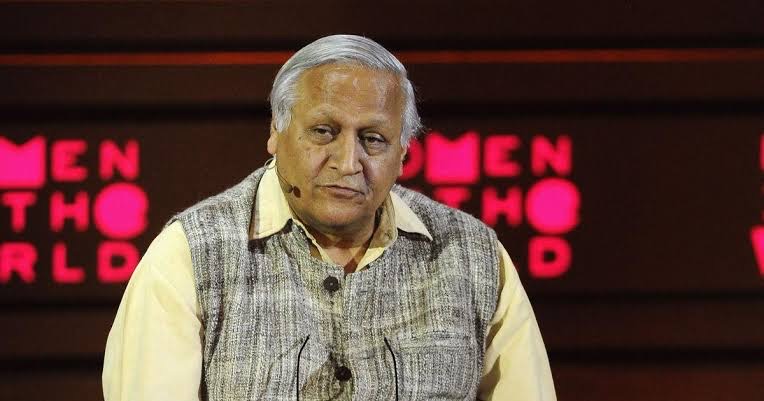
Sanjit "Bunker" Roy (30 June 1945 to 10 November 2026) was an Indian social activist and educator who founded the Barefoot College in Tilonia, Rajasthan. The college trained rural people, many of them women who had never been to school, as solar engineers, teachers, midwives, weavers, architects and doctors, and it became known around the world for the idea that the knowledge of the poor is an asset and not a deficit. Time magazine named him one of the 100 most influential people in the world in 2010, and the Government of India gave him the Padma Shri in 1986. Roy died at his home in Tilonia on 10 November 2026, aged 81, with his wife, the activist Aruna Roy, and close associates at his side. His death was widely mourned, with tributes from politicians across parties and from writers. His life story is unusual: he came from an elite background, was a national squash champion, and chose to live and work in a village in Rajasthan for more than fifty years.
Bunker Roy at a Glance
| Born | 30 June 1945 |
| Died | 10 November 2026, Tilonia, Rajasthan (aged 81) |
| Education | The Doon School; St. Stephen's College, Delhi (1962 to 1967) |
| Profession | Social activist, educator, founder of the Barefoot College |
| Known for | Barefoot College; training rural women as "Solar Mamas" |
| Sporting record | Indian national squash champion (1965); represented India in three world championships |
| Honours | Padma Shri (1986); Time 100 (2010); Jamnalal Bajaj Award (1985) |
| Spouse | Aruna Roy (married 1970) |
Early Life and Education
Roy attended the all-boys' Doon School, where he was a contemporary of Rajiv Gandhi, and then went to St. Stephen's College in Delhi, where he studied from 1962 to 1967. He was a gifted squash player: he was the Indian national squash champion in 1965 and represented India in three world squash championships. In 1970 he married Aruna Roy, who became a civil servant and later a noted activist; you can read about her in the biography of Aruna Roy. A life of privilege and a prospect of a conventional career were available to him. Instead, as one tribute published after his death put it, he chose a village over every comfort that his birth had promised.
Career
From a Water Survey to the Social Work and Research Centre
After carrying out a survey of water supplies in 100 drought-prone areas, Roy established the Social Work and Research Centre (SWRC) in 1972 in Tilonia, a village in the Ajmer district of Rajasthan. The mission soon changed from a focus on water and irrigation to empowerment and sustainability. The early programmes concentrated on siting water pumps near villages and training the local population to maintain them without dependence on outside mechanics, training paramedics to provide local medical care, and promoting solar power to reduce dependence on kerosene lighting and the time spent on it. The SWRC later became known as the Barefoot College.
The Barefoot College
The college is rooted in Gandhian ideas of self-reliance, dignity and decentralisation. It takes students, mainly women from the poorest villages, and teaches them skills such as installing, building and repairing solar lamps and water pumps without requiring them to read or write. A Village Energy and Environment Committee determines what villagers will pay for the solar panels and identifies the poorest residents who will go to the college for training. The students receive six months of training in solar panels and storage batteries and then return home to maintain and repair the systems. The college does not give out any degrees or certificates, and its approach has been described as "de-mystifying high technology". The campus near Tilonia sits on 8 acres, has a rainwater-harvesting design and was built by the students, with dirt floors and no chairs so that poor students feel comfortable.
The college also ran night schools for children and adults who had to work during the day. In 2008 about 3,000 children attended around 150 night schools. The organisation used a system of training the trainers to bring skills to villages. In 1997 Kamala Devi became the first female solar engineer trained by the college and later became head of its solar unit at Kadampura. Since 2015, more than 60 women from Zanzibar, together with women from Malawi, Somaliland and other countries, trained at the college and have assembled, installed, repaired and maintained solar power in their villages. They are popularly known as the "Solar Mamas", and their story was told in a documentary film funded by the Skoll Foundation and the Sundance Institute. Writing in Time in 2010, Greg Mortenson said the college had trained more than 3 million people for jobs in the modern world.
Cross-Border Work
In 2012 the Barefoot College became the first non-governmental organisation partner of UNESCO's Global Partnership for Girls' and Women's Education. A programme funded by the UNDP and run by India's Ministry of External Affairs brought women from villages in rural Africa without electricity to the college for training, after which they returned to install solar electricity in their own villages. In 2013 it was announced that Roy would receive a Clinton Global Citizen Award together with the young activist Malala Yousafzai.
Public Policy and the Courts
Roy was appointed by Rajiv Gandhi to the government's Planning Commission. He recommended that a "code of conduct" for non-governmental organisations be created by legislation and that a national council be set up to recommend "legitimate" organisations to the government and to monitor them. Both ideas were fiercely opposed, because critics feared that they could be used to favour friendly groups and suppress those that did not support a particular government. In 1983 he was the plaintiff in Roy v. State of Rajasthan, in which the Supreme Court struck down an emergency policy that had allowed women famine-relief workers to be paid less than men. He also spoke at the TED conference about how the Barefoot College helps rural communities to become self-sufficient.
An Episode of Humility
The buildings of the Tilonia campus received the Aga Khan Award for Architecture. The award was first attributed to "an illiterate farmer", but it was later corrected to credit a young architect, Neehar Raina, who prepared the layout, alongside a farmer from Tilonia and 12 other "barefoot architects" who built the structures. Because the architect's involvement had been left out of the original citation, Roy did not accept the award on behalf of the college and returned it. The episode shows how seriously he took the question of who deserves credit for the work.
Death and Tributes
Roy died at 6.15 am on 10 November 2026 at Tilonia, aged 81, according to a note from the activist Nikhil Dey. He was survived by his wife, Aruna Roy. Former Rajasthan Chief Minister Ashok Gehlot said that, guided by Mahatma Gandhi's principles, he made remarkable contributions to rural self-reliance, education and development, and Congress MP Shashi Tharoor spoke of his vision of training rural grandmothers as "Barefoot Solar Engineers", which lit thousands of off-grid homes across India and the developing world. Congress leader Jairam Ramesh recalled his role in creating new opportunities for what were then called voluntary agencies in development programmes, and the Communist Party of India's D. Raja spoke of five decades of work to empower rural communities. The author Amitav Ghosh called him a "true hero and pioneer".
Contribution to India's Development
Roy's contribution rests on one idea: that development must begin with the knowledge that poor communities already have. In the Barefoot College, a grandmother who cannot read became a solar engineer, a villager became a paramedic and the community decided what it would pay and who would be trained. This approach has influenced thinking about rural development, vocational training and women's empowerment far beyond India. The college demonstrated that low-cost, community-managed energy and water systems can work in remote villages, and that skills do not depend on formal certificates. It is part of a tradition of Gandhian and community-based work that includes Baba Amte, Ela Bhatt and Anna Hazare, and its practical, energy-focused work is similar in spirit to that of Harish Hande of SELCO.
Awards and Honours
- Jamnalal Bajaj Award for the application of science and technology for rural development (1985)
- Padma Shri (1986), presented by President Giani Zail Singh
- Social Entrepreneur of the Year, Schwab Foundation for Social Entrepreneurship (2003)
- St Andrews Prize for the Environment (2003)
- Robert Hill Award for promoting photovoltaics (2009)
- Time 100 list of the most influential people (2010)
- Named by the Guardian as one of the 50 people who could save the planet
- The Barefoot College won the Indira Gandhi Paryavaran Puraskar (1998) and an Ashden Award (2003)
Legacy
Roy leaves behind an institution, a method and a story. The institution, the Barefoot College, has trained people across India and in many other countries. The method, which trusts rural people with technology and with decisions about it, is studied by development practitioners. The story of the "Solar Mamas" has become a symbol of the idea that expertise and education are not the same thing. A balanced assessment should note that his proposals for regulating non-governmental organisations in the 1980s were controversial, and that the college's scale and results are described in large figures that are often reported through the organisation's own account. Even so, tributes at his death from across the political spectrum show the respect in which his work was held.
Frequently Asked Questions
Who was Bunker Roy?
He was an Indian social activist and educator who founded the Barefoot College in Tilonia, Rajasthan.
When did Bunker Roy die?
He died on 10 November 2026 at Tilonia, aged 81.
What is the Barefoot College?
It is a voluntary organisation that trains rural people, especially women, in skills such as solar engineering, healthcare and teaching, without requiring formal degrees.
What awards did he receive?
The Padma Shri in 1986, a place on the Time 100 list in 2010 and the Jamnalal Bajaj Award in 1985, among others.