


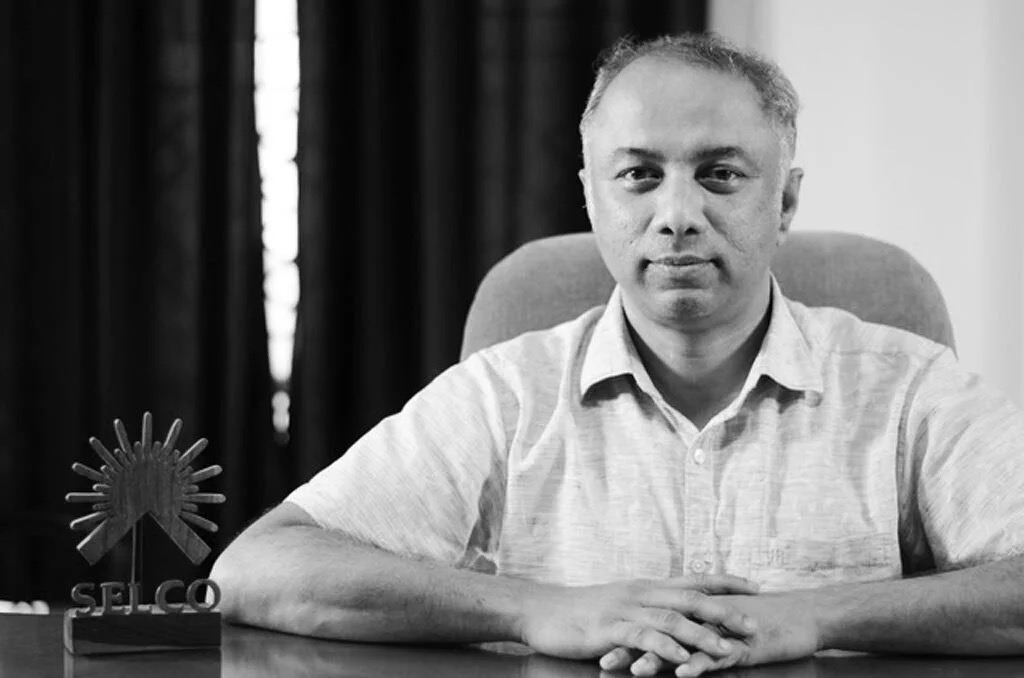
Harish Hande is an Indian social entrepreneur who co-founded SELCO India in 1995, a company that sells and finances solar lighting and other sustainable energy systems for poor households and livelihoods in rural India. He was awarded the Ramon Magsaysay Award for 2011 "for his passionate and pragmatic efforts to put solar power technology in the hands of the poor, through a social enterprise that brings customized, affordable, and sustainable electricity to India's vast rural populace, encouraging the poor to become asset creators". He trained as an energy engineer at IIT Kharagpur and the University of Massachusetts Lowell, and he left the active management of SELCO India in 2014 to lead the SELCO Foundation, which works on inclusive innovation. His approach is built on a simple idea: poor families are customers with real needs and a capacity to pay, provided that the product, the financing and the service are designed for them.
Harish Hande at a Glance
| Born | Handattu, Udupi district, Karnataka; raised in Rourkela, Odisha |
| Education | Undergraduate degree in energy engineering, IIT Kharagpur (1990); master's and PhD in energy engineering, University of Massachusetts Lowell |
| Profession | Social entrepreneur, energy engineer |
| Organisations | SELCO India (co-founder, 1995); SELCO Foundation (CEO from 2014) |
| Known for | Affordable, financed solar energy for rural households and livelihoods |
| Honours | Ramon Magsaysay Award (2011); Schwab Foundation Social Entrepreneur of the Year (2007); Ashoka Fellow (2008) |
Early Life and Education
Harish Hande was born in Handattu in the Udupi district of Karnataka, and was raised in Rourkela in Odisha, where he attended the Ispat English Medium School. He went to the Indian Institute of Technology, Kharagpur, for his undergraduate studies in energy engineering and graduated in 1990. He then went to the United States, where he completed a master's degree and later a PhD in energy engineering at the University of Massachusetts Lowell. His education, which combined engineering with an interest in energy for development, set him on a path to work on a question that most engineers of his generation did not ask: how can technology serve people with the least purchasing power?
Career
Founding SELCO India (1995)
In 1995 Hande co-founded SELCO India, a social enterprise based in Bengaluru, to reduce poverty by promoting sustainable technologies in rural India. The company emerged under the leadership of Hande and Neville Williams, president of the Solar Electric Light Fund in the United States. In the early years the Solar Electric Light Fund took a majority stake in the company, with Williams as chairman, while Hande kept a minority shareholding and the role of managing director. In December 1996 Winrock International released a conditional loan of 150,000 dollars under a USAID renewable energy programme, on condition that SELCO set up a number of solar service centres and install a minimum number of systems. The loan was repaid by 2000.
A Financing Model for the Poor
The key innovation of SELCO was not the solar panel, which was already available, but the way it was sold. In the early model, each customer paid 25 per cent of the cost as a down payment and the rest in monthly instalments that fit within the average monthly budget of a family in the region. SELCO also offered a year's guarantee on the manufacturer's warranty, free service for a year and a 90-day money-back guarantee. The idea was to remove the main barriers to adoption: high upfront cost and the lack of after-sales service in remote villages. The company's work has been concentrated in Karnataka, where it has improved living standards of poor households through solar energy and low-smoke cookstoves, and it has also worked in other states. A 2011 interview reported more than 120,000 households in Karnataka and Gujarat served by SELCO's solar lighting systems, and other profiles cite different figures for people reached or systems financed, so the numbers vary with the year and the measure used.
From Light to Livelihoods
The Magsaysay citation says SELCO's approach encourages the poor to become "asset creators", which points beyond lighting to the idea of energy as something that helps people earn more. This is a significant change in thinking: instead of regarding electricity access as charity, it is treated as an investment in productive capacity. The SELCO Foundation, set up in 2010, works to reduce poverty and improve access to health care and education through decentralised solar solutions. Its e-shala project, for example, takes education to children in areas without power supply by using solar storage, an LED projector and a tablet loaded with content.
SELCO Foundation
In 2014 Hande left the active management of SELCO India and became the CEO of the SELCO Foundation. In 2026 the foundation has continued to work with international bodies; in January 2026 a memorandum of understanding between the International Solar Alliance and the SELCO Foundation was reported, aimed at scaling up solar livelihood solutions in the Global South, and in May 2026 a podcast described him as co-founder and CEO of the foundation. The details of these items should be checked with the foundation directly.
Contribution to India's Development
Hande's contribution to development is a method as much as a product. He showed that markets can serve the poor if companies redesign finance, service and technology around the customer, and he treated energy as a means of raising income rather than only as a utility. The model has influenced other social enterprises in energy and beyond. It sits alongside other work on rural energy and self-reliance such as that of Bunker Roy and his Barefoot College, which trains rural women as solar engineers, and the work of Kiran Mazumdar-Shaw in building an Indian enterprise from a small start.
Awards and Honours
- Ashden Awards for Sustainable Energy, awarded to SELCO India in 2005, and again in 2007 for "Outstanding Achievement", presented by Al Gore
- Accenture Economic Development Award (2005)
- Social Entrepreneur of the Year (2007), Schwab Foundation for Social Entrepreneurship and the Nand and Jeet Khemka Foundation
- Business Today's "21 young leaders for India's 21st century" and India Today's "50 pioneers of change" (2008)
- Ashoka Fellow (2008)
- Ramon Magsaysay Award (2011)
- Karnataka Rajyotsava Prashasti (2011)
- Doctorate of Humane Letters, University of Massachusetts (2013)
- Distinguished Alumnus Award, IIT Kharagpur (2014)
Legacy
Hande has helped to create a field of work known as inclusive or last-mile energy. The idea that poor customers will pay for good service, and that finance and maintenance matter as much as technology, is a lasting part of his legacy. At the same time, scaling such models is not easy: the poorest households may still need subsidies or support, and companies must balance social goals with financial sustainability. SELCO's own long-term survival and the creation of the SELCO Foundation are evidence that the model has worked in practice for more than three decades.
Frequently Asked Questions
Who is Harish Hande?
He is a social entrepreneur who co-founded SELCO India in 1995 and later became CEO of the SELCO Foundation.
What did Harish Hande win the Magsaysay Award for?
For his pragmatic efforts to put solar power technology in the hands of the poor through a social enterprise offering customised, affordable and sustainable electricity.
What does SELCO do?
SELCO provides solar lighting and other sustainable energy systems to poor households and small enterprises, with financing designed to fit their budgets.
Where did Harish Hande study?
He studied energy engineering at IIT Kharagpur and the University of Massachusetts Lowell.