



Sarnath, ten kilometres from Varanasi in Uttar Pradesh, is the place where the Buddha gave his first sermon. It is one of the four holiest sites of Buddhism, and it gave independent India its national emblem. In July 2026 UNESCO inscribed the Ancient Buddhist Site of Sarnath as a World Heritage Site, India’s forty-fifth.
At a glance
- Location: near Varanasi, Uttar Pradesh
- Inscribed: 2026
- Type: Cultural
- Period: third century BCE to twelfth century CE
- Associated with: the Buddha’s first sermon
The first sermon
After his enlightenment at Bodh Gaya, the Buddha walked to the deer park at Sarnath, then called Isipatana or Mrigadava, to find five ascetics who had once been his companions. To them he explained what he had understood: the middle way between luxury and self-torment, the four noble truths and the eightfold path. Buddhists call this the turning of the wheel of the law. The five became the first monks, and the Buddhist community, the sangha, was born here.
History
The emperor Ashoka visited in the third century BCE and built a stupa and a pillar. Monasteries grew up around them and flourished for some fifteen centuries; the Chinese pilgrim Xuanzang found 1,500 monks here in the seventh century. The site was destroyed and abandoned at the end of the twelfth century. Excavation began in the 1830s under Alexander Cunningham and continued in the early twentieth century.
What to see
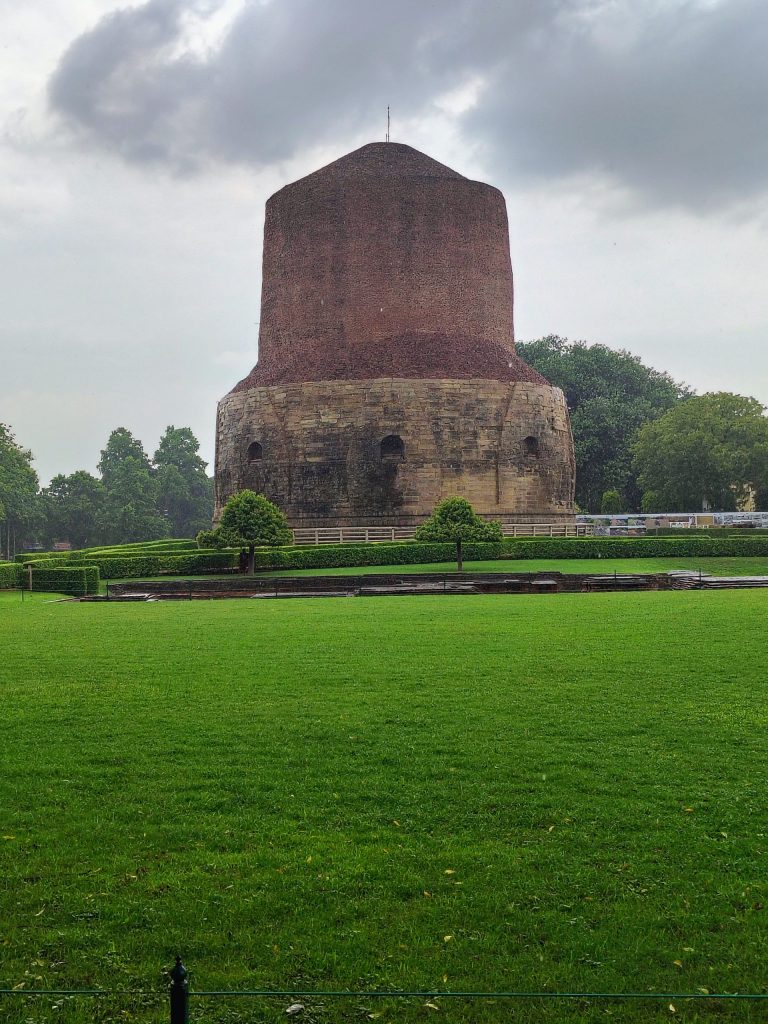
- Dhamek Stupa: a solid cylindrical tower about 43 metres high and 28 metres across, dating in its present form from about 500 CE, with a band of carved floral and geometric patterns. It is believed to mark the spot of the first sermon.
- Dharmarajika Stupa: the foundations of Ashoka’s stupa, pulled down for building material in 1794
- Ashoka’s pillar: the broken shaft still stands where it was set up, with an edict warning against division in the monastic community
- Ruins of monasteries and the main shrine
- Chaukhandi Stupa: nearby, marking the place where the Buddha met the five ascetics
The Lion Capital
The top of Ashoka’s pillar, four lions standing back to back on a drum carved with a wheel and four animals, was found in 1905. It is kept in the Sarnath Museum. In 1950 it was adopted as the national emblem of India, and the wheel is at the centre of the national flag.
Why it is a World Heritage Site
The site is directly associated with a founding event of one of the world’s great religions, and its remains show the development of Buddhist art and monastic life over many centuries.
Visiting
Sarnath is a short drive from Varanasi. The museum is closed on Fridays. Modern temples built by Buddhist communities from Sri Lanka, Thailand, Japan, Tibet and other countries stand around the old site, and the modern Mulagandha Kuti Vihara has wall paintings of the Buddha’s life by a Japanese artist.
Image: The Dhamek Stupa at Sarnath, Uttar Pradesh. Photo by Hardy Explorer, licensed under CC0, via Wikimedia Commons.