


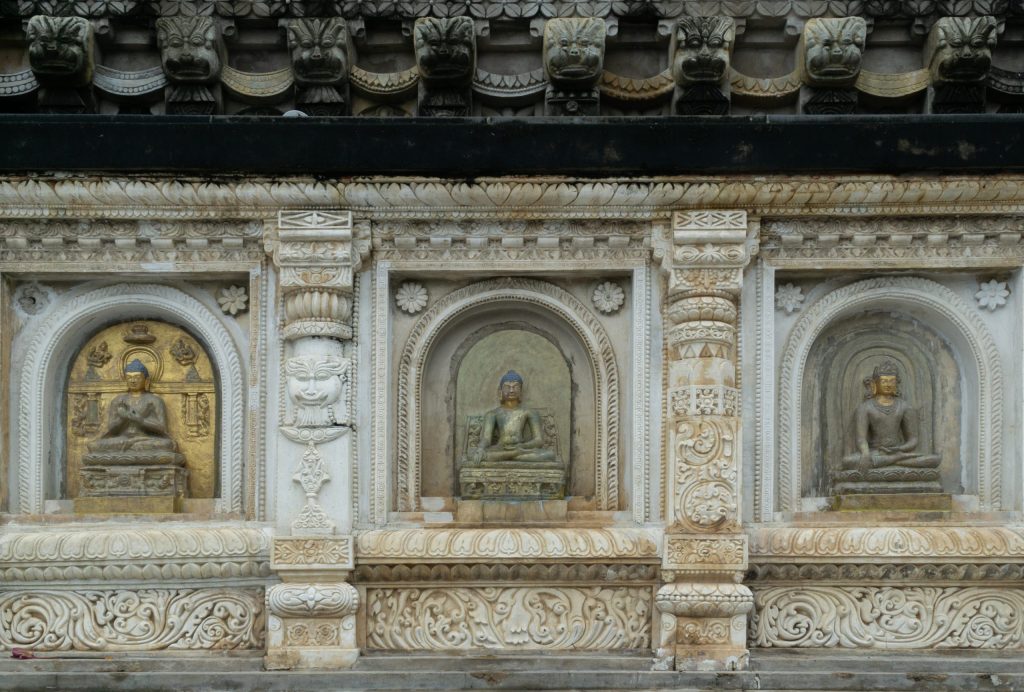

Bodh Gaya, in the Gaya district of Bihar, is the holiest place in the Buddhist world. Here, about twenty-five centuries ago, Prince Siddhartha sat in meditation under a pipal tree and became the Buddha, the Enlightened One. The temple that marks the spot was inscribed by UNESCO as a World Heritage Site in 2002.
At a glance
- Location: Bodh Gaya, Gaya district, Bihar
- Inscribed: 2002
- Type: Cultural
- First temple: third century BCE, by Ashoka
- Present temple: fifth to sixth century CE
History
The emperor Ashoka visited the place about 250 years after the Buddha’s time, built the first shrine and placed a polished sandstone slab, the Vajrasana or Diamond Throne, at the foot of the tree. The present brick temple was built in the Gupta period and is one of the earliest large brick temples to survive in India.
After the thirteenth century the temple fell into ruin. It was repaired by missions from Burma in the nineteenth century and thoroughly restored in the 1880s under Sir Alexander Cunningham.
The temple
- The tower: a tall pyramid about 50 metres high, with four smaller towers at the corners
- The shrine: a gilded image of the seated Buddha touching the earth, the gesture that calls the earth to witness his enlightenment
- The railing: parts of the stone railing date from about the first century BCE
The Bodhi tree
The pipal tree behind the temple is a descendant of the original. A cutting of the first tree was taken to Sri Lanka in Ashoka’s time by his daughter, and the tree at Bodh Gaya was later replanted from that line.
The seven places
Tradition holds that the Buddha spent seven weeks at Bodh Gaya after his enlightenment, each at a different spot. All seven are marked within the complex, including the walk where lotus flowers are said to have sprung up under his feet and the pond where a serpent king sheltered him from a storm.
Why it is a World Heritage Site
The complex is directly associated with the life of the Buddha and with the beginnings of one of the world’s great religions.
Visiting
Bodh Gaya is about 115 kilometres from Patna and has an airport at Gaya. Around the temple stand monasteries built by Buddhist communities from Thailand, Japan, Tibet, Bhutan, Sri Lanka and other countries. The pilgrim season runs from October to March. India’s other great Buddhist site, Sarnath, is where the Buddha first taught.
Image: The south side of the Mahabodhi Temple at Bodh Gaya, Bihar. Photo by Sumitsurai, licensed under CC BY-SA 4.0, via Wikimedia Commons.