


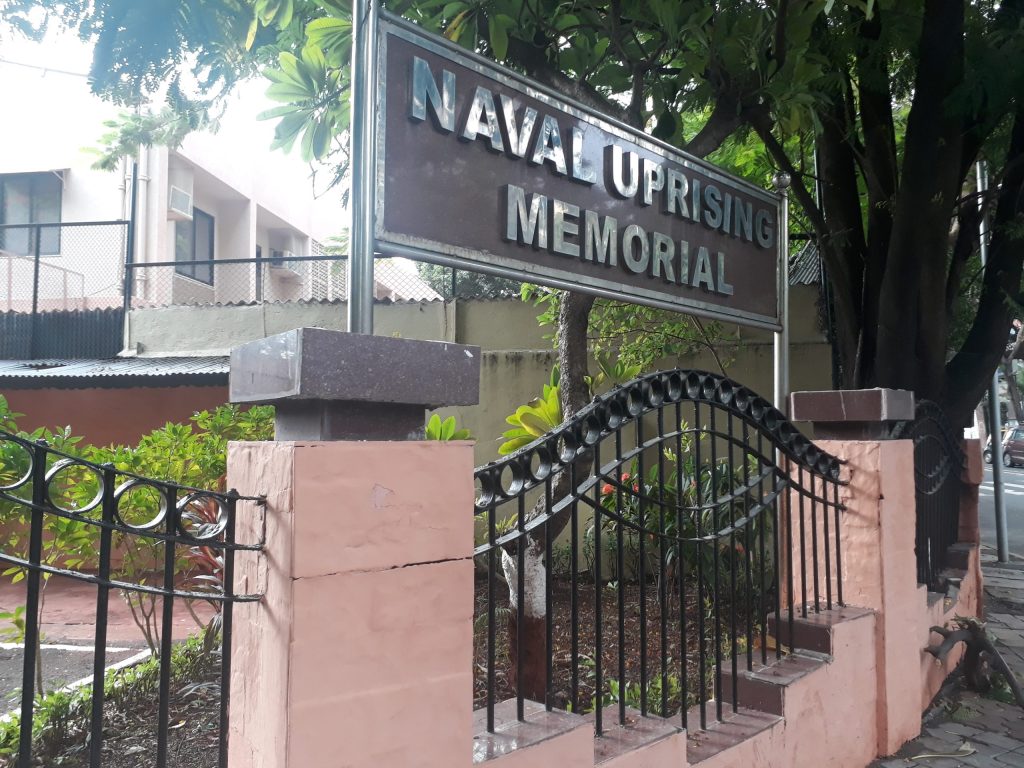

In February 1946, Indian sailors of the Royal Indian Navy went on strike in Bombay and the protest spread to ports from Karachi to Calcutta. More than 10,000 sailors in 56 ships and shore establishments took part. The mutiny lasted only a few days and ended in surrender, but it came at a moment when British authority in India was already fragile, and it has been cited ever since as a sign that the Raj could no longer rely on its armed forces.
Quick Facts
| Date | 18–23 February 1946 |
| Place | Bombay, spreading to Karachi, Calcutta, Madras and other ports |
| Scale | Over 10,000 sailors, 56 ships and shore establishments |
| Leader | Naval Central Strike Committee (President: M. S. Khan) |
| Outcome | Surrender after appeals by Vallabhbhai Patel and others |
The Background
At the end of the Second World War thousands of Indian sailors faced poor food, low pay, delays in demobilisation and racist treatment from British officers. Many had been influenced by the trials of Indian National Army officers in Delhi in late 1945 and by the nationalist feeling of the time. At HMIS Talwar, a signals school at Colaba in Bombay with about 1,000 communications operators, slogans such as “Quit India” appeared on walls, and some ratings were arrested. On 8 February 1946 some were court-martialled, and the commanding officer reportedly used racial abuse against his men.
The Revolt
On 18 February the ratings of Talwar went on strike over conditions and food, and by the evening of 19 February a Naval Central Strike Committee had been elected. The strike spread to other ships and bases in Bombay, then to Karachi, Calcutta, Madras and other places, and was joined by some elements of the Royal Indian Air Force and local police. The sailors called themselves the Indian National Navy and flew the flags of the Congress, the Muslim League and the Communist Party together on their ships. In Bombay the unrest spilled into the streets with a one-day general strike, and troops and police opened fire on crowds.
The Surrender
The British brought in superior forces and threatened to destroy the ships by bombardment. The Congress and the Muslim League did not support the revolt, fearing violence on the eve of independence; only the Communist Party of India backed it openly. On 23 February the strike committee surrendered after a meeting with Vallabhbhai Patel and others, who promised that there would be no victimisation. In practice many of the ratings were arrested and later dismissed from service, and many were not taken back into the service.
Why It Matters
Historians disagree on its importance. Some argue that it showed the British that the armed forces, on which the Raj depended, could no longer be trusted, and that this helped to persuade the Labour government to leave. Others stress that it was brief, that it was put down quickly and that the transfer of power was shaped by negotiations. On 19 February 1946, while the strike was still on, the British government announced that it would send the Cabinet Mission to India, and independence came in 1947. See also Subhas Chandra Bose, whose Indian National Army inspired many of the sailors, and the Partition of 1947.
Featured image: The Naval Uprising Memorial in Mumbai, which commemorates the 1946 mutiny. Photo by Pinakpani, licensed under CC BY-SA 4.0, via Wikimedia Commons.