


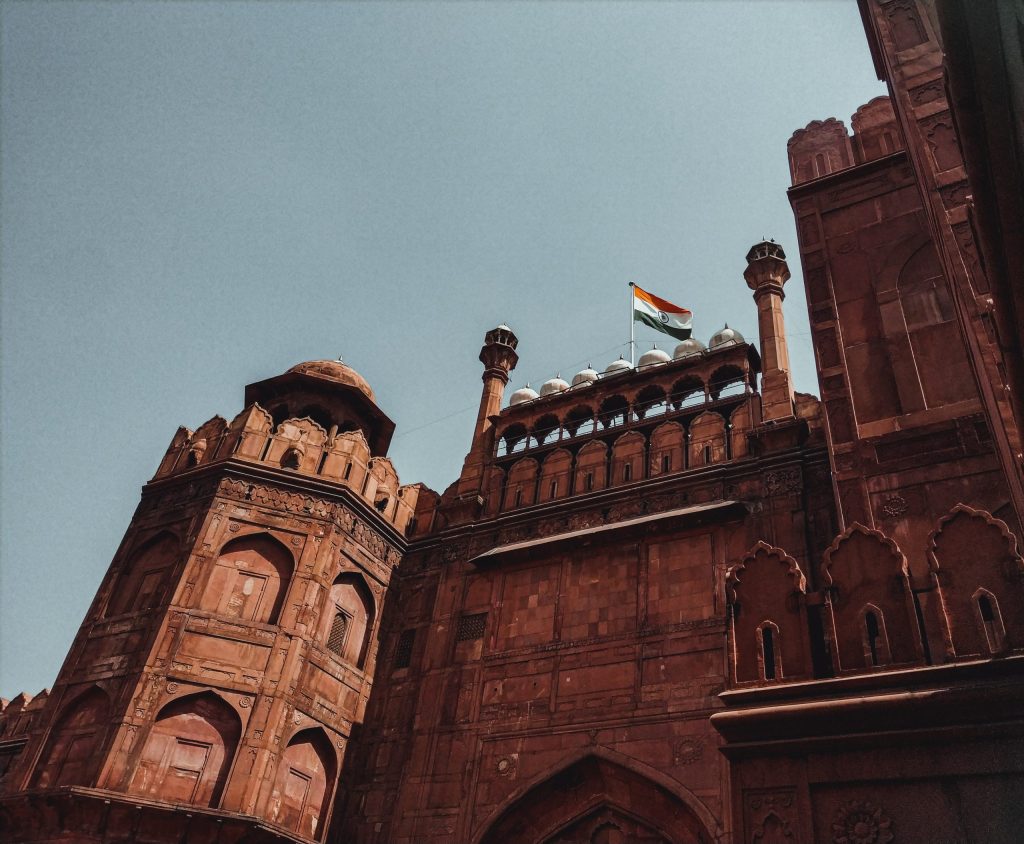

The Red Fort, or Lal Qila, was the palace of the Mughal emperors in their last capital, Shahjahanabad, now Old Delhi. It is also the place from which the Prime Minister of India hoists the national flag every Independence Day. UNESCO inscribed the Red Fort Complex as a World Heritage Site in 2007.
At a glance
- Location: Old Delhi
- Inscribed: 2007
- Type: Cultural
- Built: 1639 to 1648
- Built by: Shah Jahan
History
Shah Jahan, the builder of the Taj Mahal, decided in 1638 to move his capital from Agra to Delhi. The fort took nine years to build, enclosed by red sandstone walls about 2.4 kilometres round and up to 33 metres high.
The fort’s later history was unhappy. In 1739 Nadir Shah of Persia, after his victory at Karnal, carried off its Peacock Throne. After the Revolt of 1857 the British tried the last emperor, Bahadur Shah Zafar, in his own hall of audience, exiled him, and pulled down most of the palace buildings to make room for barracks.
What to see
- Lahori Gate: the main entrance, facing Chandni Chowk
- Chhatta Chowk: a covered bazaar, once selling silks and jewels to the court
- Diwan-i-Am: the hall of public audience, with the marble canopy under which the emperor sat
- Diwan-i-Khas: the hall of private audience, of white marble, where the Peacock Throne stood. On its walls is the Persian couplet: “If there is a paradise on earth, it is this, it is this, it is this.”
- Rang Mahal and Khas Mahal: the private palaces, once cooled by a water channel called the Stream of Paradise
- Moti Masjid: a small marble mosque added by Aurangzeb
- Hayat Bakhsh Bagh: the “life-giving garden”
The World Heritage property also includes the older fort of Salimgarh beside it.
In the freedom struggle
In 1945 and 1946 the British held the trials of officers of Subhas Chandra Bose‘s Indian National Army in the fort, which roused the whole country. On 15 August 1947 Jawaharlal Nehru raised the flag of independent India here.
Why it is a World Heritage Site
The fort represents the peak of Mughal creativity under Shah Jahan, and its plan and garden design influenced later buildings across north India. It is also a symbol of events of great importance in Indian history.
Visiting
The fort is closed on Mondays. A sound and light show is held in the evenings.
Image: The Lahori Gate of the Red Fort, Delhi. Photo by Ranjeet Chauhan, licensed under CC BY-SA 4.0, via Wikimedia Commons.