


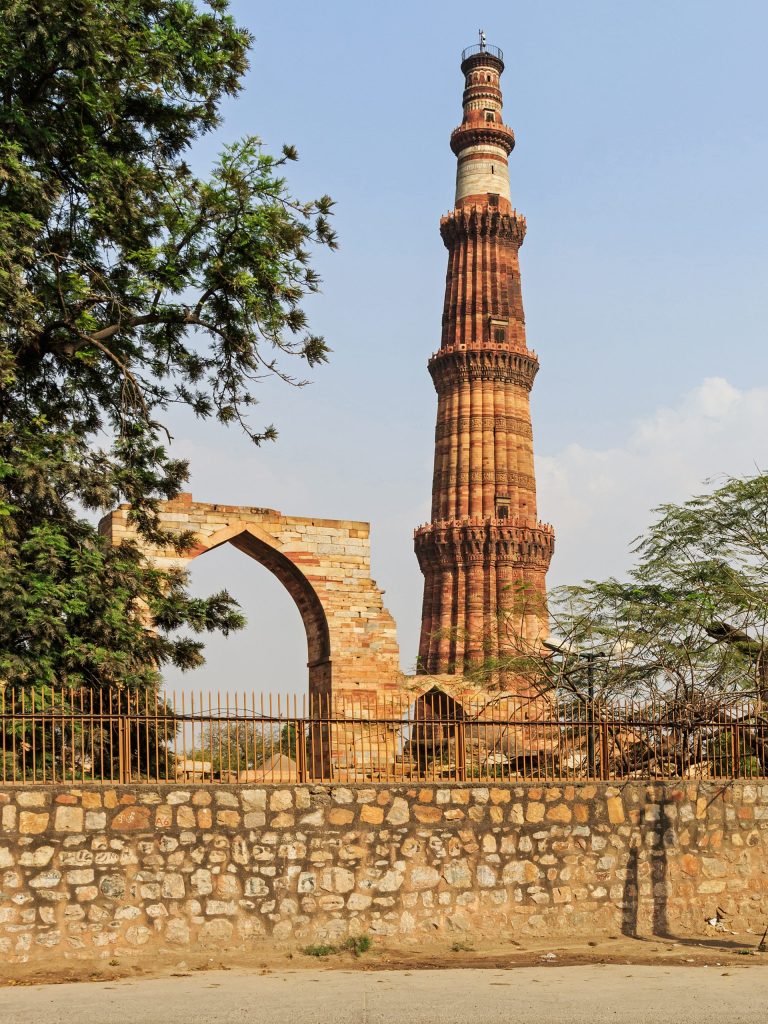

The Qutb Minar, at Mehrauli in south Delhi, is a tower of red sandstone 72.5 metres high, begun at the end of the twelfth century. It is the tallest brick minaret in the world and the oldest major monument of Muslim rule in India. UNESCO inscribed the Qutb Minar and its Monuments as a World Heritage Site in 1993.
At a glance
- Location: Mehrauli, New Delhi
- Inscribed: 1993
- Type: Cultural
- Height: 72.5 metres, with 379 steps
- Built: begun 1199; completed in the thirteenth century
History
After the second Battle of Tarain in 1192, Delhi passed to the Ghurid general Qutb ud-Din Aibak. He began the tower in 1199 and completed only the first storey. His successor Iltutmish added three more. In 1368 lightning damaged the top, and Firoz Shah Tughlaq rebuilt it as two storeys faced partly with white marble, giving five in all.
The tower may have been intended as a victory monument, as a minaret for the call to prayer, or both.
The tower
It tapers from about 14 metres across at the base to under 3 metres at the top. The lower storeys are fluted, with alternating rounded and angular ribs, and each storey ends in a balcony carried on carved stone brackets. Bands of Arabic inscription run round it.
Other monuments
- Quwwat-ul-Islam mosque: the first mosque built in Delhi. An inscription records that material from twenty-seven Hindu and Jain temples was used, and the carved pillars of its colonnades show their origin.
- The Iron Pillar: standing in the mosque courtyard, about seven metres high, made in the fourth or fifth century and bearing a Sanskrit inscription of a king named Chandra, usually identified as Chandragupta II. It has not rusted in sixteen centuries.
- Alai Darwaza: a gateway of 1311 built by Alauddin Khalji, noted for its true arches and dome
- Alai Minar: the stump of a tower that Alauddin planned at twice the height of the Qutb Minar and abandoned
- Tomb of Iltutmish: richly carved inside
Why it is a World Heritage Site
The complex is the earliest and one of the finest groups of Indo-Islamic buildings, showing how Indian craftsmen adapted their skills to a new architecture.
Visiting
The complex is open daily and has its own metro station. The inside of the tower has been closed to the public since an accident in 1981.
Image: The Qutb Minar in Delhi. Photo by A.Savin, licensed under FAL, via Wikimedia Commons.