


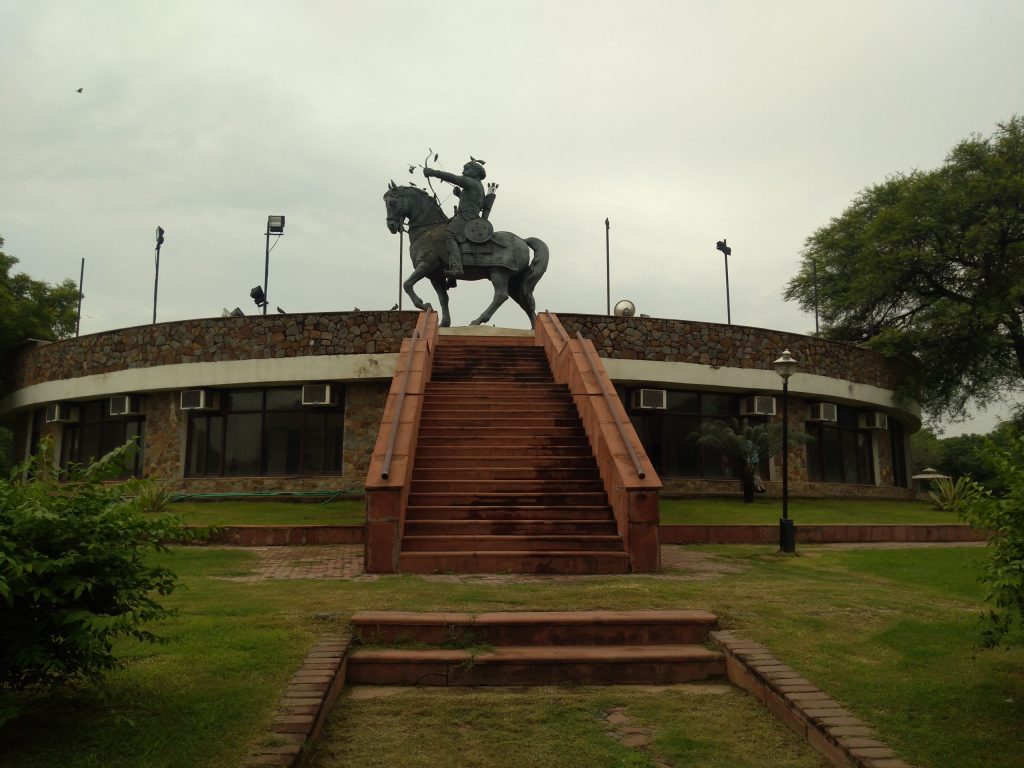

Twice in two years, in 1191 and 1192, the armies of the Chauhan king Prithviraj III and the Ghurid sultan Muhammad of Ghor met near the town of Tarain, in present-day Haryana. Prithviraj won the first battle and lost the second. The second changed the course of Indian history.
The rivals
- Prithviraj III, of the Chahamana or Chauhan dynasty, ruled from Ajmer a kingdom that covered much of Rajasthan, Haryana and Delhi. He had come to the throne as a boy around 1177 and had fought his neighbours, the Chandelas and the Chaulukyas of Gujarat.
- Muizz ad-Din Muhammad, known as Muhammad of Ghor or Muhammad Ghori, was the younger of two brothers who ruled the Ghurid empire from the mountains of central Afghanistan. He had taken Ghazni, Multan and Lahore, and had been beaten once in Gujarat in 1178.
The first battle, 1191
Muhammad seized the fortress of Tabarhinda, usually identified with Bathinda, inside Prithviraj’s territory. Prithviraj marched against him with his feudatories, and the armies met at Tarain, the modern Taraori near Karnal.
The Rajput cavalry charged and broke both wings of the Ghurid army. In the centre Muhammad attacked Govind Rai, the chief of Delhi, and wounded him, but was himself struck by a javelin and badly hurt. A young soldier leapt up behind him and carried him from the field. The Ghurid army retreated. Prithviraj besieged Tabarhinda and recovered it after some months, but did not pursue the enemy.
The second battle, 1192
Muhammad spent the year preparing. He returned with a large army, put by the chronicler Minhaj at 120,000 horsemen. Prithviraj again summoned his allies, though not all came; Jayachandra of Kannauj, his rival, stayed away.
The sultan’s tactics were different.
- He divided his light cavalry into four divisions of mounted archers, who attacked the Rajput army from different sides, shooting and withdrawing whenever it advanced, and never allowing a close fight.
- He kept a reserve of 12,000 picked heavy cavalry out of the battle.
- Towards evening, when the Rajput army was exhausted and its order broken, the reserve charged.
The Chauhan army collapsed. Govind Rai was killed. Prithviraj fled, was captured near the Sarasvati river and was put to death soon afterwards. Coins bearing his name together with the sultan’s suggest he may briefly have been kept as a vassal first.
Why the result was reversed
The heavy Rajput cavalry and elephants were formidable in a direct charge, as the first battle showed. The Central Asian method of mobile horse archery, feigned retreat and a held-back reserve denied them that charge. Division among the Indian kingdoms did the rest.
The consequences
- Ajmer and Delhi passed under Ghurid control. Muhammad left his slave-general Qutb ud-Din Aibak in charge.
- In 1194 Muhammad defeated Jayachandra at Chandawar. Within a decade Ghurid commanders had reached Bengal.
- Muhammad was assassinated in 1206. Aibak became the first ruler of the Delhi Sultanate, which lasted more than three centuries.
History and legend
The best-known version of Prithviraj’s life, the Hindi epic Prithviraj Raso, attributed to his court poet Chand Bardai, tells of his elopement with Jayachandra’s daughter Samyukta and of how, blinded and captive, he killed the sultan with an arrow aimed by sound. The poem was composed centuries later and historians do not treat these episodes as fact. Prithviraj nonetheless became, and remains, a symbol of Rajput valour.
Image: The statue of Prithviraj Chauhan at Qila Rai Pithora in Delhi. Photo by आशीष भटनागर, licensed under CC BY 3.0, via Wikimedia Commons.