


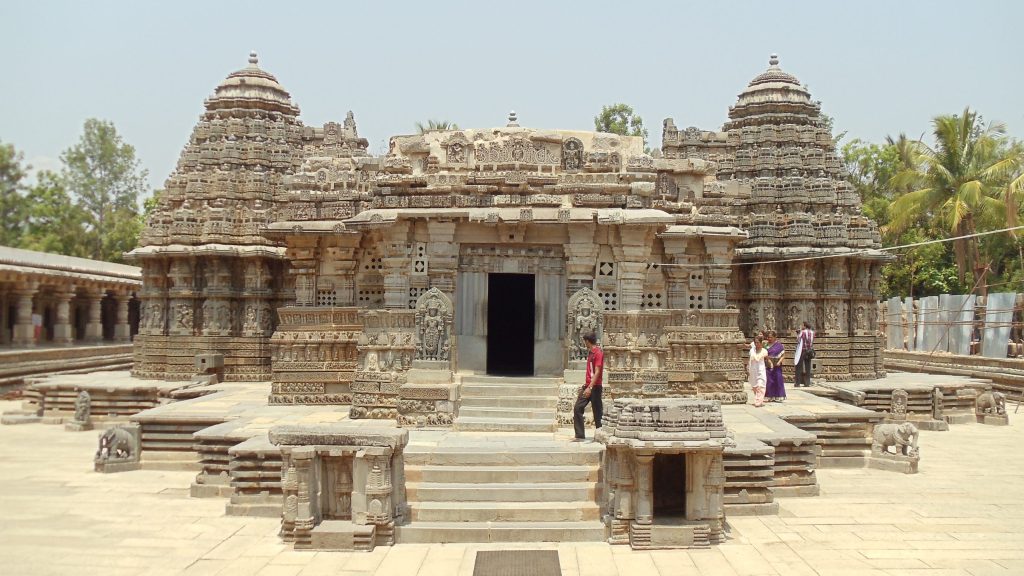

The Hoysala kings ruled southern Karnataka from the eleventh to the fourteenth century and built temples of a kind found nowhere else: low, star-shaped, and carved all over like sandalwood or ivory. Three of the finest were inscribed by UNESCO in 2023 as the Sacred Ensembles of the Hoysalas.
At a glance
- Location: Hassan and Mysuru districts, Karnataka
- Inscribed: 2023
- Type: Cultural
- Period: twelfth and thirteenth centuries
- Temples: three
The three temples
- Chennakeshava Temple, Belur: begun in 1117 by King Vishnuvardhana, traditionally to celebrate a victory over the Cholas, and dedicated to Vishnu. It took more than a century to finish and is still in worship. Under its eaves stand the famous bracket figures of women, one admiring herself in a mirror, another with a parrot, another dancing.
- Hoysaleswara Temple, Halebidu: built from about 1121 at the Hoysala capital, then called Dwarasamudra. It is a double temple of Shiva, with two shrines and two great Nandi bulls. Its outer wall is the richest of all, banded with friezes that run unbroken round the building.
- Keshava Temple, Somanathapura: built in 1258 by Somanatha, a general of King Narasimha III. It is the smallest, the most complete and the most symmetrical, with three shrines and three towers inside a cloistered courtyard.
The Hoysala style
- Plan: the shrine is laid out as a many-pointed star and raised on a platform of the same shape, which doubles as a path for walking round
- Stone: a soft, fine-grained soapstone that can be cut like wood when freshly quarried and hardens with exposure
- Friezes: at the base, rows of elephants, lions, horsemen, scrollwork and scenes from the Ramayana, the Mahabharata and the Bhagavata
- Wall images: above, large figures of the gods under carved canopies
- Pillars: turned on a lathe, with bell and disc mouldings
- Signatures: unusually, many sculptors signed their work
History
The Hoysala capital was sacked by the armies of the Delhi Sultanate in the early fourteenth century, and the dynasty faded. Its territory passed to the Vijayanagara empire, whose capital was at Hampi.
Why it is a World Heritage Site
The temples represent a distinct creative achievement, in which the Hoysala builders selected features from the northern, southern and Deccan traditions to make a style of their own.
Visiting
Belur and Halebidu are 16 kilometres apart and are visited from Hassan. Somanathapura is about 35 kilometres from Mysuru.
Image: The Keshava Temple at Somanathapura, Karnataka, on its star-shaped platform. Photo by Manoharn, licensed under CC BY-SA 3.0, via Wikimedia Commons.