



Hampi, on the Tungabhadra river in Karnataka, was the capital of the Vijayanagara empire, which ruled most of south India from the fourteenth to the sixteenth century. Its ruins lie scattered across a landscape of granite boulders. UNESCO inscribed the Group of Monuments at Hampi as a World Heritage Site in 1986.
At a glance
- Location: Vijayanagara district, Karnataka, near Hosapete
- Inscribed: 1986
- Type: Cultural
- Period: fourteenth to sixteenth centuries
- Extent: more than 1,600 surviving structures over about 40 square kilometres
History
The city was founded in the 1330s and reached its height under Krishnadevaraya in the early sixteenth century, when foreign travellers described it as one of the largest and richest in the world. In 1565 the empire’s army was defeated at the Battle of Talikota, and the capital was sacked and abandoned.
What to see
- Virupaksha Temple: older than the empire and still in worship, with a gateway tower about 50 metres high at the end of the old bazaar street
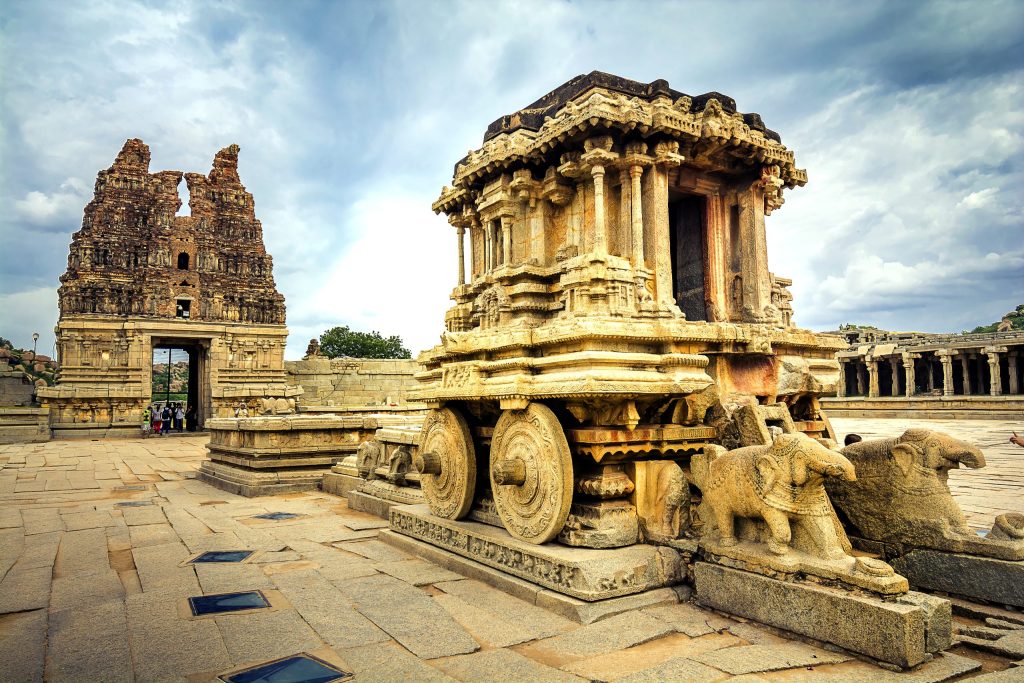
- Vittala Temple: the finest of the temples, with a shrine in the form of a stone chariot and a hall whose slender pillars give out musical notes when tapped
- Hazara Rama Temple: the royal chapel, its walls carved with the story of the Ramayana
- The royal enclosure: the great platform from which the kings watched the Mahanavami festival, a stepped tank and the Queen’s Bath
- Lotus Mahal and the Elephant Stables: buildings that blend Hindu and Islamic forms
- Lakshmi Narasimha: a monolithic figure nearly seven metres high
Why it is a World Heritage Site
Hampi is the outstanding surviving evidence of the last great Hindu kingdom of south India, and its temples and palaces mark the final flowering of the southern style of architecture.
Visiting
The nearest town and railway station is Hosapete, about 13 kilometres away. The site is large; most visitors take two days and get around by bicycle or auto-rickshaw. The site was on UNESCO’s list of heritage in danger from 1999 to 2006 because of the building of bridges nearby.
Image: The stone chariot in the courtyard of the Vittala Temple, Hampi. Photo by Ram Nagesh Thota, licensed under CC BY-SA 4.0, via Wikimedia Commons.