


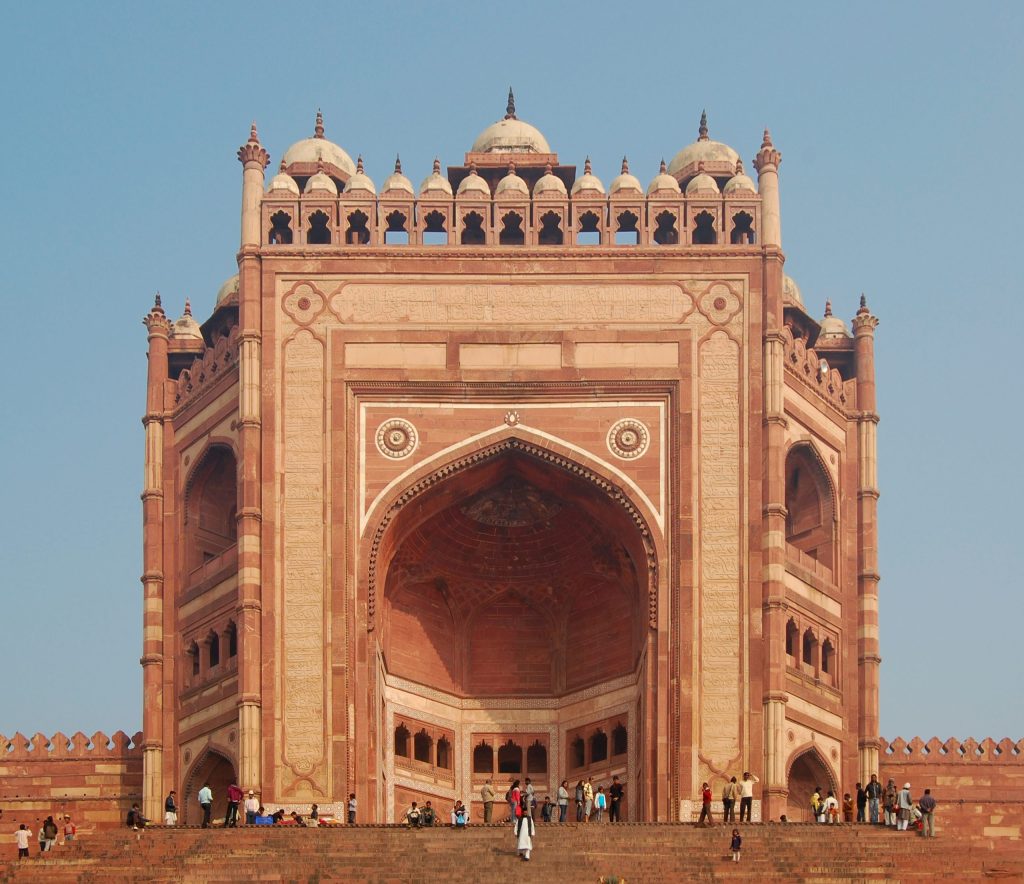

Fatehpur Sikri, the “City of Victory”, was the capital of the Mughal empire for little more than a decade. The emperor Akbar built it on a ridge 37 kilometres west of Agra and then left it, and its palaces have stood almost untouched since. UNESCO inscribed it as a World Heritage Site in 1986.
At a glance
- Location: Agra district, Uttar Pradesh
- Inscribed: 1986
- Type: Cultural
- Built: 1571 to 1585
- Built by: Akbar
History
Akbar, without an heir, visited the Sufi saint Sheikh Salim Chishti, who lived at the village of Sikri and foretold that he would have sons. In 1569 a son, the future emperor Jahangir, was born and named Salim after the saint. Akbar built a new capital at the saint’s home in gratitude, and added “Fatehpur” after his conquest of Gujarat in 1573.
In 1585 he moved to Lahore to deal with the north-west frontier and never came back to live. Shortage of water is the reason usually given for the city’s abandonment.
What to see
- Buland Darwaza: the “lofty gate”, about 54 metres high from the ground, built to commemorate the Gujarat victory
- Jama Masjid: the congregational mosque, one of the largest in India
- Tomb of Salim Chishti: a small white marble building with pierced screens, where visitors tie threads in hope of having a wish granted
- Diwan-i-Khas: a hall with a single carved pillar supporting a platform, where Akbar is thought to have held discussions with scholars of different faiths
- Panch Mahal: a five-storeyed pavilion of open colonnades
- Jodha Bai’s palace and Birbal’s house
- Anup Talao: the ornamental pool associated with the musician Tansen
Why it is a World Heritage Site
The city is the best-preserved example of a Mughal planned capital. Its buildings, almost all in red sandstone, combine Islamic, Hindu and Jain elements, reflecting Akbar’s interest in bringing the traditions of his empire together.
Visiting
Fatehpur Sikri is an easy day trip from Agra. The palace complex and the mosque are entered separately. Nearby is Khanwa, where Akbar’s grandfather Babur defeated Rana Sanga in 1527.
Image: The Buland Darwaza, the great gateway of the mosque at Fatehpur Sikri. Photo by Marcin Białek, licensed under CC BY-SA 3.0, via Wikimedia Commons.