


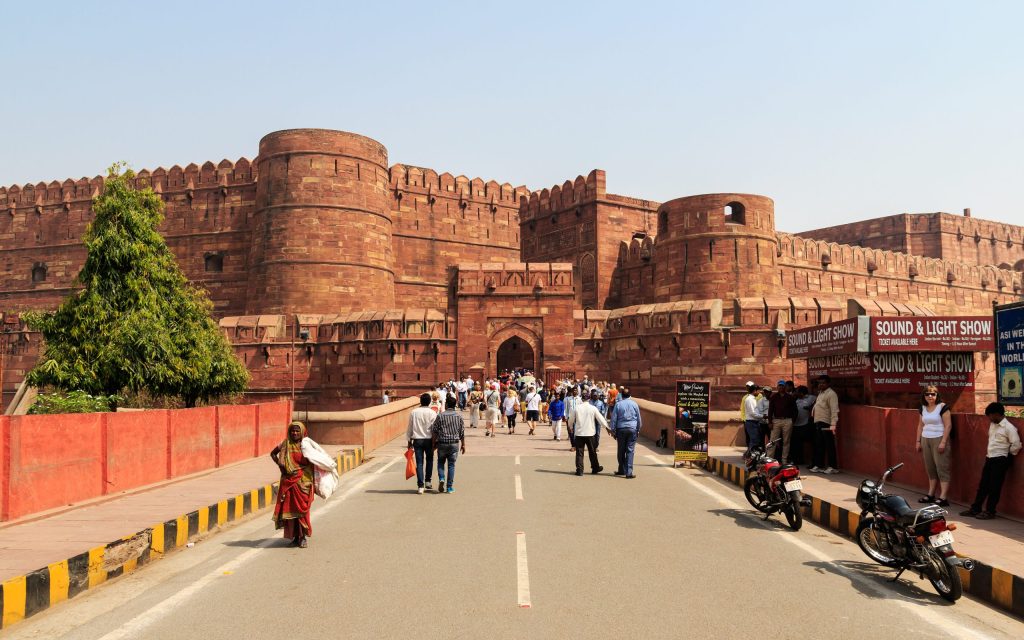

Agra Fort is the great walled citadel from which the Mughal emperors ruled India for much of the sixteenth and seventeenth centuries. It stands on the Yamuna about two and a half kilometres upstream from the Taj Mahal. UNESCO inscribed it as a World Heritage Site in 1983.
At a glance
- Location: Agra, Uttar Pradesh
- Inscribed: 1983
- Type: Cultural
- Built: begun 1565 by Akbar; palaces added to the mid-seventeenth century
- Walls: about 2.5 kilometres round and some 21 metres high
History
An older brick fort called Badalgarh stood on the site. Akbar, making Agra his capital, rebuilt it in red sandstone between 1565 and about 1573. His grandson Shah Jahan replaced many of Akbar’s buildings with palaces of white marble. In 1658 Aurangzeb imprisoned Shah Jahan here, and the old emperor died in the fort in 1666.
The fort was later held by the Jats and the Marathas and was taken by the British in 1803. Part of it is still used by the Indian Army and is closed to visitors.
What to see
- Amar Singh Gate: the entrance used by visitors today
- Jahangiri Mahal: a sandstone palace of Akbar’s time, with carved brackets in the Hindu style
- Khas Mahal: Shah Jahan’s marble private palace, facing the river
- Musamman Burj: the octagonal tower with a view of the Taj Mahal, where Shah Jahan is said to have spent his captivity
- Diwan-i-Am and Diwan-i-Khas: the halls of public and private audience
- Sheesh Mahal: the palace of mirrors
- Moti Masjid: the Pearl Mosque, built by Shah Jahan
Why it is a World Heritage Site
The fort shows the development of Mughal architecture over three reigns, from Akbar’s robust sandstone buildings, which blend Central Asian and Indian forms, to the refined marble of Shah Jahan.
Visiting
The fort is open daily. It is usually seen together with the Taj Mahal and Fatehpur Sikri, 37 kilometres away.
Image: The red sandstone ramparts of Agra Fort. Photo by A.Savin, licensed under FAL, via Wikimedia Commons.