



The Mughal empire founded by Babur nearly ended with his son. In two battles, at Chausa in 1539 and near Kannauj in 1540, the Afghan leader Sher Khan, later Sher Shah Suri, defeated the emperor Humayun and drove him out of India.
The rivals
- Humayun succeeded Babur in 1530 at the age of twenty-two. He was brave, cultivated and generous, but inclined to follow each success with months of ease. His brothers, to whom he had given large provinces, were unreliable.
- Sher Khan, born Farid, was the son of a small Afghan landholder at Sasaram in Bihar. He earned the name Sher, it is said, by killing a tiger. By skill and patience he made himself master of Bihar and then of Bengal, uniting the Afghans who had lost their power at Panipat.
The road to Chausa
In 1537 Humayun marched east to deal with him. He wasted six months besieging the fort of Chunar, then went on to Bengal, where he spent most of a year at Gaur while the rains closed the roads. Sher Khan slipped past him and seized the country in his rear, cutting his line of retreat. Humayun’s brother Hindal, meanwhile, declared himself emperor at Agra.
Humayun turned back. At Chausa, near Buxar, where the Karmanasa river joins the Ganga, he found Sher Khan across his path.
Chausa, 26 June 1539
For about three months the armies faced each other. The Mughals grew short of supplies and their animals died. Sher Khan talked of peace and appeared to accept terms.
Then, before dawn on 26 June 1539, he attacked the sleeping Mughal camp from three sides. The army was driven into the Ganga and thousands were drowned or cut down. Humayun rode his horse into the river and lost his seat. A water-carrier named Nizam gave him his inflated goatskin and helped him across.
Humayun kept a promise made in the river: at Agra he seated the water-carrier on the throne for part of a day and ordered the court to obey him.
Sher Khan had himself crowned and took the title Sher Shah.
Kannauj, 17 May 1540
Humayun raised another army, but his brother Kamran withdrew to Lahore with his troops. Humayun met Sher Shah on the Ganga opposite Kannauj, in an engagement also called the Battle of Bilgram. The Mughal force was larger and had more guns, but it was demoralised and badly placed after rain flooded its camp. When Sher Shah attacked, the crowd of camp followers fled through the ranks, and the army broke before the artillery had fired. Humayun again escaped across the river.
Exile
Humayun fled through Agra, Delhi and Lahore to Sindh, wandering for years through the desert. His son Akbar was born at Umarkot in 1542. In 1544 he reached Persia, where Shah Tahmasp gave him refuge and troops.
Sher Shah’s rule
Sher Shah ruled for only five years, but his administration became the model for the Mughals.
- Coinage: the silver rupiya, the ancestor of the modern rupee
- Roads: he restored and extended the great highway from Bengal to the north-west, later called the Grand Trunk Road, with rest houses and wells along it
- Land revenue: assessment based on measurement of the land
- Order: village headmen made responsible for crimes in their areas
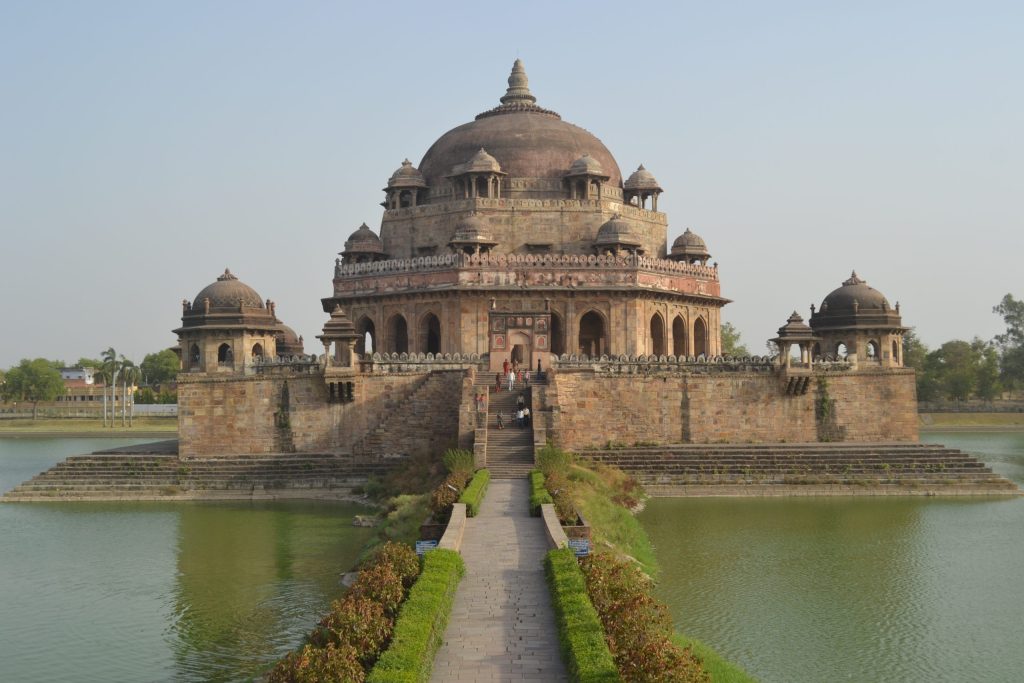
He was killed in 1545 by a gunpowder explosion while besieging the fort of Kalinjar. His tomb stands in a lake at Sasaram.
The return
Sher Shah’s successors quarrelled. In 1555 Humayun came back with Persian help and retook Delhi. He died the next year after a fall on the stairs of his library, leaving the throne to the thirteen-year-old Akbar, who had to win it again at Panipat.
Image: The tomb of Sher Shah Suri at Sasaram in Bihar. Photo by Nandanupadhyay, licensed under CC BY-SA 3.0, via Wikimedia Commons.