


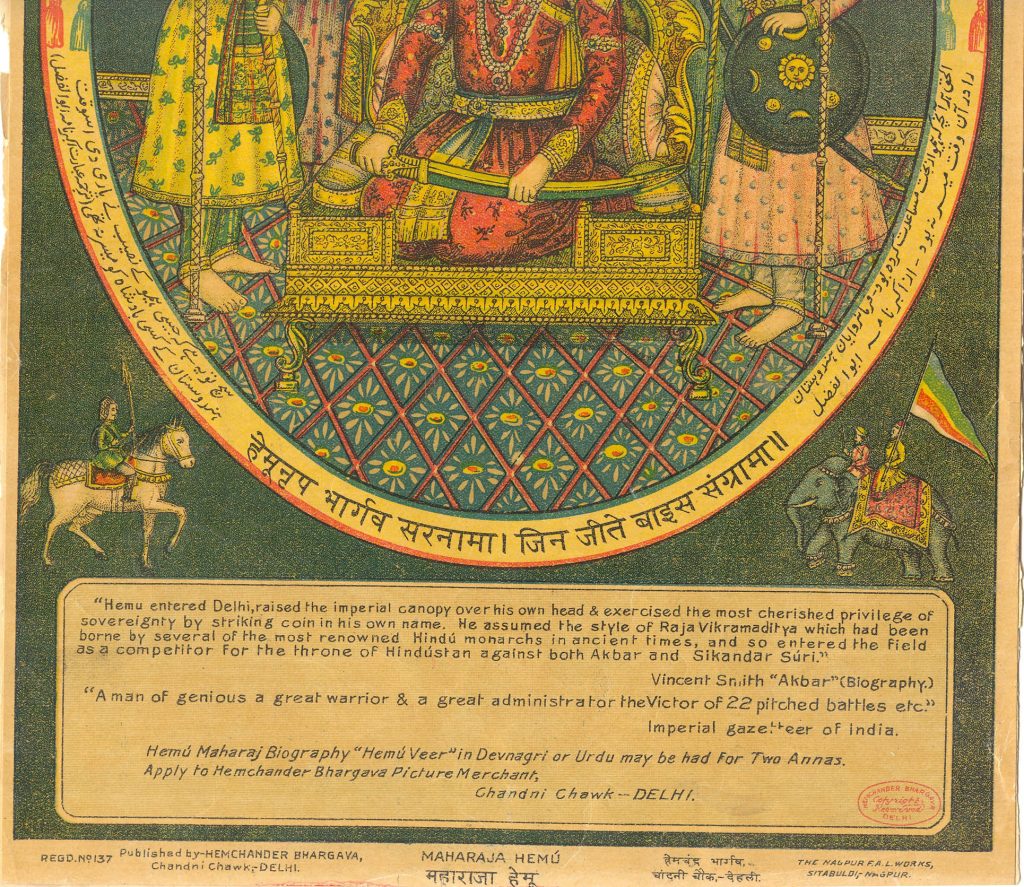

On 5 November 1556, thirty years after Babur’s victory on the same ground, a second battle was fought at Panipat. On one side was the thirteen-year-old Mughal emperor Akbar, guided by his regent Bairam Khan. On the other was Hemu, a Hindu general who had made himself ruler of Delhi. A single arrow decided it.
Hemu
Hemu, or Hemchandra, came from Rewari in present-day Haryana. By most accounts he began as a trader supplying saltpetre and provisions, rose in the service of the Sur dynasty founded by Sher Shah, and became chief minister and commander to Adil Shah Sur. He was an able general who is said to have won twenty-two battles against Afghan rebels and other rivals of his master.
The crisis of 1556
Humayun, restored to Delhi only months before, died in January 1556. His son Akbar, then in Punjab, was proclaimed emperor at Kalanaur at the age of thirteen, with the veteran Bairam Khan as guardian. The Mughal hold on India extended to little more than a few cities.
Hemu marched from the east, took Agra, and on 7 October 1556 defeated the Mughal governor Tardi Beg Khan at Tughlaqabad outside Delhi. He entered the capital and assumed the royal title Vikramaditya, striking coins in his own name. For the first time in more than three centuries a Hindu ruled at Delhi.
Decision in the Mughal camp
Most of Akbar’s officers advised retreat to Kabul. Bairam Khan insisted on fighting. He had Tardi Beg executed for abandoning Delhi, a harsh act that restored discipline, and advanced.
An early success helped. A Mughal advance guard surprised and captured Hemu’s artillery, which had been sent ahead with too small an escort.
The battle
The armies met at Panipat on 5 November. Hemu had the larger force, with 30,000 cavalry and, by the chronicles, some 1,500 war elephants. Bairam Khan kept Akbar several kilometres behind the lines.
Hemu led from the front on his elephant, Hawai. His elephants broke the Mughal right and left wings, and he was pressing the centre, with victory in sight, when an arrow struck him in the eye. He collapsed unconscious in his howdah. His troops, believing him dead, lost heart and fled.
The end of Hemu
The elephant’s driver was caught leading the animal away, and Hemu was brought, barely alive, before Akbar. The accounts differ on what followed. Some say Bairam Khan urged the boy to strike the first blow and earn the title of Ghazi, and that Akbar refused to strike a dying man; others say he touched the prisoner with his sword. Bairam Khan then beheaded him. The head was sent to Kabul and the body displayed at Delhi. Hemu’s aged father was put to death for refusing to convert, and a tower was raised of the heads of the slain.
Why it mattered
- The Mughal empire survived. Delhi and Agra were recovered at once, and the Sur claimants were finished off within a few years.
- Akbar’s reign began. He dismissed Bairam Khan in 1560 and went on to rule for almost fifty years, building the empire on alliance with the Rajputs and a policy of religious tolerance far removed from the scenes at Panipat.
Hemu’s memory
Hemu’s rule at Delhi lasted about a month. He is remembered as the last Hindu sovereign of the city before modern times and as a man who rose from a humble trade to a throne by ability alone. A memorial marks the place at Panipat where he is believed to have been killed.
Image: The captured Hemu after the Second Battle of Panipat, in a popular print of the 1910s. Photo by an unknown artist, in the public domain, via Wikimedia Commons.