


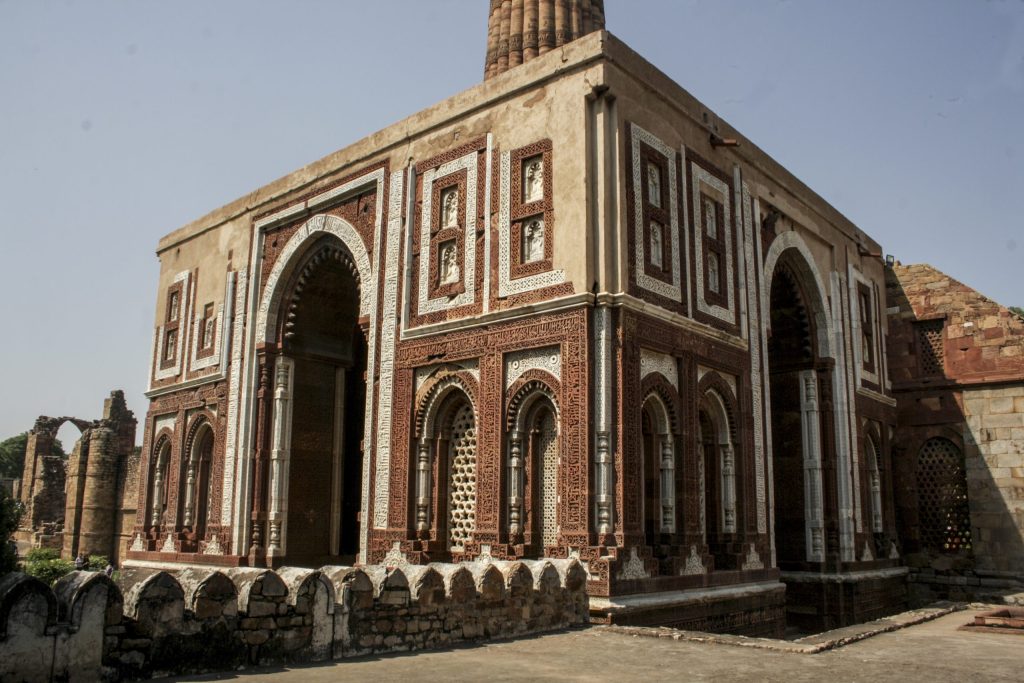

Alauddin Khalji ruled the Delhi Sultanate from 1296 to 1316. He fought off repeated Mongol invasions, conquered much of western India and sent armies deep into the south, and he introduced controls on prices, revenue and the army that have drawn the attention of historians for centuries. His reign is one of the most debated of the medieval period.
Quick Facts
| Born | c. 1266 (as Ali Gurshasp) |
| Reigned | 1296–1316 |
| Dynasty | Khalji |
| Known for | Defeating the Mongols; market reforms; conquest of Gujarat, Ranthambore, Chittor, Malwa |
| Commanders | Zafar Khan, Ulugh Khan, Nusrat Khan, Malik Kafur |
| Died | 4 January 1316 |
The Seizure of the Throne
Alauddin was the nephew and son-in-law of Jalaluddin Khalji, who had made him governor of Kara. In 1296 he raided Devagiri in the Deccan and returned with a vast amount of loot, and used it to rebel. He killed Jalaluddin at Kara, marched to Delhi and, after recruiting soldiers with the treasure, made himself sultan.
Defence Against the Mongols
The Mongols of the Chagatai Khanate invaded repeatedly. Alauddin’s armies defeated them at Jaran-Manjur (1297–98), Sivistan (1298) and Kili (1299). In 1303 a Mongol army besieged Delhi for about two months, and the sultan was forced to take refuge in an entrenched camp; he held, and the Mongols withdrew. After further victories at Amroha in 1305 and on the Ravi in 1306, the invaders stopped coming in force. He built the fortified city of Siri, and later enlarged the Quwwat al-Islam mosque complex.
Conquests
- **Gujarat:** raided in 1299 and annexed in 1304
- **Ranthambore:** captured in 1301 after a long siege
- **Chittor:** taken in 1303 and Malwa in 1305
- **Siwana and Jalore:** captured in 1308 and 1311
- **The south:** his general Malik Kafur led expeditions to Devagiri, Warangal, Dwarasamudra and Madurai in 1307–11, taking enormous plunder and extending the sultan’s overlordship to the south
These conquests ended several Rajput dynasties. The story of Padmini and Chittor is a later literary legend, first told in Malik Muhammad Jayasi’s poem Padmavat in about 1540, and is not found in the accounts of Alauddin’s own time.
Reforms
Alauddin set up a large standing army, paid in cash. To pay it without ruinous inflation he fixed the prices of grain, cloth, horses and other goods, appointed market superintendents and sent out spies to check them. His administration forbade the hoarding of grain, set up state granaries and fixed land revenue at a high rate, collected directly. The court chronicler Barani and the poet Amir Khusrau describe the measures, with different views about their purpose. His successors revoked the price controls within months of his death, and some of his land reforms were later adopted by Sher Shah Suri and Akbar.
Death and Assessment
Alauddin died in January 1316, and the Khalji dynasty fell in 1320. He is remembered as a conqueror and a strong administrator, and also as a ruler whose reign was marked by harsh punishment. The earlier sultanate is covered in Razia Sultan’s biography; before the Sultanate, see the Battles of Tarain.
Featured image: The Alai Darwaza in the Qutb complex, Delhi, built in 1311 by Alauddin Khalji. Photo by Indrajit Das, licensed under CC BY-SA 4.0, via Wikimedia Commons.