


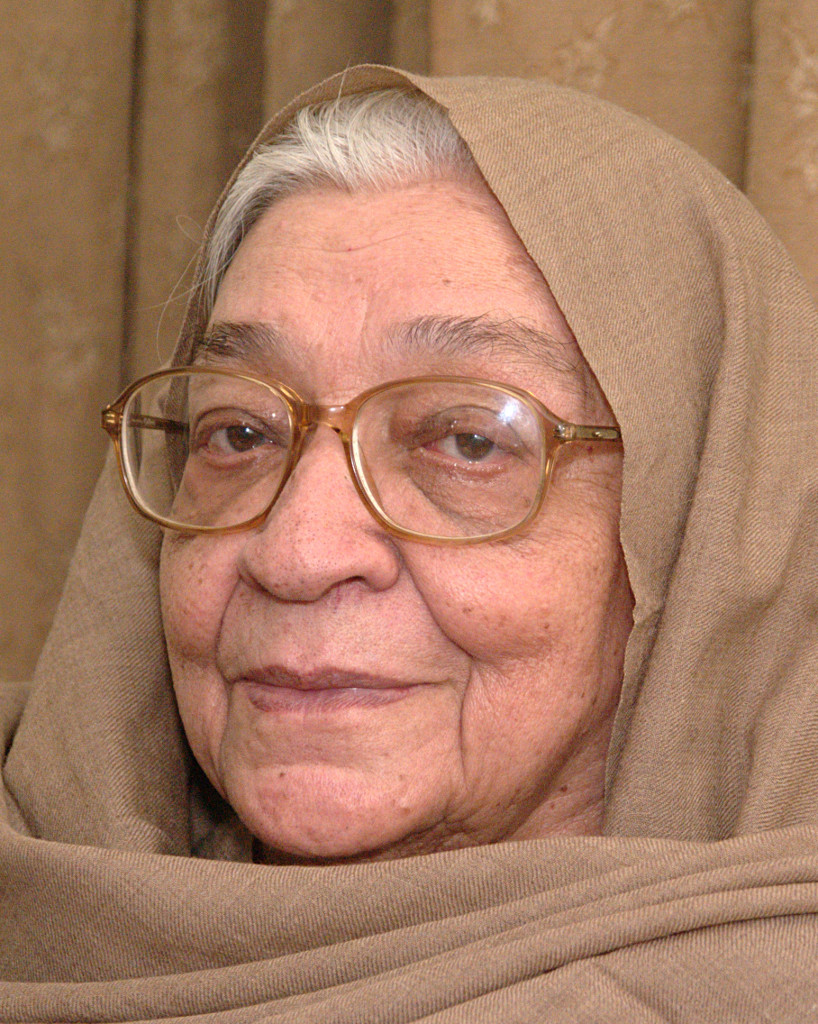

Krishna Sobti (18 February 1925 – 25 January 2019) was an Indian novelist and essayist who wrote in Hindi, among the most original voices in the language in the twentieth century. She wrote of women’s desire with a frankness that shocked her first readers, and of the undivided Punjab and its destruction at Partition in a Hindi enriched with Punjabi, Urdu and Rajasthani speech. She won the Sahitya Akademi Award for Zindaginama and the Jnanpith Award in 2017.
Quick Facts
| Full name | Krishna Sobti |
| Pen name | Hashmat (for some essays) |
| Born | 18 February 1925, Gujrat, Punjab (now in Pakistan) |
| Died | 25 January 2019, New Delhi (aged 93) |
| Language | Hindi |
| Occupation | Novelist, essayist |
| Notable works | Daar Se Bichhudi, Mitro Marjani, Surajmukhi Andhere Ke, Zindaginama, Ai Ladki, Dil-o-Danish, Samay Sargam |
| Awards | Sahitya Akademi Award (1980), Sahitya Akademi Fellowship (1996), Jnanpith Award (2017) |
| Spouse | Shivnath |
Early Life
She was born at Gujrat, a town in western Punjab, and grew up in Delhi and Shimla, where her father worked in the colonial government. She was at college in Lahore when the Partition of 1947 cut her schooling short and turned the land of her birth into a foreign country.
For two years she was governess to the child ruler of the small Rajput state of Sirohi, an experience she wrote about seventy years later.
Beginnings
Her story “Sikka Badal Gaya”, about an old Hindu landlady forced out of her village at Partition, was published in 1948 by the leading Hindi editor of the day, who printed it without changing a word.
Her first novel, Channa, was accepted by a publisher in 1952. When she saw the proofs she found that her Punjabi and Urdu words had been replaced with Sanskritised Hindi. She paid for the printed sheets to be destroyed and withdrew the book. It was published as she wrote it in 2019, the month she died.
Novels
- Daar Se Bichhudi (1958): a girl cast adrift in the Punjab of the Sikh wars, passed from one household to another
- Mitro Marjani (1967): Mitro, the daughter-in-law of a joint family, is loud, funny and openly dissatisfied with a husband who cannot satisfy her. No Hindi novel had given a married woman such a voice.
- Surajmukhi Andhere Ke (1972): a woman scarred by childhood rape and her struggle to feel again
- Zindaginama (1979): a vast chronicle of a village in western Punjab in the years before the First World War, peopled by landlords, peasants, Hindus, Muslims and Sikhs, and written in the mingled speech of the region. It won the Sahitya Akademi Award.
- Ai Ladki (1991): the last conversation between a dying mother and her unmarried daughter
- Dil-o-Danish (1993): a lawyer’s two households in the old city of Delhi
- Samay Sargam (2000): on old age and companionship
- Gujrat Pakistan Se Gujarat Hindustan (2017), drawn from her own life in 1947
Language
Each book has its own language, fitted to its people and place. She refused the purified, bookish Hindi of the academies and insisted that the language belonged to all who spoke it. Editors and critics complained; she did not change.
Hashmat
She also wrote sharp, affectionate sketches of fellow writers under a man’s name, Hashmat, collected as Hum Hashmat. She said that Hashmat wrote differently from Krishna and even held the pen differently.
The Lawsuit
In 1984 she sued the Punjabi writer Amrita Pritam, claiming that the title of Pritam’s book Hardatt ka Zindaginama infringed her rights in the word she had made her own. The case lasted twenty-six years and was decided against her in 2011, after Pritam’s death.
Awards and Refusals
- Sahitya Akademi Award (1980) and its Fellowship, the academy’s highest honour (1996)
- She declined the Padma Bhushan in 2010, saying that a writer should keep her distance from the establishment
- In 2015 she returned both her Sahitya Akademi honours in protest at the killing of writers and what she saw as growing intolerance
- Jnanpith Award (2017)
Personal Life
She lived alone in Delhi for most of her life. At seventy she married the Dogri writer Shivnath, born on the same day as herself.
Death
She died in New Delhi on 25 January 2019, aged ninety-three. She left much of her estate to a foundation that supports young writers.
Featured image: Krishna Sobti in December 2011. Photo by Mukul Dube, licensed under CC BY-SA 4.0, via Wikimedia Commons.