


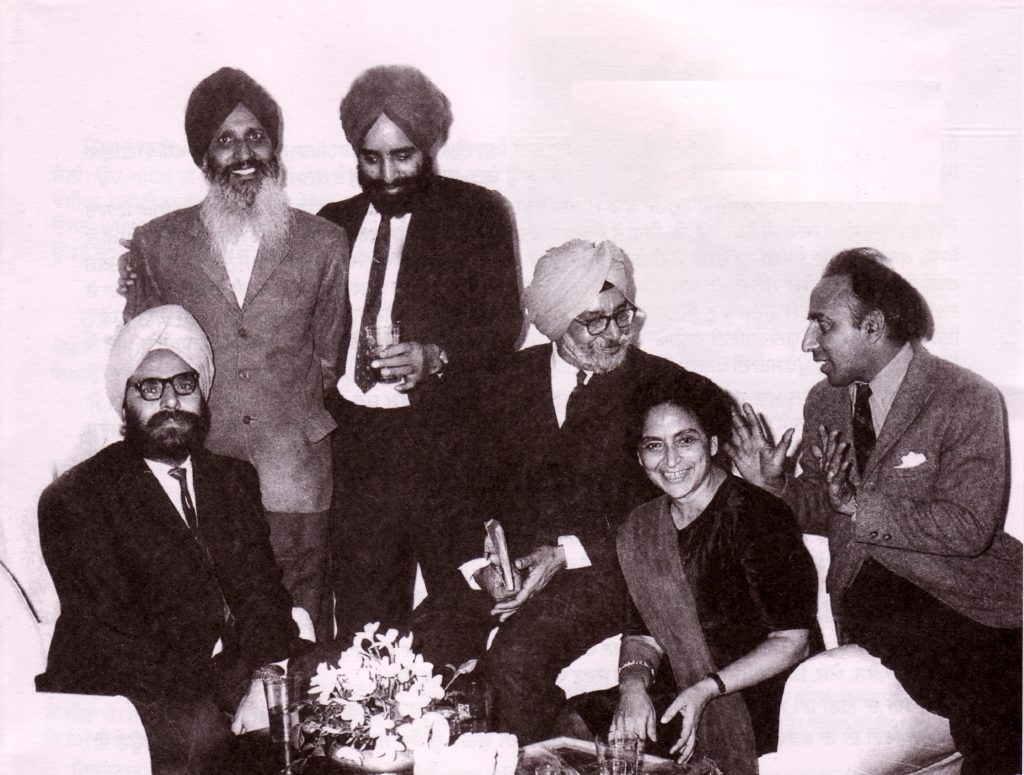

Amrita Pritam (31 August 1919 – 31 October 2005) was an Indian poet, novelist and essayist who wrote in Punjabi and Hindi. She was the first prominent woman writer in Punjabi, and her poem addressed to Waris Shah is the best-known lament for the Partition of 1947. In a career of six decades she published about a hundred books. She received the Jnanpith Award and the Padma Vibhushan.
Quick Facts
| Full name | Amrita Pritam (born Amrit Kaur) |
| Born | 31 August 1919, Gujranwala, Punjab, British India (now in Pakistan) |
| Died | 31 October 2005, New Delhi (aged 86) |
| Language | Punjabi, Hindi |
| Occupation | Poet, novelist, essayist, editor |
| Notable works | Ajj Aakhaan Waris Shah Nu, Pinjar, Sunehade, Kagaz Te Canvas, Rasidi Ticket |
| Awards | Sahitya Akademi Award (1956), Jnanpith Award (1981), Padma Shri (1969), Padma Vibhushan (2004) |
| Other | Nominated member of the Rajya Sabha (1986–1992) |
| Spouse | Pritam Singh (m. 1935; separated 1960) |
| Partner | Imroz |
| Children | 2 |
Early Life
She was born Amrit Kaur at Gujranwala, the only child of Kartar Singh Hitkari, a schoolteacher, poet and preacher of the Sikh faith who edited a literary journal, and Raj Bibi. Her mother died when she was eleven. She later wrote that she lost her faith in God that day. Father and daughter moved to Lahore, where she grew up lonely and began to write.
Her first collection of verse, Amrit Lehran (“Immortal Waves”), was published in 1936, when she was sixteen. About the same time she was married to Pritam Singh, the son of a Lahore hosiery merchant, to whom she had been engaged in childhood, and she took his name as her own.
Partition
Her early poems were romantic, but she soon joined the Progressive Writers’ Movement and wrote of the Bengal famine and of social wrongs. In 1947, pregnant and with a small child, she left Lahore as a refugee and came to Delhi.
On a train to Dehradun she wrote on a scrap of paper the poem “Ajj Aakhaan Waris Shah Nu” (“Today I Call on Waris Shah”). It asks the eighteenth-century poet of Heer Ranjha, who wept for one daughter of Punjab, to rise from his grave and see a million daughters weeping. It is loved on both sides of the border.
Career
Radio and writing
She worked in the Punjabi service of All India Radio in Delhi until 1961 and wrote steadily.
- Pinjar (“The Skeleton”, 1950): a Hindu girl abducted by a Muslim man before Partition is rejected by her own family and makes her life where she is. It was filmed in Hindi in 2003.
- Sunehade (“Messages”): the long poem that won the Sahitya Akademi Award in 1956, the first given to a woman
- Kagaz Te Canvas (“Paper and Canvas”): poems for which she received the Jnanpith Award for 1981
- Novels including Doctor Dev, Rang ka Patta, Yaatri and Unchas Din
Nagmani
From 1966 she edited the Punjabi monthly Nagmani, which she ran with the artist Imroz for more than thirty years and which introduced many young writers.
Later work
From the 1960s her writing turned towards dreams and spiritual themes under the influence of Osho. Her autobiography, Rasidi Ticket (“The Revenue Stamp”, 1976), was frank about her life.
Personal Life
Her marriage was unhappy, and she left her husband in 1960. For years she loved the Urdu poet and film lyricist Sahir Ludhianvi, an attachment she described in her memoirs and which he did not fulfil. From the 1960s until her death she lived with the painter Imroz, who designed the covers of her books; they never married, and the companionship of more than forty years became a legend in itself.
She had a son, Navraj, and a daughter, Kandala. She died in her sleep in New Delhi on 31 October 2005 after a long illness.
Honours
- Sahitya Akademi Award (1956) and Fellowship (2004)
- Jnanpith Award for 1981
- Padma Shri (1969) and Padma Vibhushan (2004)
- Honorary doctorates from several universities, and awards from Bulgaria and France
- In her last years the Punjabi Academy of Pakistan honoured her, and she was sent a ceremonial chaddar from the shrine of Waris Shah
Featured image: Amrita Pritam with the Punjabi writers Attar Singh, Harbhajan Singh, Gulzar Singh Sandhu, Mohan Singh and Balwant Gargi, 1970. Photo by Amarjit Chandan, licensed under CC BY 4.0, via Wikimedia Commons.