
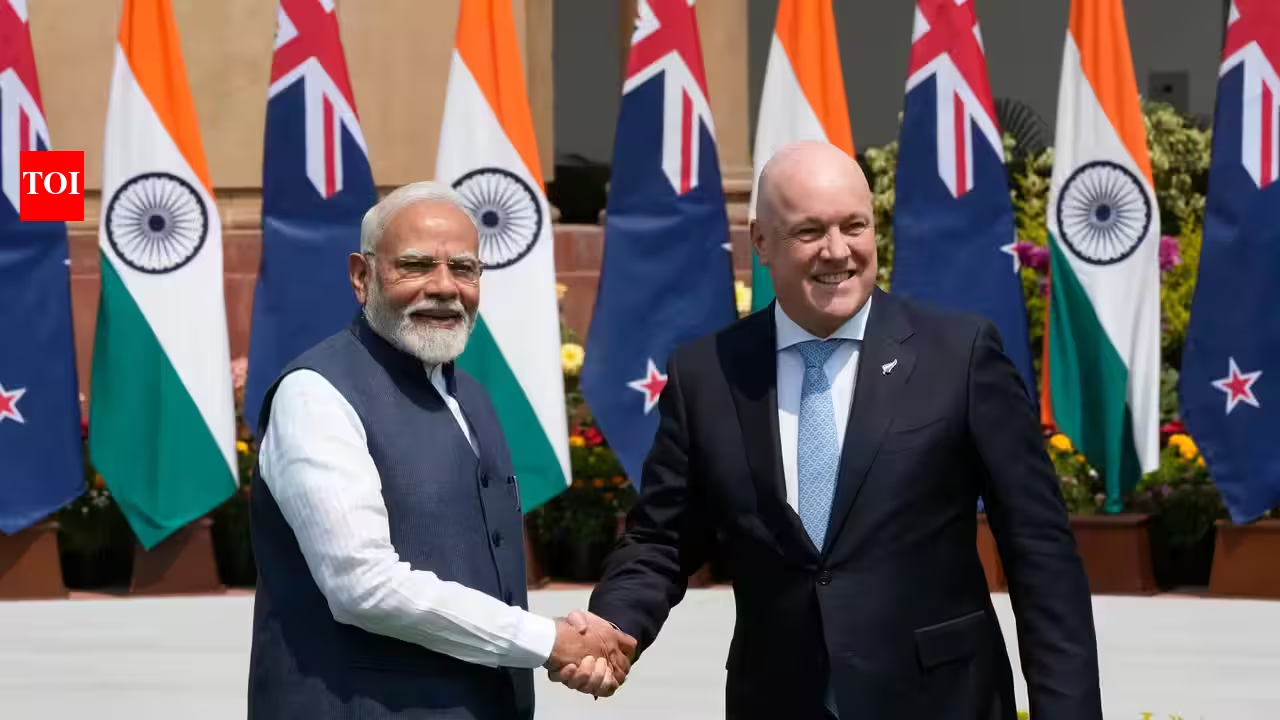
The free trade agreement between India and New Zealand came into force on October 20, 2026, giving all of India’s exports duty-free access to the New Zealand market from the first day, ThePrint reported. The pact was signed on April 27, 2026, after negotiations launched in 2010, stalled in 2015 and revived in March 2025. New Zealand has committed to invest 20 billion dollars in India over 15 years or more, and the two countries aim to double bilateral trade by 2030. It is India’s 17th operational trade agreement and the seventh implemented in five years, after those with the UAE, Mauritius, the EFTA bloc, the United Kingdom, Oman and Australia.
The argument that the deal will help Indian exporters is based on access and on the sectors named. Textiles and apparel, leather and footwear, engineering goods, auto components, gems and jewellery, agriculture, processed foods, pharmaceuticals and manufacturing are listed as beneficiaries, and 100 percent of Indian exports gain duty-free entry from day one. The investment pledge of 20 billion dollars over 15 years or more is large relative to current trade, and it gives the agreement a long-term dimension that goes beyond tariffs. The two sides took more than 15 years from the start of talks to reach a signed text, and their ability to implement it within six months of signing shows that both governments want the benefits to start quickly.
The argument that the immediate effect will be small starts with the size of the trade. Bilateral trade in 2025-26 was 1.15 billion dollars, down 11 percent from 1.3 billion dollars the year before, with Indian exports of 566.51 million dollars and imports of 589.1 million dollars, leaving India with a small deficit of 22.59 million dollars. New Zealand is therefore a very small trading partner, and even a doubling by 2030 would still leave New Zealand a small fraction of India’s overseas trade. The ThePrint report did not give details of the tariff lines opened on the New Zealand side, quotas or rules of origin, so the practical benefit to farmers and manufacturers on both sides cannot yet be measured, and the investment figure is a commitment, not money already spent.
The agreement matters because it shows how India has changed its approach to trade, signing and implementing seven agreements in five years after a long period of caution. For exporters of garments, leather goods and jewellery, access to a developed market on equal terms with competitors is useful, and for New Zealand it opens a large consumer market. The 20 billion dollar pledge, if it materialises, would be significant for sectors such as food processing and logistics. The wider message is that India is building a network of agreements with smaller, advanced economies while it negotiates larger ones. ThePrint put the new agreement alongside India’s other operational trade agreements and noted the target of doubling trade by 2030 from a base of 1.15 billion dollars.
The agreement is in force and the promises are large relative to current trade. The next two years of data will show whether they are met.




Leave a Reply