



Reflect Orbital, a US startup that plans to use satellites to reflect sunlight onto Earth at night, announced on 14 October 2026 that it has bought two dedicated launches from India’s Skyroot Aerospace, according to Via Satellite, PR Newswire and Deccan Chronicle. The first launch will use Skyroot’s Vikram-1 rocket and the second will use the larger Vikram-1U, which is still being developed. The financial value of the contract and the launch dates have not been disclosed.
Vikram-1 became the first privately developed Indian rocket to reach orbit when it lifted off from the Satish Dhawan Space Centre in Sriharikota on 18 July 2026, in a mission called Aagaman. It put its payload in an orbit of about 450 km about 15 minutes after lift-off, according to a search summary of ABC News and other reports. Skyroot was the first private company to reach orbit from Indian soil on its first attempt, according to the same reports.
Vikram-1 is designed to launch small satellites of up to 350 kg into low Earth orbit, according to Via Satellite. Vikram-1U has additional first-stage boosters and better performance than the standard rocket, but the announcement did not give figures for its performance. The reports reviewed do not give the date by which Vikram-1U is expected to be ready to fly.
Reflect Orbital wants to put two satellites in orbit during 2026, expand to more than 1,000 satellites by 2028 and possibly reach more than 50,000 in the future, according to Via Satellite. Its demonstration spacecraft, Earendil-1, received approval from the US Federal Communications Commission in July 2026. The company’s idea is to provide on-demand sunlight for services such as lighting disaster zones and extending the working hours of solar farms, according to Free Press Journal, which also reports concerns about effects on wildlife, human health and astronomy.
The reason for the Indian purchase is a shortage of launches. Reflect Orbital’s chief executive said: ‘There’s a real launch capacity shortage right now. We’re excited to work with a new launch provider, Skyroot, to help ensure access to space.’ Skyroot’s co-founder said the partnership would provide schedule certainty and mission flexibility, according to the same report.
For Skyroot, a foreign customer is a commercial milestone. The company raised about $60 million in May 2026 at a valuation of about $1.1 billion, becoming India’s first space-technology unicorn, according to Lapaas Voice, which also mentions discussions about raising $300 million at a valuation of $3 billion. The second of those figures is a report of talks and not a completed deal.
The deal also shows the effect of opening Indian space launch to private companies. A search summary of SpaceDaily describes Vikram-1 as the visible result of six years of reforms that opened orbital launch to private builders alongside ISRO. The detail of those reforms is not in the reports reviewed.
There are risks for both sides. A start-up customer depends on its own satellites and regulatory approvals, and a rocket that is still in development might be delayed. The reports do not discuss the risks, and the contract may be changed, so the launch dates are not known.
IndiaX24 will report when the first launch date for Reflect Orbital’s satellite on Vikram-1 is announced.
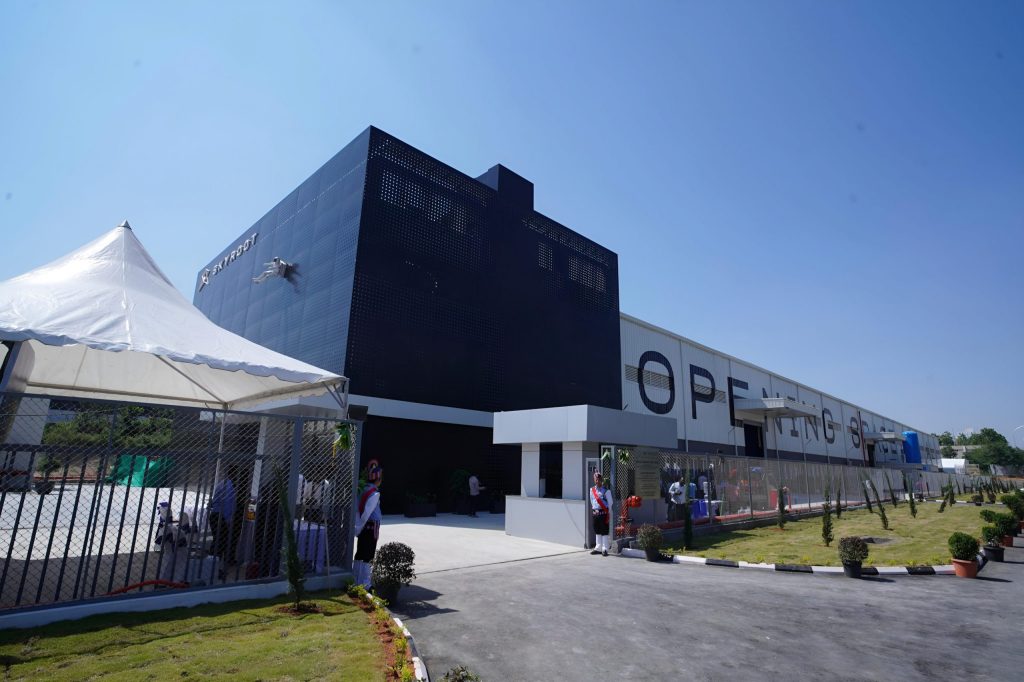
Image: The Skyroot Aerospace headquarters (file photo). Photo by Anmollshrma, licensed under CC0, via Wikimedia Commons.