


The Union Cabinet, chaired by Prime Minister Narendra Modi, approved India Semiconductor Mission 2.0 on 15 July 2026 with a total outlay of Rs 1.27 lakh crore. Information technology minister Ashwini Vaishnaw said the new phase covers the whole semiconductor value chain, organised into six pillars with chip design as the first, and includes incentives for suppliers of raw materials such as minerals and gases. The government wants India to reach self-reliance in indigenous chip production by the end of the programme. The approval came while the world faces a shortage of memory chips, and it follows the first mission, which was allocated Rs 76,000 crore.
The argument that the new mission is justified rests on what the first one delivered. Under the first mission the government approved 12 semiconductor projects across six states, with cumulative investment commitments of more than Rs 1.64 lakh crore, covering chip fabrication, display fabrication and advanced packaging. Three of these facilities have already started commercial production, which shows that the money is turning into output and not only announcements. For the second phase the government expects investment of about Rs 4 lakh crore and semiconductor production worth about Rs 2 lakh crore during the scheme period. Supporters add that a mission aimed at design, materials and chips for artificial intelligence devices fills the gaps that the first phase, which focused on plants, left open.
The argument for caution is that the results so far are narrower than the headline numbers. Only three of the 12 approved projects, or one in four, have begun commercial production, so most of the Rs 1.64 lakh crore is still a commitment and not a working factory. Most of that investment came from a single group, Tata Electronics and its semiconductor arm, which means the success of the first mission depends heavily on one company. The new mission is also larger than the old one, at Rs 1.27 lakh crore against Rs 76,000 crore, yet its expected production of about Rs 2 lakh crore is smaller than the Rs 4 lakh crore of investment it hopes to attract. Critics say that a gap between spending and output of this size needs close monitoring, especially in an industry where costs are high and global competition is intense.
The mission matters because chips sit at the centre of phones, cars, defence systems and artificial intelligence, and a country that imports all of them is exposed to supply shocks. India's wider electronics manufacturing sector already provides about 2.5 million jobs, and a domestic chip industry could add higher paying work in design and fabrication. If it succeeds, it would lower the country's dependence on a few foreign suppliers and give states such as Gujarat a base for industrial growth. If it falls short, the cost will be seen in unused plants and a larger import bill.
The Cabinet has made a large second bet on semiconductors after a first phase that is only partly complete. The next test is whether more of the 12 approved plants reach production, and whether the new money brings in suppliers and designers beyond one dominant investor.
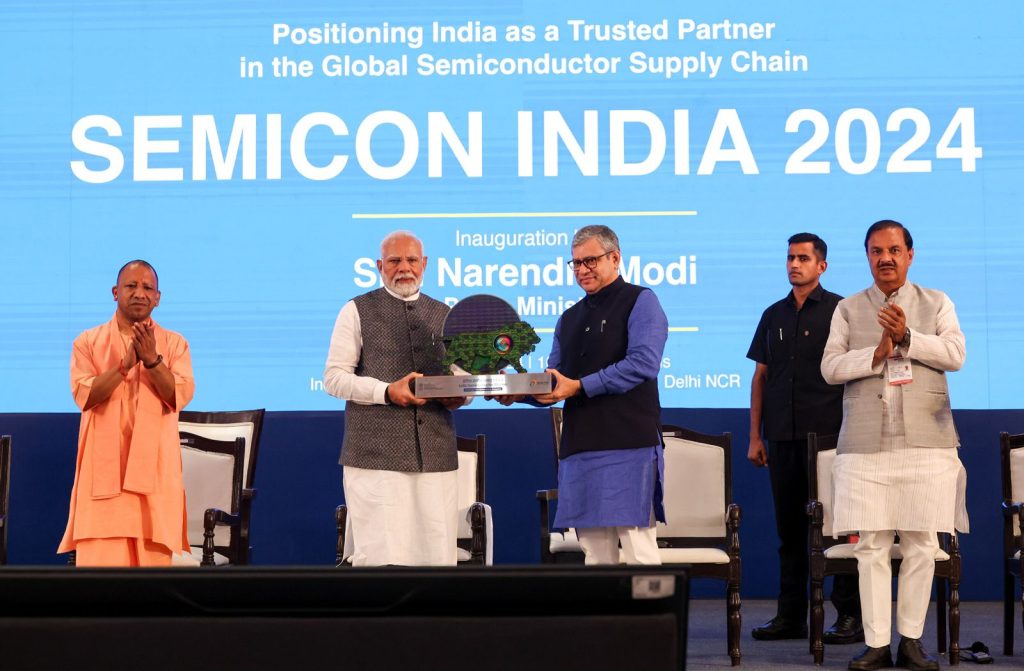
Featured image: Prime Minister Narendra Modi and Union Minister Ashwini Vaishnaw at Semicon India 2024 (file photo from an earlier edition). Photo: DisplayEcosystem, CC BY-SA 4.0, via Wikimedia Commons.