



ISRO has a long list of missions approved or under way, and a report by RVCJ Media sets out their stated timelines as of October 2026. The list is led by the Gaganyaan programme, which is covered in a separate IndiaX24 article, but it includes lunar, Venus and space station missions that were approved by the Union Cabinet in September 2024.
Chandrayaan-4 is a lunar sample return mission. It was approved in September 2024 at a cost of Rs 2,104.06 crore and is expected around 2028, according to the report, with studies of landing sites under way near Mons Mouton. A sample return mission has to land, collect material, launch from the Moon and bring the sample back to Earth, which makes it much more complex than the earlier Chandrayaan missions.
Shukrayaan is a Venus orbiter. It was approved in September 2024 at Rs 1,236 crore and has a launch window in March 2028, according to the report. Chandrayaan-5, also called LUPEX, is a joint mission with Japan’s space agency JAXA, and the report says that no launch date has been fixed for it.
The Bharatiya Antariksh Station is India’s planned space station. The report gives the timeline as the first module, called BAS-1, by 2028 and the full station by 2035, with Cabinet approval in September 2024 and a cost described as part of the Rs 20,193 crore Gaganyaan expansion. It is hard to be sure how that cost is split, and the report does not give a separate figure for the station.
The Gaganyaan flights come first. The uncrewed G1 flight is expected within calendar year 2026, according to the ISRO chairman’s statement of September 2026, while G2 and G3 are expected in 2027. The first crewed flight, H1, had a previous target of early 2027 and has no firm date as of October 2026, since it depends on the results of the uncrewed tests.
There are completed missions and other programmes in the report. NISAR, the joint satellite mission with NASA, was launched on 30 July 2025, and public releases of its data began in July 2026. The report also mentions the NVS-03 navigation satellite for the NavIC system and a new heavy-lift rocket called the Next Generation Launch Vehicle, approved in September 2024.
Adding the approved costs gives a sense of the scale. The two named missions, Chandrayaan-4 and Shukrayaan, come to about Rs 3,340 crore together, which is IndiaX24’s sum of the two figures, and the Gaganyaan expansion is much larger at Rs 20,193 crore. These are approved outlays and not what has been spent.
The timelines in the report are targets, and Indian space projects have often been delayed, as the history of the Gaganyaan G1 flight shows. The report does not describe the risks to each mission, so the dates should be treated as goals.
Taken together the schedule shows ISRO aiming at a crewed spaceflight, a lunar sample return, a Venus mission and a space station in the same few years, with the next real milestone being the Gaganyaan G1 test flight.
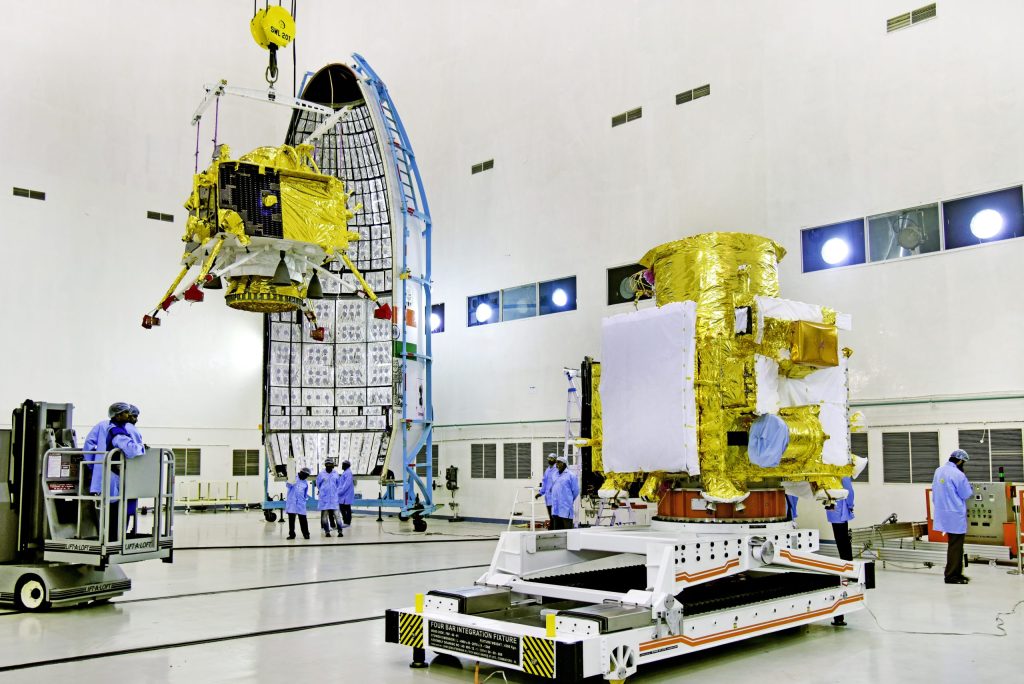
Featured image: The Vikram lander of Chandrayaan-2 being hoisted during preparation (file photo; a past ISRO lunar mission). Photo by Indian Space Research Organisation, licensed under Government Open Data License – India, via Wikimedia Commons.