


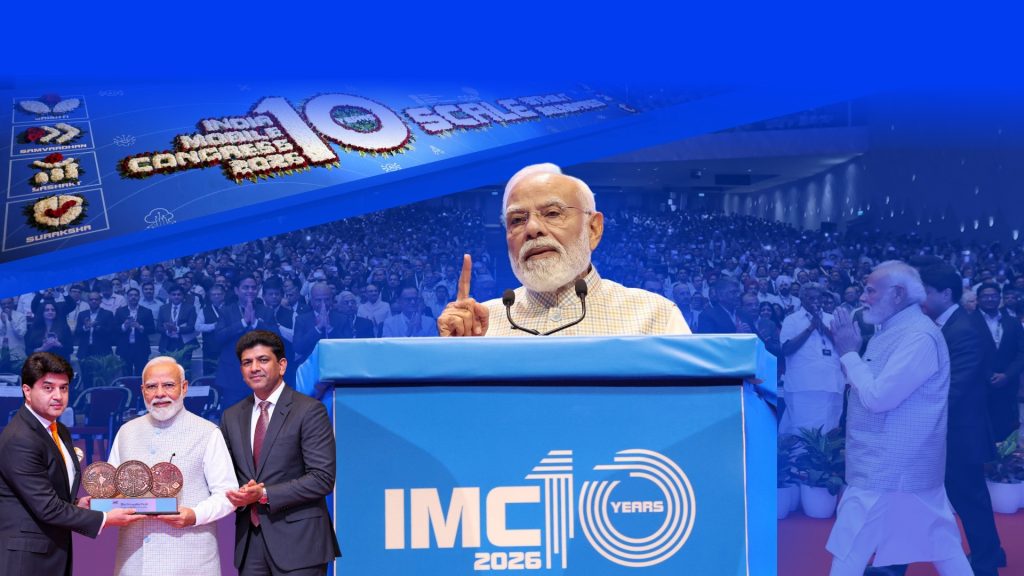
The tenth India Mobile Congress ran from 7 to 10 October 2026 at Yashobhoomi in New Delhi under the theme "Scale Without Boundaries", organised jointly by the Department of Telecommunications and the Cellular Operators Association of India. Organisers and coverage listed 6G, artificial intelligence, AI-native networks, satellite communications, semiconductors, quantum communications and cybersecurity as the main themes. The government reported more than 2,000 use cases and more than 400 startups, according to Telecom Unpacked. Communications Minister Jyotiraditya Scindia said India's data is among the cheapest in the world, at Rs 8 a gigabyte now against Rs 268 in 2014, and that average monthly use per customer has risen from 0.26 GB to 36 GB.
The argument that India is positioning itself well for 6G rests on the numbers presented. The Bharat 6G Alliance has 90 institutions and 7,700 patents, of which 4,400, or about 57 percent, are international. India had 1.31 billion wireless subscribers in August 2026, according to TRAI data, which gives operators a very large base on which to try new services. The operators showed concrete work: Reliance Jio presented a Giga MIMO radio designed for 5G and future 6G, and a Call Agent, an AI voice agent built into the network, according to Telecom Unpacked. Airtel emphasised sovereign cloud and managed security, Vodafone Idea previewed Vinzy, a regional-language AI assistant, and BSNL announced a government messaging platform, Bharat Sandesh. The 2026 programme had nine anchor sectors, including 5G and 6G, AI networks, semiconductors, non-terrestrial networks, cyber security and quantum communication, and four new sectors: smart mobility, stadium experiences, industrial robotics and transport technology.
The argument for caution is that a showcase is not a launch. Telecom Unpacked notes that many announcements were prototypes or research projects, and Jio's Call Agent came with no launch date or price in the sources reviewed. Jio's claim of more than 8,000 patents and 934 standards contributions is a company figure, and the same report says it does not predict influence over 6G, since standards are set by international bodies in which many companies take part. A count of 7,700 patents says little about whether Indian technology will be adopted in the global standard. BSNL's plan with Fujitsu on optical networks was an expression of intent, which is a preliminary statement and not a contract. Reports on the event do not give a figure for the value of agreements signed.
The event matters because the telecom network underpins digital payments, public services and a growing share of the economy. The fall in data prices from Rs 268 to Rs 8 a gigabyte helped bring hundreds of millions of people online, and the shift to 6G and AI-run networks will decide whether the next stage is cheap as well. For the industry, the Congress is where deals are made and policy is signalled, and its widening list of themes, from satellite broadband to robotics, shows that telecom is now treated as a platform for other sectors. The Congress has grown from its first edition in September 2017, which had about 2,000 delegates and 32,000 visitors, into a forum of this scale.
India's telecom story is one of scale and low prices, but 6G leadership will be settled in standards bodies and in the market, not on an exhibition floor.