


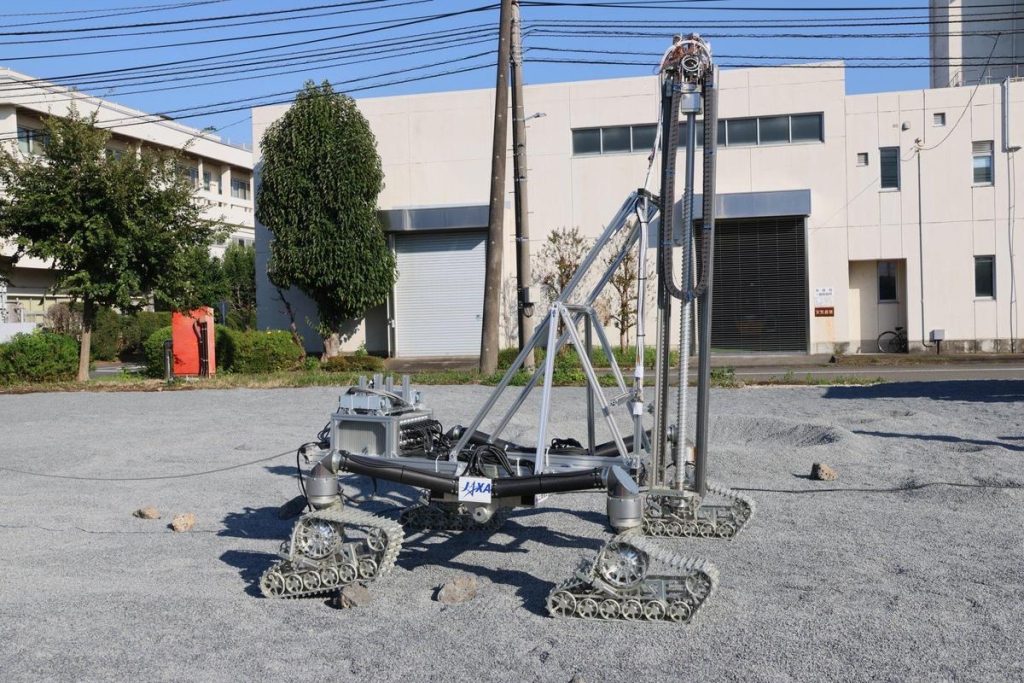
The Japan Aerospace Exploration Agency (JAXA) has unveiled the prototype of the rover for the Chandrayaan-5/LUPEX (LUnar Polar EXploration) mission, a joint project with the Indian Space Research Organisation (ISRO) that is intended to find out how much water lies hidden near the Moon's south pole. According to The Hindu, JAXA showed the rover at its Chofu Aerospace Centre in Japan on 25 November 2026 and carried out a test demonstration. The unveiling took place in Japan, not in India, since the rover is the Japanese contribution to a mission that splits the hardware between the two countries. It is the clearest public look yet at the machine that will, if all goes to plan, drive across the lunar polar terrain later this decade.
The mission is the fifth in India's Chandrayaan series. Chandrayaan-1 was launched in 2008, Chandrayaan-2, an orbiter-based mission, in 2019, and Chandrayaan-3, a lander-and-rover mission, in 2023. The Hindu notes that Chandrayaan-4, India's first lunar sample-return mission, is yet to be launched. Chandrayaan-5/LUPEX will study lunar volatile materials, including lunar water, in the vicinity of a permanently shadowed region at the Moon's south pole. The Union government gave its approval for the mission on 10 March 2025 in the form of a financial sanction. It is scheduled for launch in 2028 on Japan's H3-24L launch vehicle.
The division of labour is central to the project. JAXA is developing the rover and the launch vehicle, while ISRO is developing the lunar lander and a few of the scientific instruments, according to The Hindu. JAXA's own description of the mission says Japan will be responsible for the development and operation of the launch vehicle and rover, and India for the development and operation of the lander. The rover will carry Japanese, Indian, American and European instruments. ISRO said earlier that the scientific instruments for the mission would be contributed by ISRO, JAXA, the European Space Agency (ESA) and NASA, all connected to the exploration and in-situ analysis of volatiles in the lunar polar region.
Two of those instruments have been named. NASA's Neutron Spectrometer is a neutron detector designed to search for water beneath the lunar surface, according to the Japanese space agency, and it will be carried on the rover. ESA's Exploration Mass Spectrometer for LUPEX (EMS-L) will study the Moon's extremely thin exosphere, which the ESA describes as a tenuous mist of atoms and molecules surrounding the lunar surface. JAXA's mission page lists further instruments, including a water analyser called REIWA, an imaging spectrometer and an instrument named PRATHIMA, which stands for Permittivity and Thermophysical Investigation for Moon's Aquatic Scout. Together they are meant to map where water ice is, what form it takes and how much there is.
Why water? JAXA says the objective of LUPEX is to collect data on the quantity and quality of lunar water resources and on the principles governing their concentration, so as to determine how far they can be used for future sustainable exploration. Water is widely seen as the key resource for any lasting presence on the Moon, since it can support life and be turned into fuel. According to JAXA's description of how the rover will work, a global path will be planned in advance from the landing site to areas of interest chosen for their temperature, illumination and geology. The rover will move there, carry out a coarse observation to decide where to drill, and then a fine observation in which it will collect samples of regolith from the surface to a depth of about 1.5 metres, which the REIWA analyser will study to determine the distribution, forms and abundance of water ice. Between tasks it will stop to recharge its batteries.
What does India gain? The Hindu describes the mission as a precursor to ISRO's lunar sample-return mission and to plans to send the first Indian to the Moon by 2040. Building the lander for a polar landing extends the capability India showed with Chandrayaan-3, which put a lander and rover on the Moon in 2023, and it does so in partnership with a space agency that is supplying a rover and a heavy-lift launcher. For ISRO, working with JAXA also means sharing the cost and the technical risk of a more demanding mission than any it has flown alone.
There are risks and open questions that are worth stating plainly. A polar landing is harder than an equatorial one: the Sun sits low on the horizon, shadows are long and deep, and temperatures in permanently shadowed regions are extremely cold. The rover must therefore plan its route and manage power carefully, which is why JAXA's plan emphasises waypoints and recharging. The 2028 launch date is a schedule target, and mission dates in lunar exploration have a history of slipping, so the date should be read as a goal rather than a guarantee. The joint nature of the mission also means that a delay in any one of the lander, the rover, the launcher or the instruments from four agencies can affect the whole. And the prototype shown at Chofu is just that: a demonstration vehicle in a test environment, not the flight model.
Still, the unveiling matters for a few reasons. It shows that the partnership approved in 2025 has moved from paper to hardware, with the rover now running on a test field. It gives ISRO and JAXA a milestone to point to ahead of the 2028 launch window. And it signals how India's space programme is evolving, from independent missions towards international collaborations in which it provides a major element, here the lander and some instruments, alongside partners from Japan, the United States and Europe.
For readers following the programme, the next things to watch are integration tests of the lander and rover, the final selection of the landing site near the south pole, and any change to the launch schedule. If the mission succeeds, it will tell scientists whether the water ice that orbiters have suggested at the poles is present in quantities that make it worth using. That answer will shape the plans of every space agency that hopes to build a base on the Moon, and it will give India a central role in finding it.