


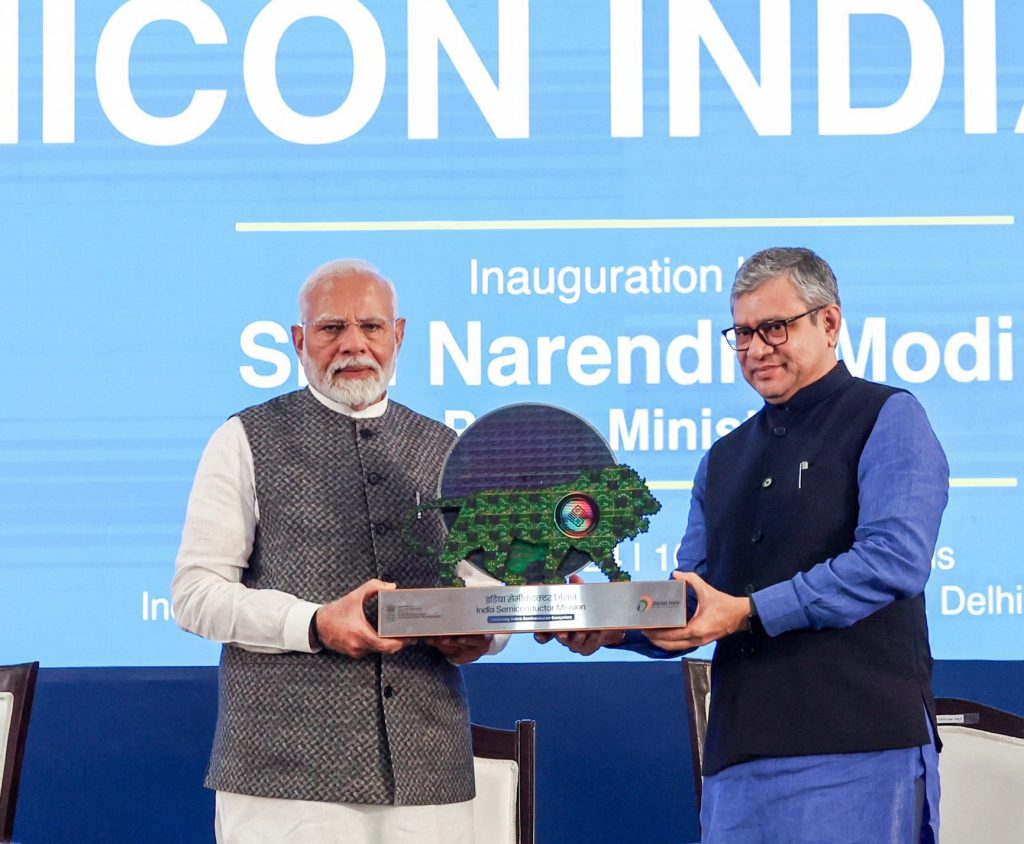
The Union Cabinet approved seven decisions with a combined outlay of Rs 2,19,353 crore on 15 July 2026, and two of them were aimed at electronics manufacturing. Semicon 2.0, the second phase of the Semiconductor Mission, was cleared with an outlay of Rs 1,27,500 crore, and the Mobile Phone Manufacturing Scheme with Rs 62,500 crore. Together they account for Rs 1,90,000 crore, or about 87 percent of the total. The other decisions were two elevated corridors in Varanasi along the Varuna and Ganga rivers, costing Rs 10,998 crore and Rs 14,448 crore, a National Investment Policy for Urea-2026, and two railway projects costing Rs 2,542 crore and Rs 1,365 crore. Railway Minister Ashwini Vaishnaw briefed the media.
The argument that Semicon 2.0 is a major commitment is based on the size of the outlay. At Rs 1,27,500 crore it is the largest single decision of the day, and it follows the first phase of the mission, under which 12 semiconductor projects across six states have been approved with committed investment of more than Rs 1.64 lakh crore. The mobile manufacturing scheme, at Rs 62,500 crore, extends support to one of the sectors where India has built a large production base. The decisions are linked to the goal of reducing dependence on imported chips and components, a theme that DRDO has also highlighted in its roadmap. The urea policy, which carries no financial allocation, aims to make India self-reliant in urea production, which shows that the Cabinet was also taking decisions on inputs for agriculture.
The counter-argument is that outlays are not outcomes. The announcement of the decisions gave no targets, durations, job numbers or expected output for any of the schemes, so it is hard to say what the money will deliver. Semiconductor manufacturing is capital-intensive and technically difficult, and the roadmaps point to mature nodes such as 28 nm as the near-term goal, with the frontier of 2 nm in 2047. A scheme of this size also has to be matched by private investment, trained people, reliable power and water, and a supply of materials, none of which are covered by the outlay alone. The Rs 62,500 crore for mobile phones continues government support for the sector, and the effect on exports and domestic value addition will have to be measured over time. The infrastructure items, such as the Varanasi corridors, are costed at Rs 10,998 crore and Rs 14,448 crore and are unrelated to technology.
The package matters because electronics is among the fastest-growing sources of manufacturing and exports, and chips are a strategic input for everything from phones to defence systems. A strong domestic base would reduce exposure to supply shocks, as the country has seen with crude oil prices above 110 dollars a barrel. For states, the decision means competition for the plants and suppliers that will use the funds, and for workers it means demand for engineers and technicians.
The Cabinet has committed large sums to chips and phones, and the details of how they will be spent will matter more than the headline numbers. The implementation, and the plants that start production, will be the real test.