


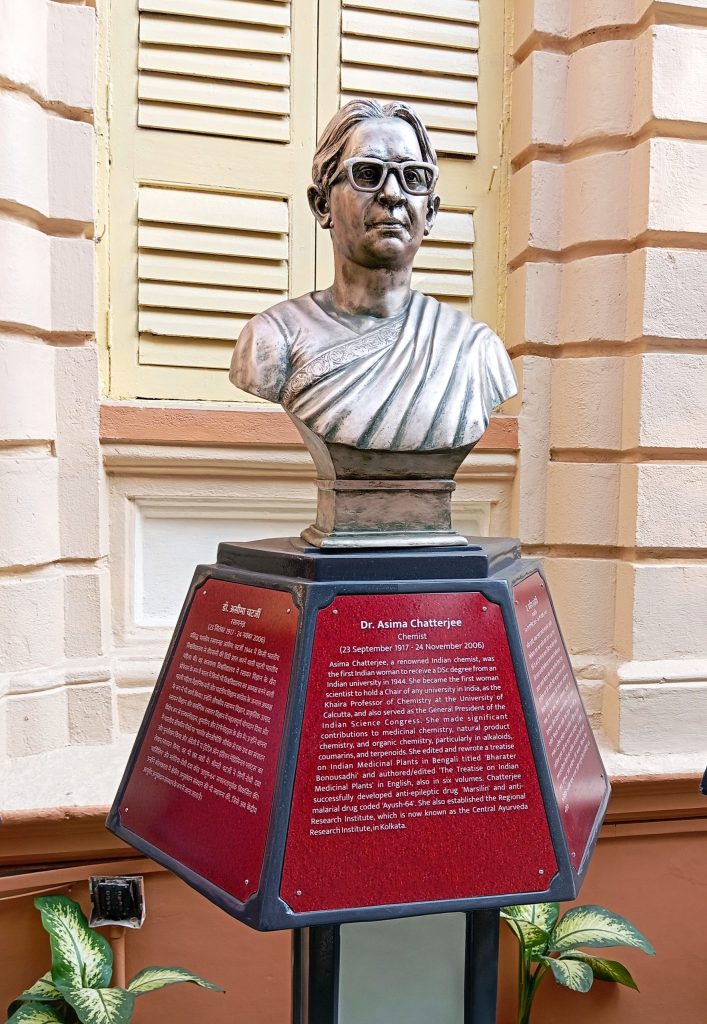

Asima Chatterjee (23 September 1917 – 22 November 2006) was an Indian organic chemist who studied the chemistry of medicinal plants. She was the first woman to be awarded a Doctor of Science by an Indian university, and her work led to drugs for epilepsy and malaria made from plants used in traditional medicine.
Quick Facts
| Full name | Asima Chatterjee (née Mukherjee) |
| Born | 23 September 1917, Calcutta |
| Died | 22 November 2006, Kolkata (aged 89) |
| Field | Organic chemistry, phytomedicine |
| Education | Scottish Church College; University of Calcutta (M.Sc., 1938; D.Sc., 1944) |
| Known for | Chemistry of plant alkaloids and coumarins; anti-epileptic and anti-malarial drugs |
| Position | Khaira Professor of Chemistry, University of Calcutta (1962–1982) |
| Honours | Shanti Swarup Bhatnagar Prize (1961), Padma Bhushan (1975) |
| Other | Nominated member of the Rajya Sabha (1982–1990) |
| Spouse | Baradananda Chatterjee (m. 1945) |
| Children | 1 |
Early Life
She was born in Calcutta, the elder of two children of Dr Indra Narayan Mukherjee, a physician, and Kamala Devi. Her father was an amateur botanist, and she traced her interest in medicinal plants to him. The family, unusually for the time, encouraged her to study science.
Education
She graduated with honours in chemistry from Scottish Church College in 1936 and took her M.Sc. in organic chemistry from the University of Calcutta in 1938. She did her doctoral research on the chemistry of plant products, working under the chemist Prafulla Kumar Bose, and in 1944 became the first woman to receive the D.Sc. of an Indian university.
Career
Teaching
In 1940 she founded the chemistry department of Lady Brabourne College in Calcutta. She joined the University of Calcutta in 1954 and in 1962 was appointed Khaira Professor of Chemistry, one of the most distinguished chairs in the university. She held it until 1982.
Abroad
Between 1947 and 1950 she worked in the United States, at the University of Wisconsin and the California Institute of Technology, and in Zurich with the Nobel laureate Paul Karrer.
Research
Working with little money and equipment, she studied the compounds found in Indian medicinal plants.
- **Alkaloids:** She worked out the structures of alkaloids from plants such as Rauwolfia and of the vinca alkaloids of the periwinkle, a family of compounds used against cancer.
- **Epilepsy:** From the aquatic fern Marsilea minuta she developed an anti-epileptic preparation, later marketed as Ayush-56.
- **Malaria:** She developed an anti-malarial preparation from Alstonia scholaris and other plants.
- **Coumarins:** She studied this class of plant compounds in the bael tree and others.
She published about 400 papers and edited a six-volume work on Indian medicinal plants.
Recognition
- **1960:** Fellow of the Indian National Science Academy
- **1961:** Shanti Swarup Bhatnagar Prize in chemical sciences, the first woman to receive it
- **1975:** Padma Bhushan; in the same year she became the first woman elected General President of the Indian Science Congress
- **1982–1990:** member of the Rajya Sabha, nominated by the President
Personal Life
She married Baradananda Chatterjee, a physical chemist, in 1945. Their daughter, Julie, also became a professor of chemistry. She worked in her laboratory into her eighties and died in Kolkata in 2006.
Legacy
She established a regional research institute for Ayurveda in Kolkata and trained many of the next generation of Indian natural-product chemists.
Featured image: A bust of Asima Chatterjee at the Birla Industrial and Technological Museum, Kolkata. Photo by Salil Kumar Mukherjee, licensed under CC BY-SA 4.0, via Wikimedia Commons.