


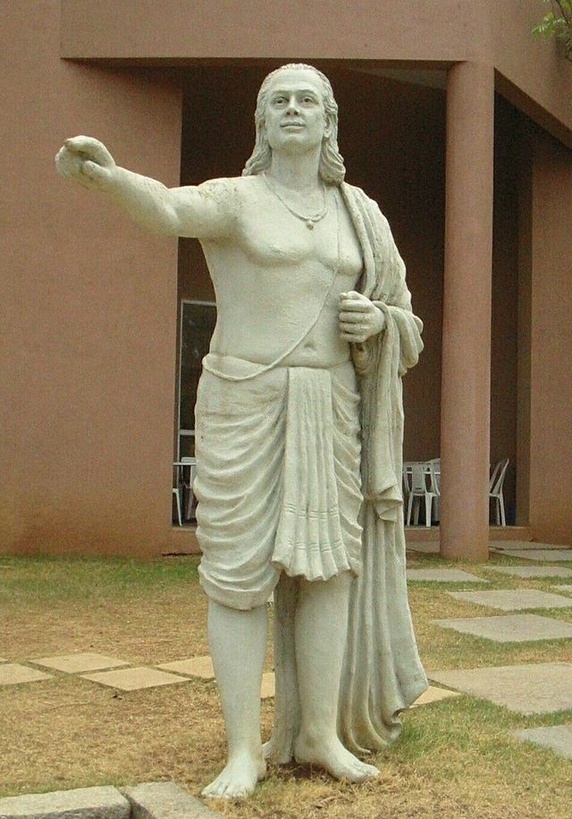

Aryabhata (476 – about 550 CE) was the first of the great mathematician-astronomers of classical India. In a short book in Sanskrit verse, the Aryabhatiya, written when he was twenty-three, he gave a remarkably accurate value of pi, a table of sines, methods for solving equations, and a system of astronomy in which the earth is a sphere that rotates on its axis. India’s first satellite was named after him.
Quick Facts
| Born | 476 CE |
| Died | about 550 CE |
| Worked at | Kusumapura (Pataliputra, modern Patna) |
| Field | Mathematics, astronomy |
| Major work | Aryabhatiya (499 CE) |
| Known for | Approximation of pi; sine table; rotation of the earth; explanation of eclipses; solution of indeterminate equations |
| Era | Gupta period |
Life
Very little is known of his life. He states in his book that he was twenty-three years old when 3,600 years of the Kali age had passed, which gives 476 CE for his birth and 499 for the work. He says that he sets out the knowledge honoured at Kusumapura, generally identified with Pataliputra, the capital of the Gupta empire, where he seems to have lived and taught. A later commentator calls him a native of Ashmaka, a region of the Deccan; some scholars place his origin in Kerala. Tradition connects him with the university at Nalanda.
The Aryabhatiya
The book has 121 verses in four sections: a table of astronomical constants; mathematics; the reckoning of time; and the sphere. It is extremely condensed, a set of rules to be memorised and explained by a teacher. He also devised a way of writing numbers as syllables so that large figures could be fitted into verse.
Mathematics
- **Pi:** he states that a circle of diameter 20,000 has a circumference of 62,832, which gives 3.1416, correct to four decimal places. He calls the value “approaching”, which suggests he knew it could not be exact.
- **Sines:** he gave a table of sines for every 3¾ degrees, and a rule for calculating them. The Sanskrit word he used, passing through Arabic into Latin, became “sine”.
- **Place value:** his methods of calculation assume the decimal place-value system. He did not use a symbol for zero in the surviving text, though the system implies one.
- **Arithmetic and algebra:** square and cube roots, the areas of triangles and circles, the sums of series of numbers, squares and cubes
- **Indeterminate equations:** a general method, later called the kuttaka or “pulveriser”, for finding whole-number solutions of equations of the form ax + by = c
Astronomy
- **The rotating earth:** he taught that the earth is a sphere turning on its axis once a day, and that the stars only seem to move, as the bank seems to move backwards to a man in a boat. Most later Indian astronomers rejected this.
- **Eclipses:** he explained them as shadows, the moon passing into the earth’s shadow or coming between the earth and the sun, and set aside the myth of the demon Rahu
- **The moon and planets:** he said they shine by reflected sunlight
- **Measurements:** his length for the year and his figure for the circumference of the earth were close to the true values
His planetary theory kept the earth at the centre, with the planets moving on epicycles. The claim sometimes made that he proposed a sun-centred system is not accepted by most historians.
Influence
A second work, the Arya-siddhanta, is lost. The Aryabhatiya was studied and commented on for a thousand years, by Bhaskara I, by his critic Brahmagupta, and by the astronomers of Kerala. Translated into Arabic in the eighth century, his methods influenced the mathematics of the Islamic world and, through it, of Europe.
Legacy
India’s first satellite, launched on 19 April 1975 under U. R. Rao, was named Aryabhata. A research institute of observational sciences at Nainital and a crater on the moon also bear his name.
Featured image: A modern statue of Aryabhata; no likeness from his own time exists. Photo by Cpjha13, licensed under CC BY-SA 4.0, via Wikimedia Commons.