


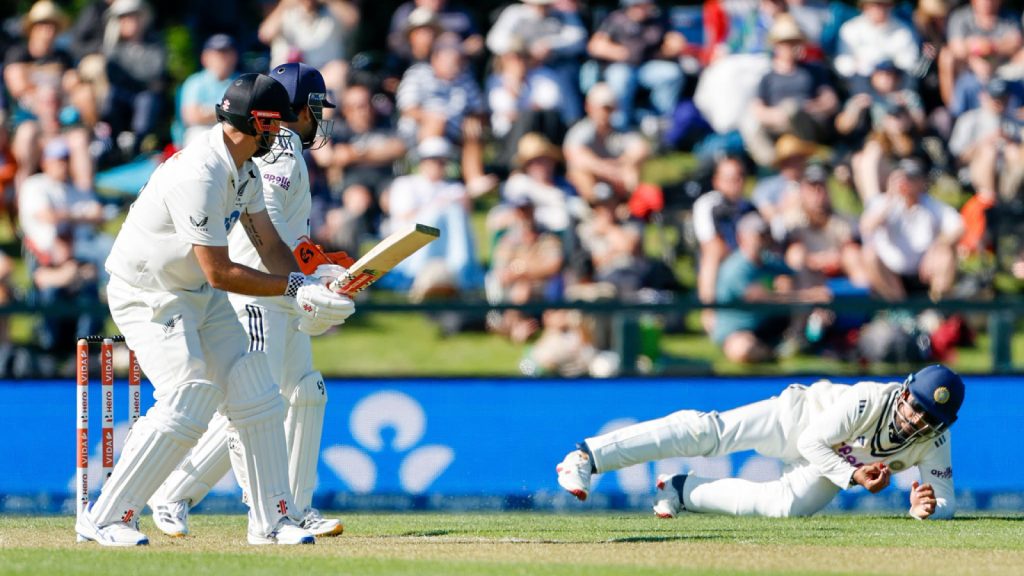
India ended the second day of the second Test against New Zealand at Hagley Oval, Christchurch, on Saturday, 28 November 2026, in a precarious position at 116 for six, still trailing New Zealand's first-innings total of 356 by 240 runs. Akash Deep had done his bit by completing a five-wicket haul that bowled the hosts out, but when the visitors needed their batters to respond, three loose shots and a disciplined New Zealand pace attack, backed by superb catching, left them facing the danger of a heavy defeat in what is effectively a series decider. Dhruv Jurel is unbeaten on 7 and will have to lead the effort on Sunday, according to The Hindu's report.
The Test began with plenty of promise for India. Captain Shubman Gill, winning the toss for the 11th time in his 12 Tests, chose to bowl, hoping to exploit moisture in a surface that had been affected by rain in the days before the match. The first Test at Wellington's Basin Reserve had been drawn, so the series was level and the second and final Test carried everything. India handed a debut to Gurnoor Brar, who became India's 321st Test cricketer, in place of Prasidh Krishna. On day one, New Zealand reached 246 for five at stumps, with Tom Blundell unbeaten on 53 and Glenn Phillips on 36, after India had reduced them from 110 for one to 110 for four in 16 deliveries thanks largely to a spell of 7-4-7-2 from Akash Deep.
Day two began with India hoping to wrap up the innings quickly. Akash did complete a deserving five-wicket haul, but the hosts' lower order ensured India had to work harder than expected. Blundell, resuming on 53, fell 11 short of a century when he top-edged a pull off Gurnoor Brar to Akash at long-leg; his 89, from 211 balls with 10 fours, provided the backbone to the New Zealand innings. Akash then had Matt Henry caught behind to finish with five wickets. India's fielding, however, continued to let the side down. Henry was given two reprieves: Devdutt Padikkal dropped a straightforward chance at gully before lunch, and Brar put down a regulation catch at deepish mid-on, leaving Akash visibly frustrated. New Zealand added 26 runs in the second session before being bowled out for 356, 40 minutes after lunch. Akash finished with 5 for 99 from 31.3 overs, Brar and Anshul Kamboj took two each and Washington Sundar one. Jasprit Bumrah, who bowled 26 overs for 49 runs, remained wicketless.
That wicketless run was one of the stories of the match. The Hindu noted that Bumrah going wicketless in an away Test is a rarity, and doing so through two consecutive innings even rarer; on day one he went through a 220-ball wicketless spell. The talking point was a change in his run-up. At times in the second session he took longer strides than usual, and sometimes he stretched his arms ahead of his body while running in, instead of hiding the ball with both hands as he usually does. Old footage of him bowling in a similar way in the Vijay Hazare Trophy final in December 2015 surfaced on social media. Akash Deep said after the day's play that Bumrah had been practising it before the match. "He is Jasprit Bumrah. If he is doing something, there has to be a reason for it, right?" Akash said. Bumrah's experiment did not produce a wicket in the New Zealand innings.
India's reply began disastrously. Henry struck in the opening over, bowling Yashasvi Jaiswal for a duck. Padikkal then chased a wide delivery and edged behind for 21. K.L. Rahul and Gill tried to rebuild, but Kyle Jamieson found the outside edge of Gill's angled bat off the final ball before tea, and Tom Latham completed the catch in the slips as India went into the break at 59 for three. Rahul, who had looked assured, scored 25 before miscueing a square drive to point off Jacob Duffy.
Rishabh Pant tried to unsettle Jamieson by charging down the track and missing his first delivery, then mixed cautious defence with calculated aggression before a wild heave off Duffy brought his downfall for 23. Jamieson, stationed at point, held a difficult skier. Washington Sundar, who made 10, was caught in the slips off Nathan Smith to the final delivery of the day, leaving India at 116 for six. Jurel survived a series of close calls, including a difficult chance at third slip that Phillips failed to hold in the penultimate over, and several edges that fell short of the cordon.
The Hindu's assessment was that the New Zealand pacers were markedly more disciplined than their Indian counterparts. Apart from Akash, the Indian bowlers often strayed too wide or too short, while Henry, Jamieson and Duffy consistently made the batters play, drawing edges and keeping the pressure on. The scorecard backs that up: Henry took 1 for 29 from 13 overs, Jamieson 2 for 33 from 13, Smith 1 for 29 from 12 and Duffy 2 for 21 from 8. New Zealand's innings, in contrast, included 28 extras, 13 of them no-balls, which points to a lack of discipline in India's bowling and in its fielding.
The follow-on is now a live question. Under the usual rule for Tests of this length, a side that trails by 200 or more runs can be asked to bat again, which means India need to add at least 41 more runs to take their total beyond 156 and avoid that fate. Jurel and the lower order will have to manage that, and the Hindu's verdict is that after a promising fightback with the ball, India has allowed the hosts to seize control of the Test. Beyond avoiding the follow-on, the visitors need to find a way to counter an attack that has so far been far more consistent.
The stakes are considerable. India are pursuing a Test series victory in New Zealand for the first time in 17 years, and they also want to keep alive their outside hopes of reaching the World Test Championship final. With the first Test drawn, a loss here would cost them the series. The Hindu's preview said New Zealand have six Tests scheduled over eight weeks, beginning in Wellington, and Latham, who had registered a pair in Wellington against Bumrah, scored 59 on this occasion, a reminder of how quickly fortunes change in the longer format.
The match can still turn. On a pitch that has offered movement to the pacers, a first-innings deficit of the kind India now face is not unprecedented in the history of the game, and Akash's five wickets show the surface has something for the bowlers on both sides. But on the evidence of day two, New Zealand hold the advantage, and India's response on Sunday morning, led by Jurel and the lower order, will decide whether this Test remains a contest.