


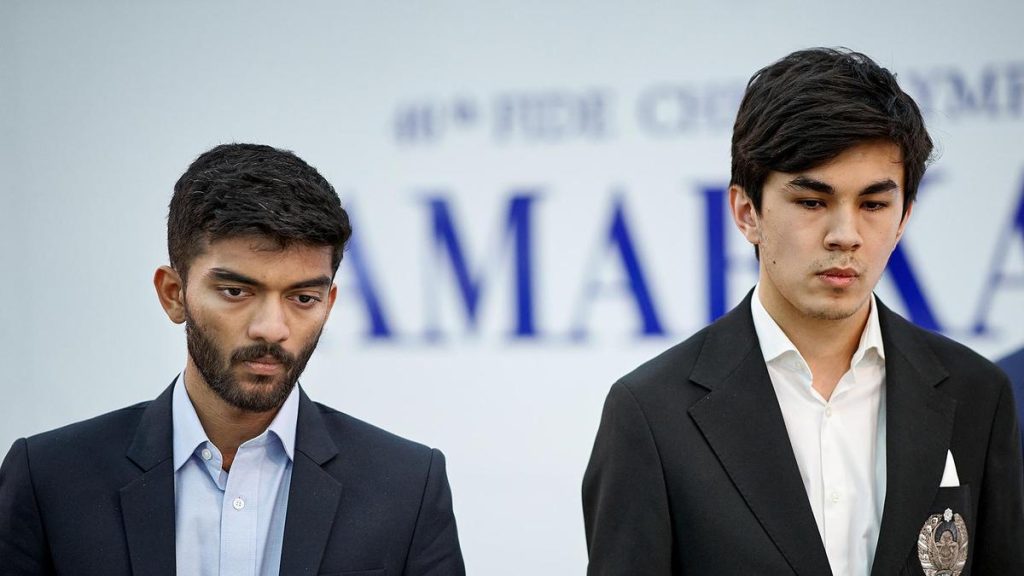
When the Salesforce FIDE World Chess Championship match begins in Geneva on Tuesday, November 24, 2026, the defending champion will arrive carrying both a title and a question mark. D. Gukesh won the crown by defeating China's Ding Liren in the 2024 World Championship match, but his results since then have been well below his usual standard. Across the board will be Uzbekistan's Javokhir Sindarov, whose recent run has included victories in the World Cup and the Candidates tournament. As The Hindu put it, Gukesh faces a stern challenge, and the numbers help explain why.
The contrast in ratings is stark. Gukesh is currently ranked 26th in the world with a rating of 2710, while Sindarov occupies fourth place with 2782 points, a difference of 72 points. The report notes that Sindarov has enjoyed a strong run that has taken him to career-best figures in both rating and world ranking, while the Indian's performances have been below his usual standards since winning the world title. It is rare for a reigning champion to enter a title defence ranked this far below his challenger, and that is what makes this match so intriguing.
Gukesh's dip is documented. According to the PTI report on Anand's comments, a string of disappointing results this year has pushed him down the rankings. He finished last or joint last at the Prague Masters in March, at Norway Chess in June and at the Quantbox Chennai Grand Masters in July. Those are three elite events in which he finished at or near the bottom. A champion's form before a title match is never a guarantee of what follows, but it is part of the context, and Sindarov's path to the match has been the opposite.
Sindarov earned his place through hard competition. He won the World Cup and the Candidates tournament, the two routes that lead a challenger to the title match. Each is a long and demanding event, and winning both in a single cycle shows consistency under pressure. When a challenger arrives with that kind of momentum, the champion's historical advantage of holding the title can feel smaller than it looks on paper.
The match itself has a clear structure. It will consist of 14 classical games, and the first player to reach 7.5 points will claim the title. If the score is tied after 14 games, games of shorter duration will be played to decide the winner. The time control is 120 minutes for the first 40 moves, with 30 seconds added for the remainder of the game from move 41. The rules also discourage quick draws: the minimum benchmark for a draw by mutual agreement is 40 moves, though a draw can still occur through threefold repetition or stalemate. These conditions favour players who can sustain concentration over long games, and they make it harder for the player who is behind to be rescued by a short, safe draw.
The prize fund is $2.5 million. Each victory in a classical game earns the player $200,000, and the remaining amount is distributed equally. If the contest goes to tiebreaks, the winner receives $1.3 million and the runner-up $1.2 million. Those figures show the scale of the event, though for the players the real prize is the title.
The venue is the Fondation Martin Bodmer in Cologny, near Geneva, which houses a library and museum with a collection of more than 150,000 documents. It is an unusual setting for a modern world championship, closer to a scholar's retreat than a sports arena, and it will give the match a distinctive atmosphere.
Both players will be supported by trusted teams. Gukesh is expected to have the services of his long-time trainer, Poland's Grzegorz Gajewski, while Sindarov is likely to be assisted by International Master Roman Vidonyak. Both camps are also expected to have additional support from other players and seconds. In a match where opening preparation can decide games, the work done by these teams in the weeks before the first move will count for a great deal.
One more fact captures the novelty of the occasion: at 20, Gukesh and Sindarov are the youngest participants in a world championship match in chess history. That is a remarkable statement about how the game has changed. Anand, speaking to reporters on the sidelines of the Total Chess World Championship Tour Pilot, said the trend is toward younger players. "First of all, the trend is to get younger. Not only India and Uzbekistan, Turkey as well. Of course there are others, but these seem to be ahead, and the Olympiad seems to confirm them," he said. He also pointed to the role of technology, saying "computers play a very, very big part in that," but argued that wisdom and experience from a mentor remain useful.
Anand's most striking contribution to the week's conversation was his advice to Gukesh. The five-time world champion, who is now the FIDE Deputy President, said he has told the young champion that "sometimes it's better to let go and just relax, because no amount of worrying is going to fix some things." He added that he had been saying this to Gukesh for five or six years. "A lot of times I told him, 'When I was 20 or when I was 18, I also worried like you.' But there are some points when it's pointless, and worrying isn't going to improve your performance, so you might as well just enjoy it," he said.
The message is a psychological one, and it is aimed at a particular risk. A champion who is out of form, ranked 26th and facing the world's fourth-ranked player, is likely to feel pressure from every direction. Anand's advice is to play with freedom. It is the kind of guidance that only someone who has been in that position can give with authority, which is why it carries weight.
Anand also spoke of the Indian talent pool. Gukesh, Arjun Erigaisi, R. Praggnanandhaa and Praggnanandhaa's sister R. Vaishali are often referred to as "Vishy's kids," having trained at the Westbridge Anand Chess Academy set up by Anand. He said he is happy with the label, though he is more careful about taking credit for all sorts of things. Sindarov, meanwhile, is part of Rustam Kasimdzhanov's Uzbek golden generation, and Anand said Kasimdzhanov likely filled for the Uzbek players the mentoring role that he himself filled for the Indians.
What should supporters expect? The ratings and recent form suggest that Sindarov is the favourite on paper, but a 14-game match is a different test from a single tournament. Preparation, stamina and the ability to recover after a loss are all factors, and Gukesh has already proved that he can win a world championship match under pressure. His 2024 victory over Ding Liren is a reminder that form tables do not decide matches by themselves. It is also fair to say that the reports do not offer predictions from the players themselves, and this article does not either.
For Indian chess, the match is another milestone in an extraordinary period. India has produced a champion in Gukesh, a world-class group of young grandmasters and, as Anand noted, a women's title contender in Vaishali, who will face China's Ju Wenjun in the Women's World Championship match next year. Whatever happens in Geneva, the depth of talent behind Gukesh suggests that the country's place in the sport is secure for years.
The first game is on Tuesday. Anand's advice will be the first thing many fans think of as the opening moves are played: worry less, enjoy the chess. If Gukesh can follow it, he will have a chance to show that his recent results were a passing dip. If Sindarov continues his run, India's champion will find himself challenged in a way he has not been before. Either outcome will make for a gripping fortnight at the board.