


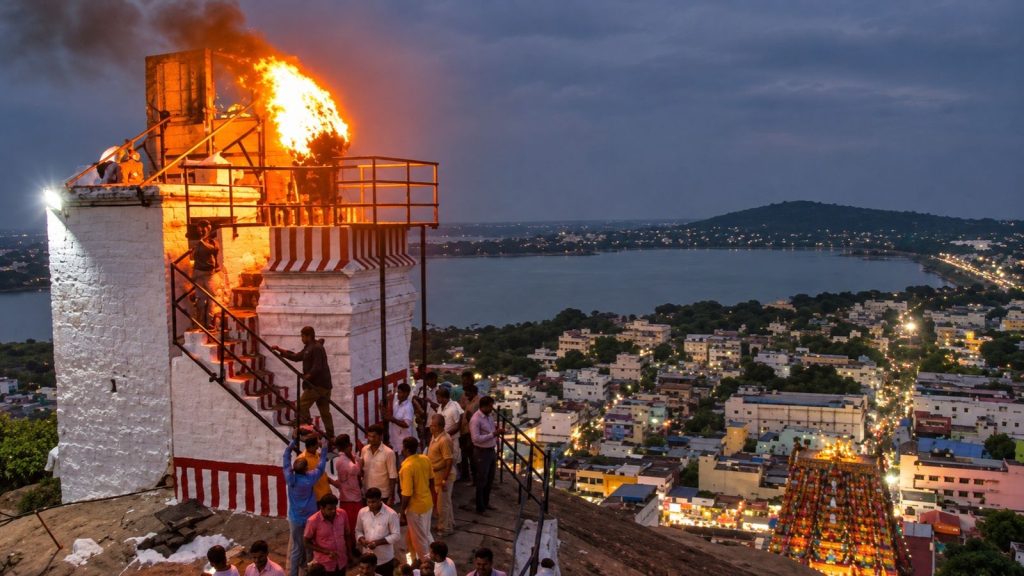
The Supreme Court on Friday, 27 November 2026, heard contempt petitions and applications over the failure to light the ceremonial Karthigai Deepam at the disputed stone pillar on Thirupparankundram hill near Madurai, and said it would pass some interim orders that day, according to The Hindu's live coverage. Petitioners alleged that the Tamil Nadu government had already decided not to comply with the court's 20 November order, that the temple's Board of Trustees was not independent, and that the state stopped the Archaeological Survey of India (ASI) from examining the pillar. The state and the temple deny wrongdoing. At the time of writing, the interim orders had not yet been reported, so this article sets out the dispute and the arguments heard, not an outcome.
The background is a long-running quarrel about where a festival lamp may be lit. Traditionally, the Karthigai Deepam is lit at the Deepa Mandapam, near the Uchipillaiyar temple on the lower slopes of the hill. Hindu groups wanted the ritual extended to the 'Deepathoon', a stone pillar higher up the hill, about 50 metres from the Sikandar Badusha dargah. The dargah side opposes the demand and has claimed ownership of the entire hilltop before the Supreme Court. On 20 November the Supreme Court permitted the lighting of the lamp at the Deepathoon on 24 November, which coincided with Karthigai Deepam, as a "limited one-time arrangement". On 24 November, the lamp was lit only at the traditional place.
The Tamil Nadu government's defence rests on two claims. The first is administrative. Madurai District Collector Nishant Krishna said in a preliminary status report that every arrangement had been made to light the lamp at the Deepathoon, but that the temple's Board of Trustees did not authorise a lamp-lighting team, and that the temple's report reached him only at about 8:30 p.m. on 24 November, long after the lamp was lit at 6 p.m. His counsel, senior advocate Gopal Sankaranarayanan, argued that the Supreme Court had directed the Collector only to make arrangements, not to perform the religious act, and said "hearing must be first held on whether there was prima facie contempt at all". The temple's resolution, as quoted by The Hindu, said the lamp is lit at the Deepa Mandapam "as per the practice followed from time immemorial", on the basis of "historical continuity, Agamic evidence and the opinions of the Sthanikars".
The second claim concerns the pillar itself. A 2026 report compiled by the state's Departments of Survey and Settlement and of Archaeology says the pillar near the dargah is a Great Trigonometrical Survey (GTS) pillar erected by the British, and places the original Deepathoon below the dargah, according to The Hindu. The five-volume report runs to over 1,800 pages and identified more than 800 stations in its first phase, of which 484 were physically documented; Thirupparankundram was a secondary station with a stone pillar and stone mark. The state told the Madurai Bench of the Madras High Court in December 2025 that there was no evidence the pillar was called a deepathoon or that a lamp was ever lit on it as a customary practice. The petitioners reject this; senior advocate Saideepak Iyer told the Supreme Court that the Deepathoon is not a survey pillar.
The petitioners' case is that the state engineered non-compliance. Senior advocate Guru Krishnakumar called the Collector's report "like a confession" and said the Board of Trustees was "chosen as the vehicle and refuge to hide behind". Iyer argued that the trustees were appointed on 13 November, a week before the Supreme Court order, and were "State appointees", and that the 20 November direction gave the trustees no discretion to differ, including on the basis of Articles 25 and 26. Another counsel, P. Valliappan, said ministers had made statements even before 24 November that the lamp would not be lit at the stone pillar. The petitioners also say the four Sthanikars denied giving any opinion in favour of lighting the lamp at the Deepa Mandapam. They have asked the court to shift the sacred flame from the Deepa Mandapam to the Deepathoon, light it from the same flame, and replace the trustees.
Solicitor General Tushar Mehta, appearing for the ASI, called it "a case of aggravated contempt and administrative arrogance". He alleged that an ASI team was stopped at the dargah entrance by the police, asked to leave and descended the hill without examining the stone pillar, and said the role of the police was "condemnable". He suggested a neutral agency, such as a former Supreme Court judge together with a central force, to ensure compliance, and said the court can invoke Article 129 and need not depend on the Contempt of Courts Act. Senior advocate Sidharth Luthra, for the police commissioner, countered that 5,797 personnel were deployed as a security ring and "there was no leaf left unturned". Senior advocate A.M. Singhvi, for the HR&CE Commissioner, said the 20 November order was "nuanced" and that the trustees had "elbow room" to interpret it, while Jaideep Gupta said the Commissioner does not interfere in religious decisions of the Board.
The bench, headed by Justice Aravind Kumar, was sharp with all sides. Justice Kumar said that "however high, no person can defy a Supreme Court order" and that "anybody trying to create constitutional chaos, we will set it right". He also said the court would look at the evidence to see whether the respondents' tears were "real or crocodile tears", and that safeguards on the hill would be strengthened, not diluted, responding to senior advocate Huzefa Ahmadi, who appeared for the dargah and asked the court to protect the dargah's rights and access. The court clarified that it would hear only the contempt issue and not the main dispute over the Deepathoon. Earlier, on 26 November, it had agreed to list a plea seeking a personal affidavit from the Tamil Nadu Chief Secretary on the government's decision-making, including any role of Chief Minister C. Joseph Vijay.
Outside court, the row has acquired a political edge. The Hindu reports that the Madras High Court's Madurai Bench passed a 'John Doe' order on 24 November restraining anyone from violating the Supreme Court's order. The order was directed at "members of the general public", an ex parte injunction against unknown persons, and it reminded the District Collector that under Article 144 all authorities must act in aid of the Supreme Court. Tamil Nadu BJP president Nainar Nagenthran submitted a complaint to Governor Rajendra Vishwanath Arlekar on 26 November, alleging disregard of the court's order and inhumane police treatment of people who sought implementation. According to The Hindu's related headlines, he was arrested at Tirunelveli earlier while heading to the hill, and about 300 BJP leaders and others were arrested at Thirupparankundram. Union Railways Minister Ashwini Vaishnaw accused the TVK government of "stopping the lighting of a traditional deepam", which he said hurts the sentiments of millions.
There are two ways to read the dispute. On one reading, the Supreme Court's interim arrangement was clear, the state had notice and ample time, and the failure to light the lamp at the Deepathoon is the kind of defiance that the court must punish if its orders are to mean anything. On the other, the order created a one-time exception to a practice the temple says dates back over 150 years, the lighting of a religious flame is for the temple's competent authorities and not for a Collector, and the court itself has so far taken only preliminary steps on contempt. The question of whether the pillar is a survey pillar or a lamp pillar, and who owns the hilltop, is not before the court in the contempt hearing at all.
What happens next matters beyond Madurai. If the court finds wilful disobedience, it could order the lamp lit on a substituted date, as petitioners have asked, with a court commissioner and central forces, or it could examine the conduct of officials and trustees. If it declines, the case will return to the main dispute over rights at the hilltop. Either way, the hearing is a test of how far a state government can go in interpreting a Supreme Court direction on a religious question, and of how the court enforces a one-time arrangement that one side says was never carried out. Readers should watch for the interim orders, any direction on the Chief Secretary's affidavit, and the date set for the next hearing.