


The Supreme Court on 23 September 2026 delivered a split verdict on whether petitions challenging the law on appointing the Chief Election Commissioner and other Election Commissioners should go to a Constitution Bench. Justices Dipankar Datta and Satish Chandra Sharma disagreed: Justice Datta rejected the Centre's request to refer the case to a larger bench, and Justice Sharma accepted it. The petitions challenge the Chief Election Commissioner and Other Election Commissioners (Appointment, Conditions of Service and Term of Office) Act, 2023, and in particular Section 7, which provides for a selection committee of the Prime Minister, the Leader of Opposition in the Lok Sabha and a Union Cabinet Minister nominated by the Prime Minister. The papers go to the Chief Justice of India.
The argument for a Constitution Bench is that the question is basic. The petitioners say the committee gives the executive a two-to-one majority and undermines the independence of the Election Commission under Article 14 read with Article 324. They rely on the 2023 Anoop Baranwal judgment, in which the Court set up an interim committee of the Prime Minister, the Leader of Opposition and the Chief Justice of India until Parliament made a law, and then Parliament replaced the Chief Justice with a cabinet minister. According to Juris Hour, Justice Sharma concluded that Sections 6, 7 and 8 should be examined by a Constitution Bench, and the judges asked the Chief Justice to consider a permanent five-judge bench for pure constitutional questions.
The argument against a reference is that the Court has already said enough and further delay costs more. The Centre, represented by the Attorney General and the Solicitor General, argued that the earlier directions were interim and that Parliament was competent to legislate, and that the committee's composition alone does not show bias. Justice Datta declined to send the matter up, and the judges noted that the ordinary course for a split is a reference to a three-judge bench, which could cause more delay. Every further month leaves the law in force while elections go ahead, and the Commission is itself under pressure, with protests in Delhi since 2 October demanding the resignation of Chief Election Commissioner Gyanesh Kumar.
The question matters because the Election Commission runs every national and state election, and public trust in it depends on how its members are chosen. If the Court strikes down or reads down Section 7, the next appointment could be made by a different panel, and if it upholds the law, the executive's role in choosing commissioners will be settled. Either way, the voter-roll revisions in 17 states and the Delhi case will be conducted by a body whose appointment process is still being questioned. The 2023 Baranwal ruling and the 2023 law have pointed in different directions on who should sit on the panel, and a larger bench would have to decide which prevails.
The Court has not ruled on whether the 2023 law is valid. That question waits for a larger bench, once the Chief Justice constitutes one.
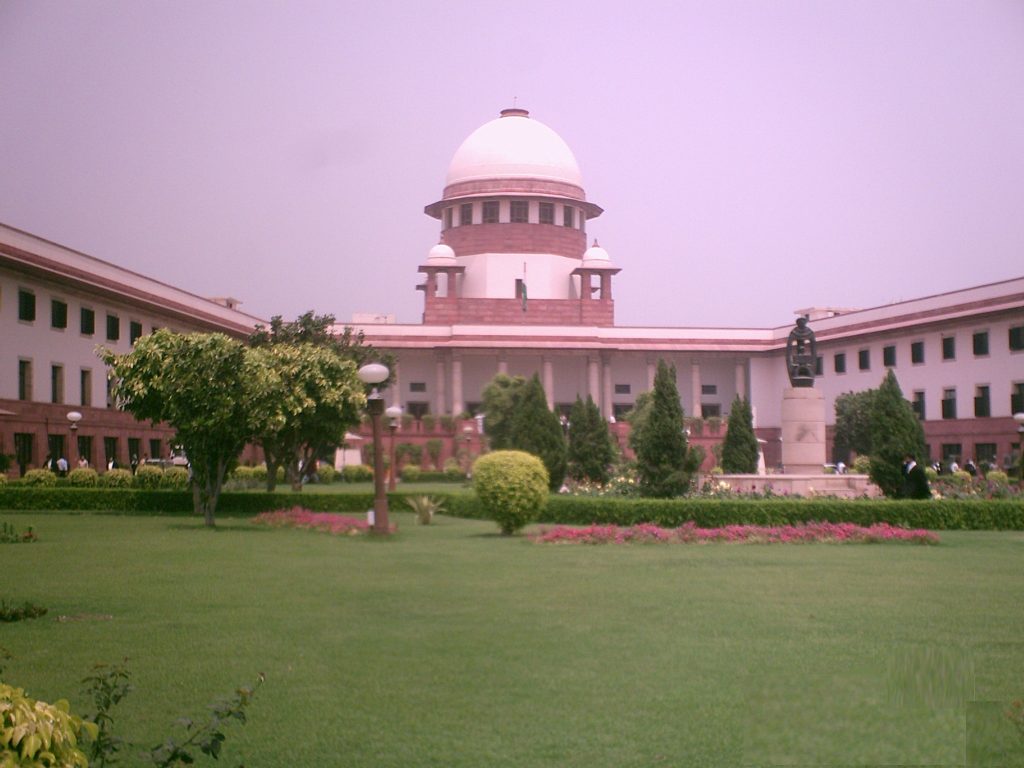
Featured image: The Supreme Court of India in New Delhi (file photo). Photo: Legaleagle86 at English Wikipedia., CC BY-SA 3.0, via Wikimedia Commons.