


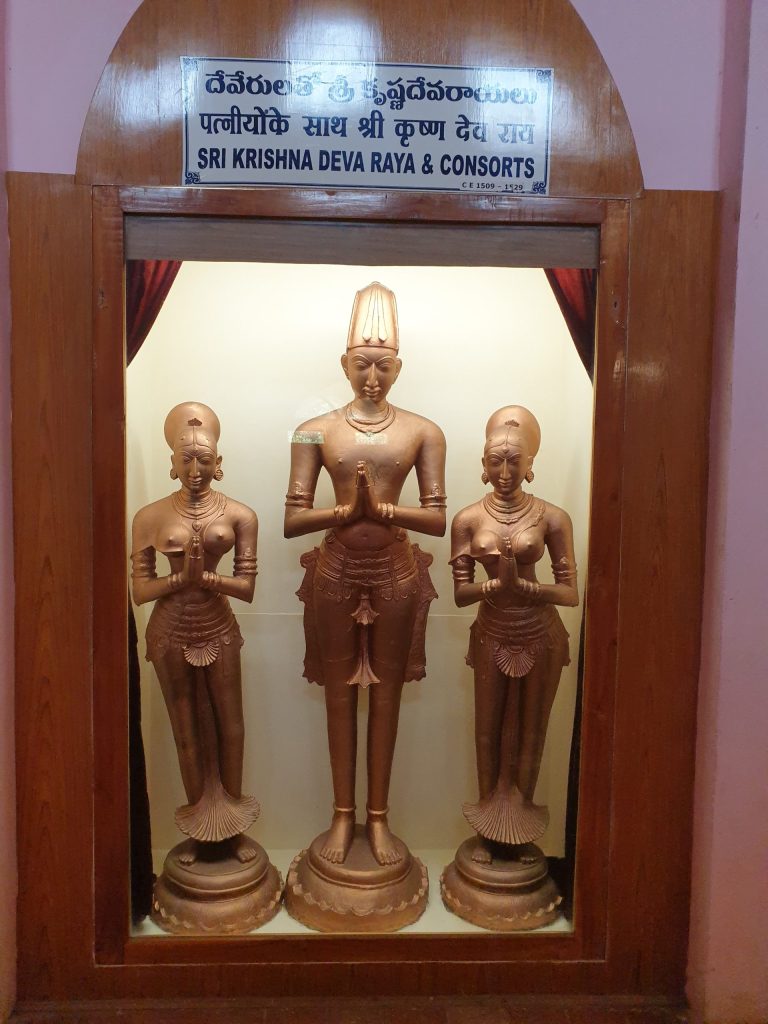

Krishnadevaraya (reigned 1509–1529) was the greatest emperor of Vijayanagara, the kingdom that dominated south India from the fourteenth to the sixteenth century. In twenty years he defeated every rival, carried his arms from the Deccan to Odisha, and made his capital, the city whose ruins stand at Hampi, one of the wonders of the age. He was also a poet and a patron under whom Telugu literature had its golden age.
Quick Facts
| Born | 1471 (traditional date) |
| Died | 1529 |
| Dynasty | Tuluva |
| Title | Emperor of Vijayanagara |
| Reign | 1509–1529 |
| Capital | Vijayanagara (Hampi) |
| Known for | Military victories over the Deccan sultans and the Gajapatis; patronage of literature; the Amuktamalyada |
| Chief minister | Saluva Timmarusu |
| Successor | Achyuta Deva Raya |
Accession
He belonged to the Tuluva family, which had seized the throne a few years earlier, and succeeded his half-brother Vira Narasimha in 1509. Tradition says the dying king ordered the minister Timmarusu to blind Krishnadevaraya so that his own small son might rule, and that the minister deceived him with the eyes of a goat. Timmarusu, whom the emperor called Appaji, “father”, guided him through the first half of the reign.
Conquests
The kingdom he inherited was beset on every side.
- **The Deccan sultans:** in his first year he defeated the forces of Bidar and Bijapur, and took the fortress of Raichur and the fertile land between the Krishna and Tungabhadra rivers. He later restored a captive Bahmani sultan to his throne, taking a title meaning “establisher of the Muslim kingdom”.
- **Rebel chiefs:** he subdued the chief of Ummattur in the south
- **Odisha:** in a series of campaigns from 1513 to about 1518 he took the forts of Udayagiri, Kondavidu and Kondapalli from the Gajapati king Prataparudra and advanced almost to Cuttack. He then made a generous peace and married a Gajapati princess.
- **Raichur, 1520:** the Sultan of Bijapur retook Raichur. Krishnadevaraya marched against him with an enormous army and won the most famous battle of his reign, with the help of Portuguese musketeers.
He never lost a battle.
The Portuguese
The Portuguese had taken Goa in 1510, with his encouragement, from Bijapur. They sold him the Arabian and Persian horses on which his cavalry depended, and he kept them as allies. Two Portuguese visitors, Domingo Paes and Fernão Nunes, left detailed accounts of his capital. Paes thought it as large as Rome and the best-provided city in the world, and described the king himself: of medium height, fair, marked by smallpox, cheerful, a great ruler and a man of much justice, but subject to sudden fits of rage.
Patron and Poet
His court is remembered for the Ashtadiggajas, the “eight elephants” of Telugu poetry, led by Allasani Peddana. The jester-poet Tenali Ramakrishna, hero of countless folk tales, is placed among them. The emperor himself wrote the Amuktamalyada, a long Telugu poem on the Tamil saint Andal, which contains a section of shrewd advice on kingship. He supported Kannada, Sanskrit and Tamil writers as well.
Builder
He added the great gateway and hall of the Virupaksha temple, built the Krishna temple to hold an image brought from Udayagiri, enlarged the Vittala temple, and founded a new suburb with tanks and canals. He made rich gifts to temples across the south, above all Tirupati, where statues of him and his queens still stand.
Last Years
His young son, crowned in his lifetime, died in 1524. The emperor, suspecting poison, had Timmarusu’s family blinded, an act he is said to have regretted. He died in 1529 while preparing another campaign, and was succeeded by his half-brother.
Legacy
Thirty-six years after his death the empire’s army was destroyed at the Battle of Talikota and his city sacked. He is claimed with equal pride by speakers of Kannada, Telugu and Tulu.
Featured image: Statues of Krishnadevaraya with his queens Chinnadevi and Tirumaladevi at the Chandragiri Museum, Andhra Pradesh. Photo by Ravitheja Kumar Reddy C, licensed under CC BY-SA 4.0, via Wikimedia Commons.