



India has told the United Nations that nuclear weapons must not be treated as “routine instruments of statecraft”, in a sharp reply to Pakistan on Friday, 9 October 2026.
Quick Facts
| Forum | First Committee of the UN General Assembly (disarmament and international security) |
| Date | 9 October 2026 |
| India’s speaker | Anmol Sher Singh Bedi, Senior Adviser (Disarmament) |
| Occasion | Right of Reply, after Pakistan raised Jammu and Kashmir |
What India Said
Bedi said Jammu and Kashmir is “an integral and inalienable part of India”.
“We call for India’s illegally occupied territories to be vacated and returned,” he said, adding that India does not seek conflict.
“India has always stood for peace and continues to seek peace with one and with all. However, if there is no accountability for reckless actions, then peace rarely becomes a pause between crises.”
On Nuclear Weapons
“We heard concerns about escalation. These are legitimate concerns. However, these are best judged by conduct over time. Nuclear weapons must not be treated as routine instruments of statecraft,” Bedi said.
He argued that a posture relying on a “nuclear overhang” to limit the consequences of lower-level hostile activity “raises the risk of escalation and not the prospect of restraint”.
India, the statement said, will “not bow” to nuclear blackmail.
India’s Own Position
Bedi said India’s capabilities are defensive, shaped by its own security environment, and not directed against any state.
The Context
The First Committee is the General Assembly body that deals with disarmament. Member states can use a “right of reply” to respond to remarks made about them by another delegation.
Source: The Hindu (10 October 2026).
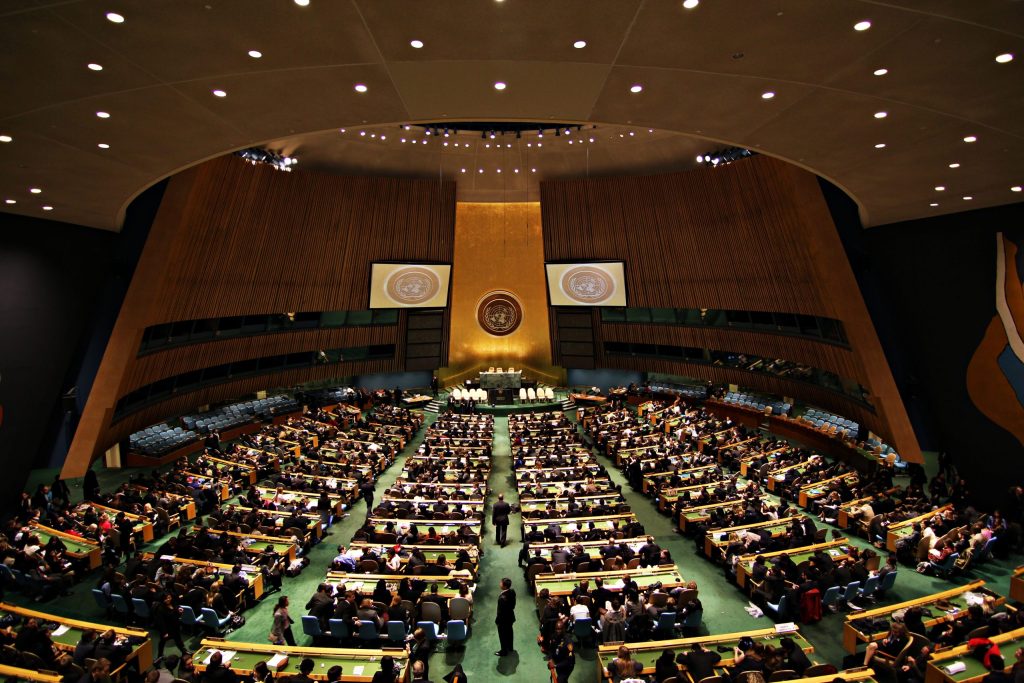
Featured image: The UN General Assembly Hall in New York (file photo). Photo by Basil D Soufi, licensed under CC BY-SA 3.0, via Wikimedia Commons.