


The director general of the Indo-Tibetan Border Police, Shatrujeet Kapur, said on 22 October that Indian forces are in several ongoing face-offs with the Chinese army in Arunachal Pradesh, the first official confirmation of how widely tensions have spread on the northeastern frontier. He said the confrontations began in July in the Upper Subansiri region, in the Taksing sector, and that the ITBP's new Shaurya commandos have been involved. Reports citing Kapur said Chinese troops pitched tents about 6 to 7 kilometres inside what India considers its side of the Line of Actual Control, near the Maja operating base. The disclosure came weeks after Chinese President Xi Jinping visited New Delhi in September for the BRICS summit, his first trip to India in seven years, and six years after the June 2020 clash in the Galwan Valley.
The argument that relations are moving in the right direction rests on the volume of diplomacy. Xi's visit to Delhi included a meeting with Prime Minister Narendra Modi, and the Working Mechanism for Consultation and Coordination on India-China Border Affairs, which has existed since 2012, held its 36th round on 6 August. In September the two armies held their first commander-level meeting in Arunachal Pradesh, according to Al Jazeera. The border runs for about 3,500 kilometres and has never been fully agreed, so incidents are bound to occur, and a 1993 agreement commits both sides to keep the peace along the Line of Actual Control. External Affairs Ministry spokesperson Randhir Jaiswal has said the situation "gets disturbed from time to time" when Chinese forces diverge from patrolling patterns. Supporters of engagement can argue that talks, not a collapse in contact, are what keep face-offs from becoming fights.
The counterargument is that the face-offs show the thaw has not changed conditions on the ground. Kapur warned that China's military capabilities on the frontier have advanced and that traditional methods may no longer be enough to meet them. Bosiram Siram, the Congress leader in Arunachal, claimed that Chinese troops had intruded nearly 50 kilometres into Upper Subansiri, a political claim that the government has not confirmed. In 2020 at least 20 Indian soldiers died at Galwan, and China later acknowledged four deaths among its own troops. Praveen Donthi of the International Crisis Group told Al Jazeera that such stand-offs are likely to recur and some could escalate, while BR Deepak of Jawaharlal Nehru University said that border arrangements remain fragile without clear political guidance in both capitals.
The question matters for India's security and its economy. A land border of this length cannot be defended without large permanent deployments, and each confrontation raises the risk of an accident that neither government wants. Delhi is also trying to balance its relationship with Washington, where trade talks continue, against a more cooperative approach to Beijing, and a serious clash would complicate both. For the people of Arunachal Pradesh, who live close to the frontier, the stakes are immediate, because patrols and supply routes are affected first.
The confirmation of ongoing face-offs shows that diplomacy and tension are running side by side on the India-China border. The thaw that began in September will be judged by whether the face-offs ease or become something more serious.
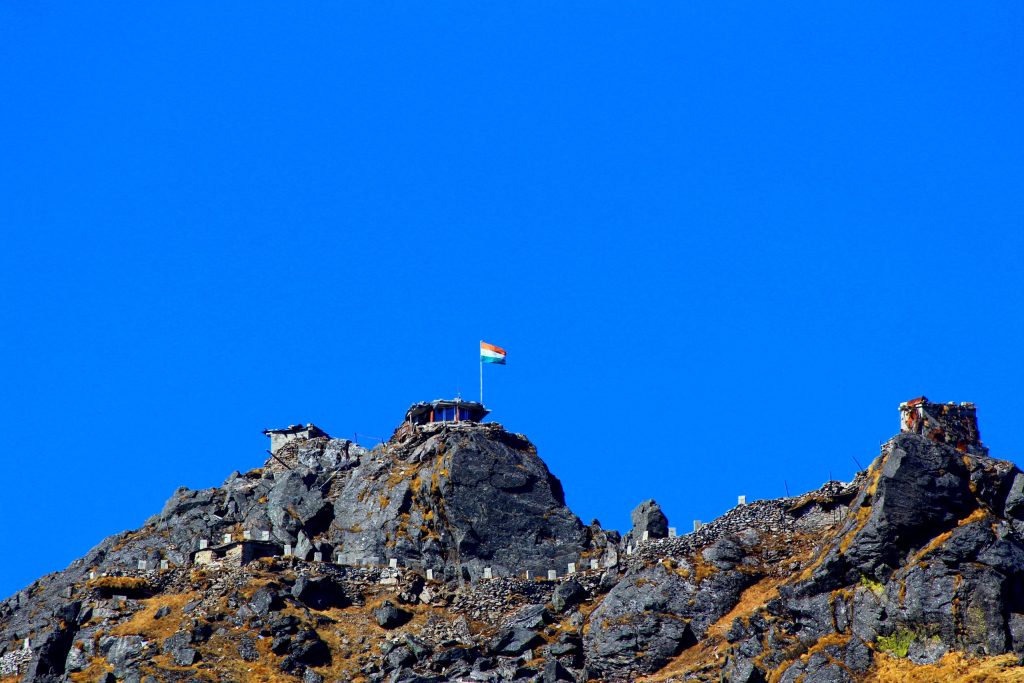
Featured image: The India-China border at Nathu La in Sikkim (file photo; not one of the Arunachal Pradesh face-off sites). Photo: Vinay.vaars, CC BY-SA 3.0, via Wikimedia Commons.