


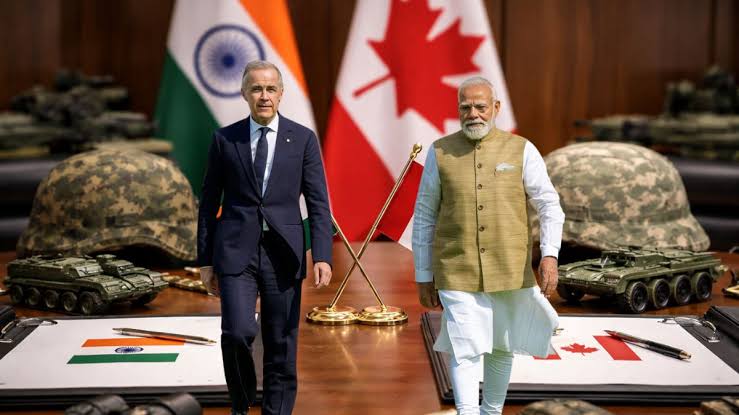
India and Canada could announce a defence agreement during Prime Minister Narendra Modi's official visit to Canada in December, according to India's High Commissioner to Ottawa, Dinesh K. Patnaik. Speaking in the Canadian capital on 18 November 2026 at a gathering organised by the Centre for Strategic Statecraft and the Canadian International Council, Mr. Patnaik also said that the two countries are in the final stages of negotiating a Comprehensive Economic Partnership Agreement. "We are on the cusp of finalising it," he said. The remarks suggest that the visit, scheduled for 11 and 12 December, is being prepared as a major milestone in a relationship that was badly damaged only a little over three years ago.
The turnaround is striking when set against the recent past. Mr. Patnaik took over as India's High Commissioner to Ottawa in September 2025. Before that, both countries had expelled each other's High Commissioners and reduced their diplomatic presence following the murder of Sikh Khalistani activist Hardeep Singh Nijjar in June 2023. The then Canadian Prime Minister Justin Trudeau had accused India of orchestrating the killing, which threw bilateral relations into a tailspin. Subsequent reports by Canadian agencies also listed India, alongside China and Russia, as an interferer in domestic politics. The turnaround, which began with the mutual reinstatement of High Commissioners, is now set to reach a milestone with Mr. Modi's trip.
In his speech, Mr. Patnaik said the two nations are no longer talking about a reset of their derailed relations, but about an overarching boost in ties that spans defence, space, nuclear energy, deep technology, trade and the mobility of people. That list is wider than the one that dominated earlier phases of the relationship, which relied heavily on trade in pulses and education links, and it suggests that Delhi and Ottawa are now thinking about strategic cooperation rather than purely commercial exchanges. He added that the two nations had moved from a complete lack of trust, a little over a year ago, to an "unprecedented degree of mutual trust".
The envoy was candid about what went wrong. "The reason was the lack of trust. India believed that Canada was actively promoting separatism in India, and Canada believed India was organising violence in Canada," he said. According to him, a series of meetings between senior ministers, the National Security Advisers of both countries and agencies at all levels helped the two sides to rebuild trust. "Today, we have reached the highest levels of trust, where the most sensitive areas of cooperation, such as deep tech, defence, and space, are subjects of mutual cooperation," he said. He added that cooperation between Canadian and Indian agencies remains at a high level.
Mr. Patnaik also offered an analysis of why the quarrel had been so damaging. "The fact is that in the core strategic concerns of Canada and India, there is no conflict," he said. "Still, all it took for the entire bilateral relationship to be derailed was the fringe diaspora issue," a reference to the Nijjar murder and the dispute that followed. His argument was that the two countries cannot afford to let fringe issues derail their extensive mutual interests. It is a diplomat's formulation, and it will not satisfy those in either country who believe that the allegations around the murder deserve fuller answers, but it indicates how the Indian government intends to frame the relationship going forward.
The trade track has its own history of recent steps. In March 2026, Canadian Prime Minister Mark Carney visited India, the first bilateral visit by a Canadian prime minister since 2018, and the two leaders launched negotiations on a Comprehensive Economic Partnership Agreement with agreed terms of reference. They set a target of 50 billion US dollars in bilateral trade by 2030. Later, at the G7 summit in Evian, France, the two countries agreed to conclude negotiations for a free trade agreement by the end of the year, a deadline that explains the High Commissioner's language about being on the cusp of finalising it. A signing or an announcement during the December visit would fit that schedule.
The defence element is new and potentially significant. Canada and India have not historically had deep defence ties, and the diplomatic freeze made any cooperation impossible for a time. A formal defence agreement could cover areas such as dialogue between the armed forces, training, defence industry collaboration and information sharing, though the High Commissioner did not describe its contents, and the report on his remarks does not say what form it would take. It is therefore too early to say whether it would be a broad framework, a narrower memorandum or a package of separate arrangements.
The inclusion of space and nuclear energy points to areas where the two countries have complementary strengths. Canada has long-standing expertise in civil nuclear technology and uranium, and India is expanding its nuclear power programme and its space ambitions. Deep technology, which can include areas such as artificial intelligence, quantum computing and advanced materials, is another field where both governments have said that they want closer ties. The mention of the "mobility of people" is also important, since students, skilled workers and families have been among the groups most affected by the downturn in relations, with visa and consular services being reduced at the height of the dispute.
There are, however, risks that officials will have to manage. The Nijjar case has not disappeared, and public opinion in Canada, especially in the Sikh community, remains sensitive about it. Any announcement of a defence pact will be read in that light, and it will draw questions from opposition politicians and community groups about whether the security concerns have been fully addressed. In India, the government has consistently denied involvement in violence abroad while insisting that Canada must act against extremist groups that it says operate from its territory. Mr. Patnaik's remarks suggest that both sides believe they have found a workable balance, but it will be tested by events.
The timing is also notable in the context of India's wider diplomacy. New Delhi has been working to broaden its partnerships with Western countries, and the repair of ties with Canada fits that effort. For Ottawa, deeper links with India offer diversification at a time when Canada is looking to expand its trade beyond its largest neighbour. These shared incentives help to explain why both capitals have moved quickly in the last year, from restoring High Commissioners to launching trade negotiations and now discussing defence.
What to watch in the next three weeks is straightforward. Officials will need to complete the text of the trade agreement if it is to be ready for announcement, and they will need to decide whether the defence agreement is to be signed during the visit or merely announced as an intention. The programme for the two days in Canada, which has been described only in outline, will show how much weight the two sides place on each element. If the plans come together, the 11-12 December visit would complete a rapid journey from mutual expulsions to a partnership that spans trade, security and technology. If they do not, the High Commissioner's confident language will have set expectations that the two governments must then work to meet.