


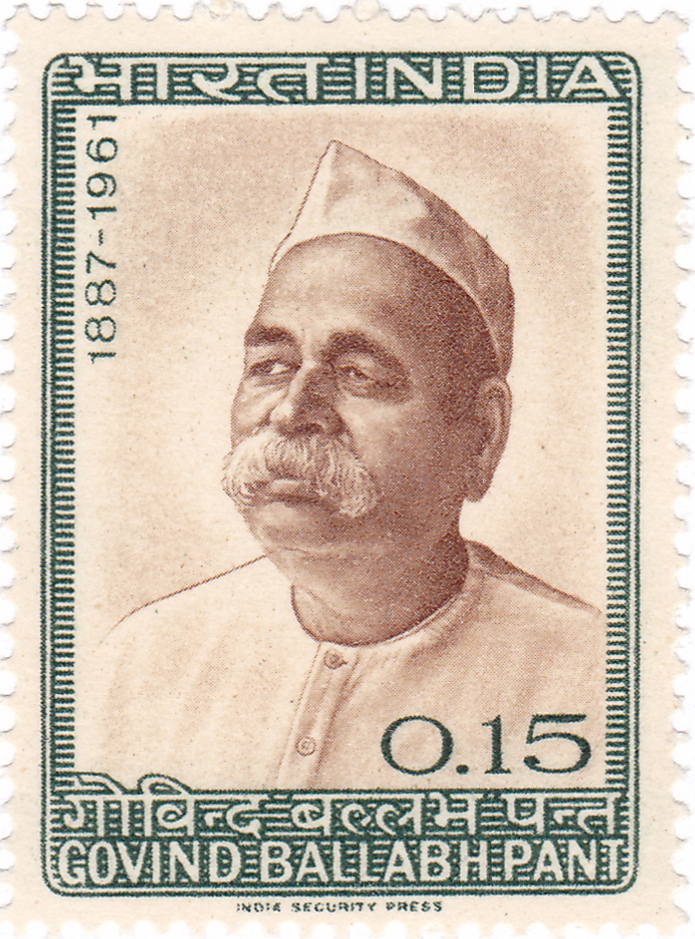

Govind Ballabh Pant (10 September 1887 – 7 March 1961) was an Indian freedom fighter and statesman, the first Chief Minister of Uttar Pradesh and Union Home Minister from 1955 until his death. In Lucknow he abolished the zamindari system of landlordism in India’s largest state. In Delhi he carried through the reorganisation of the states on the basis of language. He was awarded the Bharat Ratna in 1957.
Quick Facts
| Full name | Govind Ballabh Pant |
| Born | 10 September 1887, Khoont, Almora district (now Uttarakhand) |
| Died | 7 March 1961, New Delhi (aged 73) |
| Education | Muir Central College and University of Allahabad (B.A., LL.B.) |
| Party | Indian National Congress |
| Offices | Premier of the United Provinces (1937–1939; 1946–1950); Chief Minister of Uttar Pradesh (1950–1954); Union Home Minister (1955–1961) |
| Awards | Bharat Ratna (1957) |
| Children | Krishna Chandra Pant and two daughters |
Early Life
He was born in a village near Almora in the Kumaon hills, into a Brahmin family of Maharashtrian origin that had settled there centuries earlier. He was brought up by his maternal grandfather, a government official. At Allahabad he took a law degree in 1909, standing first and winning a gold medal.
Lawyer and Reformer
He set up practice at Kashipur in the foothills. In 1914 he helped a village council to win a case against the system of coolie begar, under which hill villagers were compelled to carry the baggage of travelling officials without pay. He founded an association to work for the uplift of the hills, and the practice was ended after an agitation in 1921.
He entered the provincial legislature in 1923 as a member of the Swaraj Party and soon became its leader there. He was a member of the defence team in the Kakori conspiracy case, in which Ram Prasad Bismil and others were tried.
The Freedom Movement
In November 1928, at a demonstration in Lucknow against the Simon Commission, he was beaten by mounted police. The injuries to his back never healed, and left him bent and with a permanent tremor.
He was jailed in 1930 and 1932, in 1940, and from 1942 to 1945 in Ahmednagar Fort with the rest of the Congress Working Committee. He was known in the party as a patient negotiator and a master of parliamentary procedure.
Uttar Pradesh
He headed the first Congress government of the United Provinces from 1937 to 1939 and returned as Premier in 1946. When the Constitution came into force in 1950 he became the first Chief Minister of Uttar Pradesh.
- **Zamindari abolition:** legislation passed in 1951 ended the rights of the landlords who stood between the state and the cultivator, and made several million tenants owners of their land
- **Order:** he steered the province through the violence and the refugee crisis of 1947
- **Language:** Hindi in the Devanagari script was made the language of administration
Home Minister
After the death of Vallabhbhai Patel and the brief tenure of a successor, Jawaharlal Nehru brought him to Delhi in January 1955 as Home Minister.
- **States reorganisation:** he piloted the Act of 1956 that redrew the map of India into fourteen states and six territories, largely on linguistic lines, and dealt with the agitations that followed in Bombay and Punjab
- **Official language:** he chaired the parliamentary committee on the replacement of English by Hindi, and worked out the assurance that English would continue as long as the non-Hindi states wished
- **Kerala:** he was Home Minister when the Centre dismissed the communist government of E. M. S. Namboodiripad in 1959
He was Nehru’s most trusted colleague in these years and in effect the deputy leader of the government.
Death
He suffered a stroke in February 1961 and died on 7 March. His son, K. C. Pant, was later a Union minister for many years.
Legacy
An agricultural university at Pantnagar in the Terai, the first of its kind in India, a hospital in Delhi and an engineering institute at Pauri bear his name. In the hills of Uttarakhand he is remembered as the region’s first national leader.
Featured image: Govind Ballabh Pant, from a 1965 postage stamp of India. Photo by India Post, Government of India, licensed under Government Open Data License – India, via Wikimedia Commons.