



The Constitution (131st Amendment) Bill, 2026, failed in the Lok Sabha on 17 April 2026, according to Wikipedia and Drishti IAS. The bill received 298 votes in favour and 230 against, and it needed 352 votes, which is two-thirds of the 528 members present and voting. The Law Minister, Arjun Ram Meghwal, introduced it on 16 April during a three-day special session that ran from 16 to 18 April.
A constitutional amendment under Article 368 needs a majority of the total membership of the house and two-thirds of the members present and voting. In this case 298 votes were 54 short of the 352 required, which is IndiaX24’s subtraction. Another summary of the vote on Wikipedia’s page on the 2027 Census says the bill fell short by 56 votes, so the exact margin is described differently by sources. A Wire report cited in search results called it the first time in 12 years that the Modi government had failed to get a constitutional amendment passed.
The bill had a double purpose. It sought to operationalise the 33% reservation for women in the Lok Sabha and state assemblies that the 106th Constitutional Amendment of 2023 provided, by carrying out delimitation on the basis of the 2011 Census and not waiting for the next Census. It also proposed to raise the maximum size of the Lok Sabha to 850 seats, of which up to 815 would be from states and up to 35 from union territories, according to Wikipedia.
The government’s stated reason was speed. Drishti IAS says the bill aimed to bring forward the implementation of women’s reservation from around 2034 to 2029, and Wikipedia quotes the argument that waiting for the next Census would delay the effective participation of women in the democratic polity. The bill also aimed to end the freeze on seat allocation that has been in place since the 42nd Amendment of 1976 and to restore the principle of one person, one vote, one value.
The objections centred on delimitation. According to Drishti IAS, southern states opposed population-based delimitation, arguing that it would penalise states that have controlled their population effectively, and they demanded that women’s reservation be completely separated from the delimitation exercise. A research paper cited in search results summarised the debate as support for women’s reservation in principle but opposition to its link with delimitation. The sources reviewed do not give the voting pattern of individual parties.
After the defeat, the government withdrew two companion bills that depended on it, the Delimitation Bill, 2026 and the Union Territories Laws (Amendment) Bill, 2026. The amendment itself fell, so the arrangements of the 106th Amendment stay as they were, under which women’s reservation takes effect after a delimitation that follows the Census.
The result has consequences for the timing of both reforms. The 2027 Census, which IndiaX24 covers in separate articles, will include the first caste enumeration since 1931, with its main enumeration in February 2027, and the Census is expected to provide the basis for any future delimitation. A separate IndiaX24 explainer sets out what the defeat means for the seat arrangements.
The vote also shows the arithmetic of the Lok Sabha. With 298 members in favour, the government side was far from the 352 needed, and opposition parties together had enough to block the amendment, which makes cooperation across parties necessary for any constitutional change in this house.
The defeat is a reminder that constitutional changes in India need broad agreement, and that the questions of how many seats each state gets and when women’s reservation begins remain open.
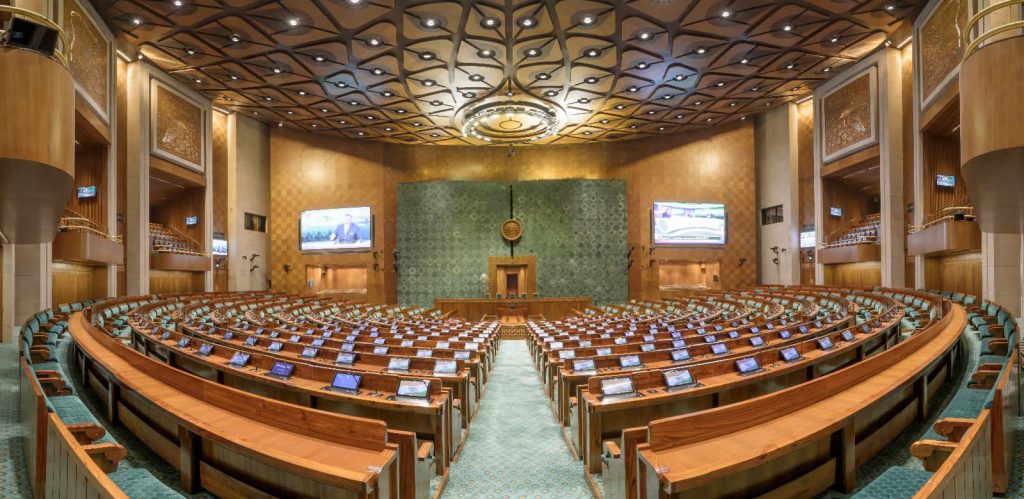
Featured image: The Lok Sabha chamber in the new Parliament building, New Delhi (file photo). Photo by Ministry of Parliamentary Affairs, licensed under Government Open Data License – India, via Wikimedia Commons.