


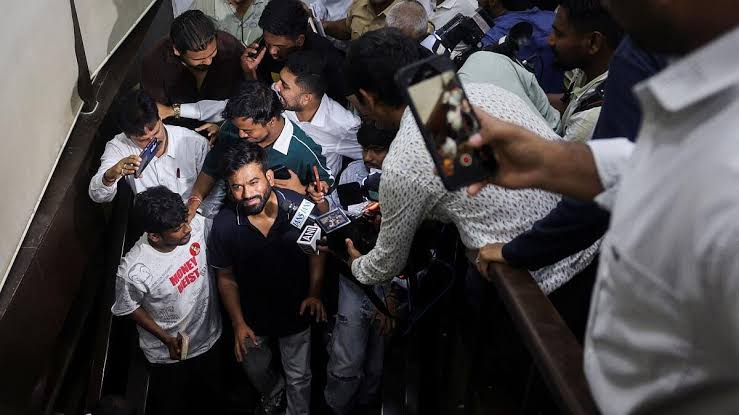
Delhi Police detained Abhijeet Dipke, the 31-year-old founder of the Cockroach Janta Party, on Friday 16 October as he left a house in central Delhi on his way to a rally at Connaught Place, and released him the next day on the order of a special executive magistrate. Student leader Neha Bora, president of the All India Students' Association, was held the same day and also released on Saturday. Two other leaders of the movement, Ashutosh Ranka and Saurav Das, were arrested on 14 October after entering Jantar Mantar, a protest site that police had declared off limits, and were still in custody when Dipke walked out of the police station. They were released later after about a week in judicial custody, and Delhi Police's Crime Branch has summoned both for questioning on 14 November, according to The Week. The movement, founded in May amid anger over leaked exam papers and poor job prospects, has held near-daily protests this month.
The argument that the police action was justified is based on public order and on the law. Authorities had banned demonstrations at Jantar Mantar, and the two leaders arrested on 14 October were accused of entering the site in violation of that ban. A senior police officer, Sachin Sharma, told Reuters that Dipke and Bora were held in preventive detention, a measure used to stop a gathering that officers fear could disturb the peace. Thousands of extra officers were deployed in the capital, Central Park was closed for what officials called "administrative reasons," and metal barricades were placed at major intersections, which kept the rally small: nearly 500 protesters reached Connaught Place in groups. Defence Minister Rajnath Singh said the protests were an attempt by the Congress party to "seize power" and described the young protesters as "pawns in the politics of anarchy." Supporters of the government say that a movement calling for the removal of a constitutional officer must stay within the law, and that police have a duty to prevent crowds from forming at sites that have been closed. They also point out that Dipke was released promptly once the rally was over, which they say shows that preventive detention was used for a short period and not as punishment.
The counterargument is that the detentions show a government uneasy with peaceful dissent. No criminal charges were reported against Dipke or Bora, and the magistrate ordered Dipke's release within a day, which suggests that the preventive detention had a thin legal basis. Dipke has said he and his supporters are "not afraid" and are ready to go to jail. The grievances behind the movement are not imaginary: the education minister resigned in July after weeks of protests over leaked exam papers, and the Election Commission's revision of the voter rolls has removed more than 130 million names. Rights groups say the government has eroded democratic freedoms through pressure on journalists, civil society and opponents, which the government rejects. Banning protests at the traditional site and closing a public park, critics argue, sends young people the message that their only lawful outlet has been taken away. Dipke posted on X that he was now "just waiting for my brothers to be free," a reference to Ranka and Das, and Bora said she was urging the impeachment of the chief election commissioner and a halt to the revision.
The confrontation matters because the protesters are young, urban and organised through social media, a group that many parties have struggled to reach. Some analysts quoted by Al Jazeera say Prime Minister Narendra Modi faces the toughest challenge of his time in office. How the authorities treat the movement will affect confidence in the right to protest, a freedom the Constitution protects within reasonable limits. A heavy hand risks swelling the crowds, while a refusal to engage with the complaints about exam leaks and the voter rolls risks leaving them unanswered.
Dipke's release ended one episode, but the movement's demands, including the resignation of the chief election commissioner, are unchanged. The next few weeks will show whether the government chooses dialogue or further restrictions.