


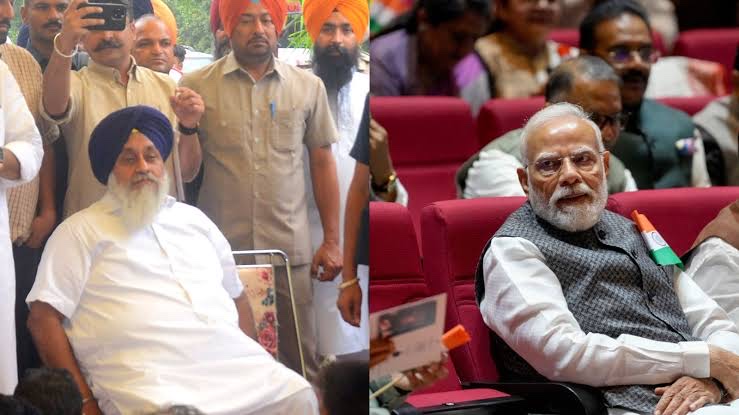
Union Home Minister Amit Shah on Tuesday, 24 November 2026, announced that the Shiromani Akali Dal (SAD) is returning to the National Democratic Alliance (NDA), and that the Bharatiya Janata Party and the Akalis will contest the next Punjab Assembly elections together. "The next Punjab Assembly elections, BJP and SAD will contest in alliance," Mr. Shah said, according to The Hindu. "On this occasion of Guru Purab today, NDA's oldest member has returned to the alliance," he added. The announcement ended months of speculation and closed one of the most closely watched political questions in the border State ahead of an election due in early 2027.
The reunion has a long history behind it. The SAD snapped its 24-year-old alliance with the BJP in September 2020 over the three farm laws, which have since been scrapped. At the time of the split, Lok Sabha MP Harsimrat Kaur Badal was part of the Narendra Modi government as a Minister with Cabinet rank. Her exit from the ministry, and the party's exit from the alliance, marked a break between two partners that had fought elections together for decades and that had been a fixture of Punjab's political landscape. Mr. Shah's description of the SAD as the NDA's "oldest member" recognises that history.
Negotiations on seat-sharing for the 2027 Assembly polls had been under way, and the announcement was widely anticipated. The signals had been building for weeks. Last month in Delhi, Mr. Shah predicted an NDA government in Punjab in 2027. When he visited Chandigarh on 1 November, he repeated that an NDA government would be formed in the border State. The statement reignited buzz about a possible SAD-BJP alliance. On 2 November, when SAD president Badal was asked about the possibility of a re-alliance, he gave a guarded response, saying: "You will come to know in a few days as to what will happen". He also reiterated that, except for the Congress and the Aam Aadmi Party (AAP), he is open to an alliance with other parties that accept his party's philosophy. The Hindu's report on the announcement did not give the seat-sharing formula, and a joint press conference by the two parties was scheduled for later in the day.
The numbers from the past show why seat-sharing will matter. Punjab has 117 Assembly seats, and the five-year term of the current House ends on 16 March 2027. In the 2022 Assembly polls, which the two parties fought separately, the BJP won two seats and the SAD won three. The AAP registered a landslide victory that year, winning 92 seats. Before the alliance ended, the formula was lopsided in the Akalis' favour in the Assembly: under the previous pact, the BJP contested 23 seats and the SAD 94. In parliamentary elections the arrangement was reversed in proportion, with the SAD fighting 10 seats and the BJP the remaining three of Punjab's 13 Lok Sabha seats. Whether the two parties return to that template, or work out a new arrangement reflecting the BJP's expanded ambitions in the State, is the main open question.
The ruling AAP, meanwhile, has already moved. On 31 October, it released a list of 40 candidates for the Assembly election, all of them sitting legislators, and was the first party to announce names. Chief Minister Bhagwant Mann will re-contest from Dhuri in Sangrur district. Among other prominent candidates are Assembly Speaker Kultar Singh Sandhwan from Kotkapura, Minister Sanjeev Arora from Ludhiana West (he is currently in jail in an alleged money laundering case), Kuldeep Singh Dhaliwal from Ajnala, Inderbir Singh Nijjar from Amritsar South, Kulwant Singh from SAS Nagar and Bram Shanker Sharma Jimpa from Hoshiarpur. Mr. Mann said the names were chosen on the basis of surveys and that "new faces will also get a chance", adding that the party's principle is to release the list of candidates three or four months before elections so they have time to go to the people.
The BJP has also been preparing. On 15 November, Punjab BJP president Kewal Singh Dhillon constituted a State manifesto committee headed by senior leader Avinash Rai Khanna, with members including Manpreet Singh Badal, Ashwani Sharma, Manoranjan Kalia, Som Parkash, Rana Gurmeet Singh Sodhi, Ashwani Sekhri, Satnam Singh Sandhu, Raghav Chadha, Rajinder Gupta, Harbhajan Singh, Parampal Kaur and H.S. Phoolka. It also created a "chargesheet" committee, chaired by former Punjab chief Sunil Jakhar, which includes Iqbal Singh Lalpura, Vijay Sampla, Shwet Malik, Maharani Preneet Kaur, Ravneet Singh Bittu, Dinesh Babbu, Sushil Rinku, Geja Ram, Vikramjit Singh Sahney, Ashok Mittal, Sandeep Pathak, S.S. Channi and Jagmeet Singh Brar. The party said senior leaders had been included in both committees so that experience and representation from various fields would shape the manifesto, while the second panel would carry a distinct responsibility, that of building a case against the government.
The BJP's campaign line against AAP is already visible. On 6 November, Haryana Chief Minister Nayab Singh Saini alleged that the AAP government in Punjab had spent elsewhere the ₹1,600 crore announced by Prime Minister Modi for the flood-hit State last year, noting that Himachal Pradesh was given ₹1,500 crore. He also claimed that AAP had failed to fulfil its pre-2022 promise of ₹1,000 a month for every woman in Punjab, asking who would pay the promised arrears of ₹50,000. Those are allegations made by Mr. Saini and were reported as such; they are the kind of argument both allies are likely to use together once the alliance is formalised.
Punjab's other political issues will also shape the contest. On Monday, Punjab Congress chief Pargat Singh wrote to Prime Minister Modi urging him to reopen the Kartarpur Corridor and resume trade through the Attari-Wagah border. The corridor, which links Gurdwara Darbar Sahib in Pakistan, where Guru Nanak Dev spent the last years of his life, with the Dera Baba Nanak shrine in Gurdaspur district, has been shut since 7 May last year, when the Indian armed forces carried out pre-dawn missile strikes on nine terror targets in Pakistan and Pakistan-Occupied Kashmir. Mr. Singh said the closure had caused deep disappointment among devotees and had affected livelihoods in border districts, and he asked the Centre to examine reopening the Attari-Wagah Integrated Check Post subject to security safeguards. With the BJP-led Centre and the SAD now on the same side, the Congress is likely to press the question of whether the alliance can deliver on such demands.
What does the alliance mean for the contest? The 2022 results show the limits of what either party can claim: with two and three seats respectively, neither party was close to a majority, and the AAP's 92 seats came on the back of a wave. The new alliance will have to show that it can add up to more than the sum of its parts, and that the issues behind the 2020 break, which centred on the farm laws, no longer divide the two sides' voters.
The symbolism of the day is unmistakable. Guru Purab is among the most important days in the Sikh calendar, and by choosing it for the announcement, Mr. Shah tied the political reunion to a moment of religious significance in Punjab. How the SAD explains its return to its own base, which left the alliance over the farm laws, will be a test of its leadership. Mr. Badal's earlier remark that he was open to any party except the Congress and the AAP gave him room, and the Akali Dal's argument is likely to be that the laws are gone and that Punjab's interests are better served by being close to the Centre.
The next few days will bring clarity on the seat-sharing details, the allocation of constituencies and the answers to questions about how the two parties will share campaign responsibilities. For now, the headline is simple: Punjab's oldest NDA alliance has been restored, and the 2027 election has become a contest between a ruling AAP that has already named 40 candidates and an NDA that has reassembled.